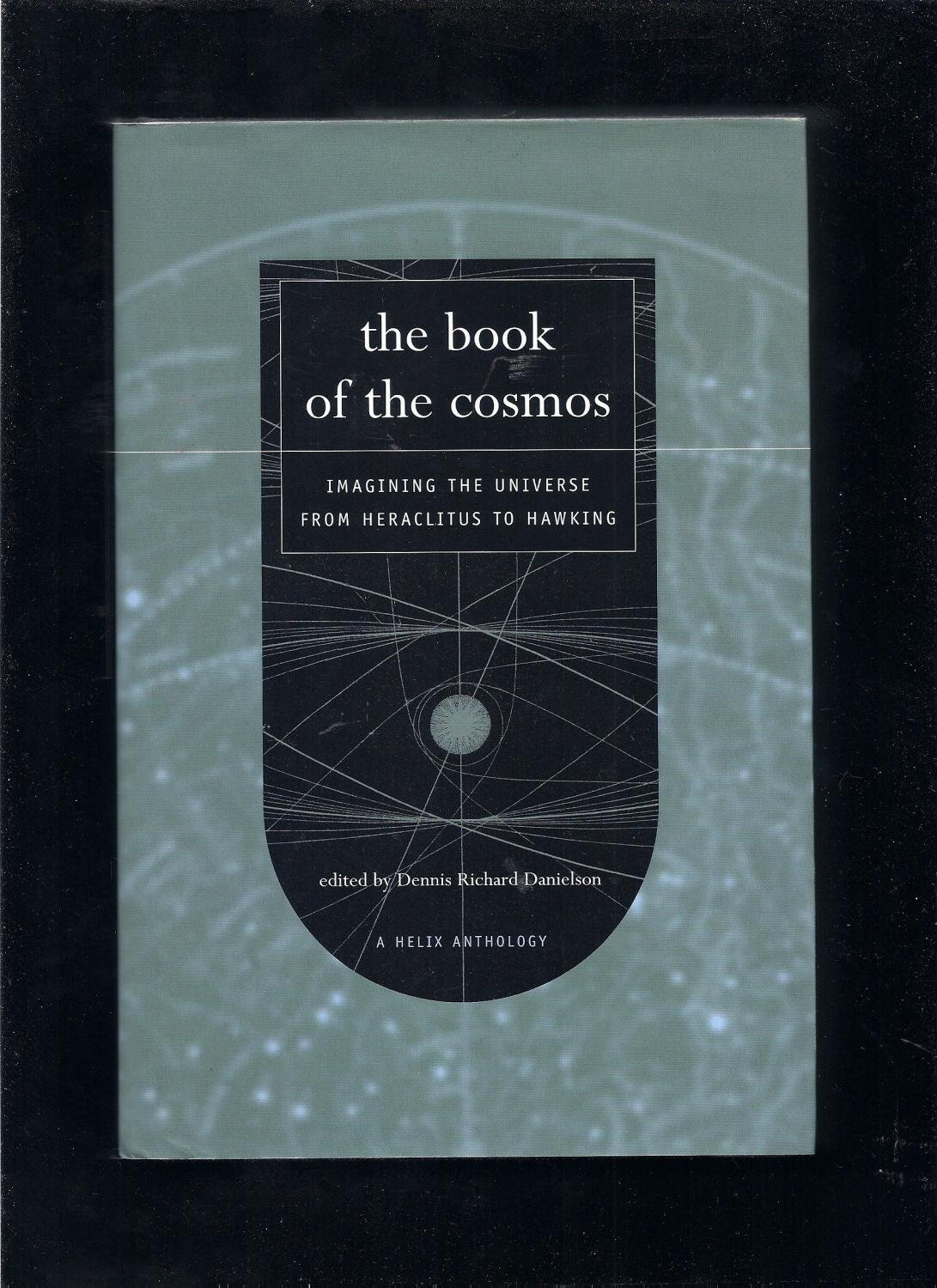
The Book of the Cosmos: Imagining the Universe from Heraclitus to Hawking, A Helix Anthology
$26.40
by Dennis Danielson



In this monumental book, Professor Dennis Danielson has assembled a remarkable anthology that surveys the richness and excitement of the human quest to understand the universe-its origin, its structure, and its significance. From the ancient world to the latest theories of cosmic physics, The Book of the Cosmos presents the art as well as the science of human attempts to describe the universe, not only in colorful scientific prose but also in engaging excerpts from poetry and philosophy, diaries and dialogues, essays and epistles, from writers as diverse as Aristotle, Copernicus, Cicero, Albert Einstein, and Edgar Allan Poe.Here, as never before in a single volume, we taste firsthand the exhilaration, flair, and occasional bewilderment of a hundred authors from across written history who shaped, and continue to shape, our view of the cosmos. So many books published these days seem to deliberately ignore the forest for the trees, or the leaves, or the chloroplasts, or the chemistry of biopigments. Readers interested in big questions usually have to make do with the obligatory summing-up at the end, in which the author tries to justify his or her narrow interest through heroic feats of recontextualization. The Book of the Cosmos: Imagining the Universe from Heraclitus to Hawking , on the other hand, is 600 pages of well-expressed deep thought on the biggest picture of them all. In roughly chronological order, editor Dennis Danielson presents 85 sets of excerpts from big thinkers from biblical times to the present, introducing each to the modern reader with insightful running commentary that is consistently helpful without being obtrusive. The ancient Greeks hit the ground running, leaving us a rich conceptual legacy, which we are still exploring and exploiting even as our own work becomes more and more machine-mediated. Danielson gives us a wide base of ancient thought to give a sense of our heritage. He includes both obvious choices, such as Plato, and lesser-known writers, such as Parmenides. The often neglected Middle Ages brought us Ptolemy, Moses Maimonides, and others who set the stage for the Renaissance and the Enlightenment, and the writings from these times betray an unexpected continuity of thought between the ancient and modern eras. Of course, the late-20th-century selections of such writers as Freeman Dyson and Steven Weinberg, which close the book, shouldn't imply an end to cosmological thinking. If anything, the last chapters of The Book of the Cosmos provoke a hunger for more. --Rob Lightner "Dennis Danielson's Book of the Cosmos: Imagining the Universe from Heraclitus to Hawking is a remarkably rich and varied collection of cosmological writings. Not only has Danielson chosen these selections with care and originality, he has further enhanced their interest and accessibility by insightful commentary. It seems safe to predict that this treasury will bring delight and even amazement to many readers." -- Michael J. Crowe , Professor of the History and Philosophy of Science, University of Notre Dame and author of The Extraterrestrial Life Debate 1750-1900 , Theories of the World from Antiquity of the Copernican Revolution , and Modern Theories of the Universe from Herschel to Hubble "The romance of cosmic discovery has never been so thoroughly documented as in The Book of the Cosmos . Dennis Richard Danielson, the volume's editor, has hand-picked the most insightful thoughts ever penned on the Universe. From scientists to philosophers to poets, the contrast of views is stimulating, but the similarity of views is striking - we are all kindred souls in the timeless human quest to make sense of the universe in which we live." -- Neil deGrasse Tyson, Astrophysicist, Director of Hayden Planetarium, New York City & Visiting Research Scientist, Princeton University Dennis Danielson is Professor of English at the University of British Columbia in Vancouver, where he teaches honors and graduate courses in the literature of cosmology. He has lectured on topics such as Copernicanism, concepts of space, and the Anthropic Cosmological Principle to non-scientific audiences in the U.S., Canada, England, Germany, and South Africa.