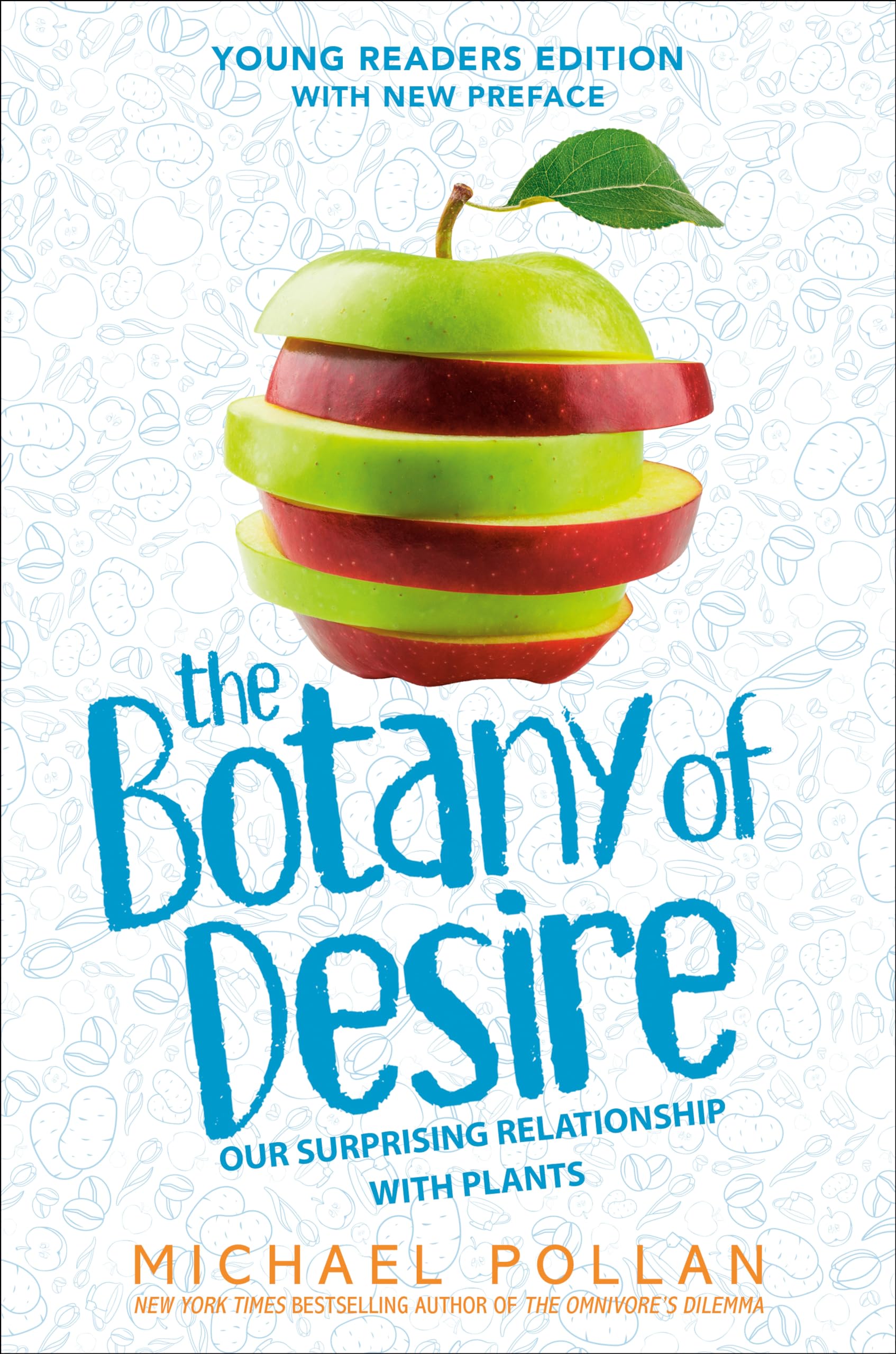
The Botany of Desire Young Readers Edition: Our Surprising Relationship with Plants
$10.13
by Michael Pollan



By the bestselling author of The Omnivore's Dilemma, this is Michael Pollan's ingenious companion book about the surprising and close relationship between people and plants. In this entertaining young readers edition of the environmental studies classic, Michael Pollan demonstrates how people and domesticated plants have formed a reciprocal relationship. He links four fundamental human desires—sweetness, beauty, energy, and control—with the plants that satisfy them: the apple, the tulip, coffee, and the potato. In telling the stories of four familiar species, Pollan illustrates how the plants have evolved to satisfy humankind’s most basic yearnings. And just as we’ve benefited from these plants, we have also helped them to thrive. The Botany of Desire is perfect for STEM-focused young readers who want to learn more about: human history, biology, and environmentalism - climate change and its impact on our relationship with plants - gardening and the human-plant relationship "Pollan’s friendly, conversational tone and first-person recollections bring levity and enthusiasm; his sharp wit and self-awareness give much-needed life to what would otherwise have been more esoteric and dryly scientific sections. Pollan’s passion for his subject is evident and infectious as he encourages readers to psychologically reconnect with nature . . . those who are drawn to it will find a wealth of information and food for thought. A fascinating and accessible adaptation for science-minded or history-obsessed youngsters." — Kirkus For more than thirty years, Michael Pollan has been writing about the places where the human and natural worlds intersect. In addition to magazine and newspaper writing, including regular contributions to the New York Times Magazine , he is the author of nine books, seven of which have been New York Times bestsellers. He has received numerous awards, including two James Beard Awards, the John Burroughs Prize, the U.S. Humane Society’s Genesis Award, and the Lennon Ono Grant for Peace. In 2009 he was named one of the top 10 “New Thought Leaders” by Newsweek , and in 2010 he was chosen by Time as one of the 100 most influential people in the world. Michael Pollan grew up on Long Island, New York, was educated at Bennington College, Oxford University, and Columbia University, and teaches journalism and nonfiction writing at UC Berkeley and Harvard. He lives in the San Francisco Bay Area with his wife, the painter Judith Belzer. Preface Every now and then an idea comes along that changes everything—or at least, everything about how you look at the world. For me, it is the idea at the heart of this book, an idea that is about to infect you. One of the weirdest things about being human is our so-called relationship to nature. The weirdness is embedded in that very phrase: To have “a relationship to nature” implies that we somehow stand outside it, and from that mythical position “relate” to it. Yet we humans are animals who evolved just like every other species. We are fully a part of nature, even if we seldom feel that way. Maybe it’s our arrogance, the belief that we are somehow special and therefore above it all. We feel powerful in nature, for better and worse. We manipulate other species in all sorts of ways, and have altered the landscape and earth’s ecosystem so dramatically that we have caused a new geologic era called The Anthropocene. I suppose it’s nice to feel special and powerful, but it leads to all sorts of problems—including the environmental crisis we now find ourselves in. I don’t believe we can begin to resolve this crisis until we completely rethink our place in nature. That means learning to see ourselves as one creature among many, and regarding other creatures not as unfeeling objects for us to exploit, but as fellow beings with their own interests, intelligence, and perspectives that are deserving of our respect. This is the idea at the heart of this book, which I think of as offering a plant’s-eye view of the world. One of our greatest blessings as humans is our imagination, which allows us to put ourselves in the shoes (or roots) of other creatures, the better to see the world from their perspectives. That’s what you will learn to do as you read this book—see how, far from being the passive objects of our attentions, plants are busy with their own agendas. And for many of them, especially the ones we arrogantly call “domesticated,” that means getting animals like us to do things for them they can’t do for themselves: spread their genes around the world, clear land and create new habitat for them, and then care for them. The question of who’s really in charge here is a live one, and the answer will surprise you. When we begin to see the world, and ourselves, from the plant’s point of view, everything changes. We gain new respect for the ingenuity of plants, and begin to develop a more realistic (and humbler) sense of our own role and powers in nature. You