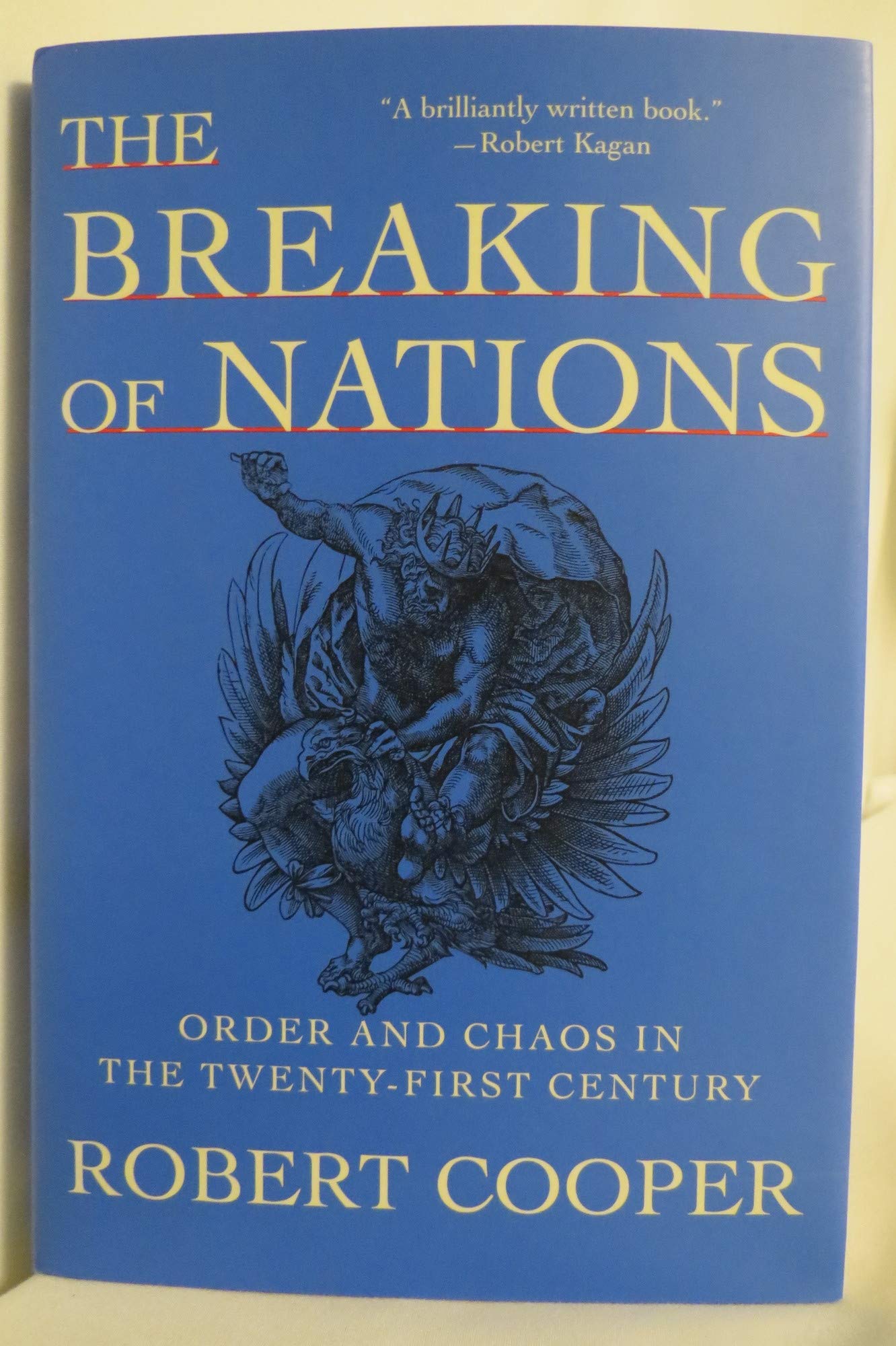
The Breaking of Nations: Order and Chaos in the Twenty-First Century
$13.40
by Robert Cooper



In this book, Robert Cooper sets out his radical new interpretation of the new international order that has emerged from the debris of Communism's collapse. The United States, Cooper argues, has yet to decide whether to embrace the "post-modern" world of interdependence, or pursue unilateralism and power politics. Cooper shows that the greatest question facing post-modern states is how they should deal with a world in which missiles and terrorists ignore borders and where Cold War alliances no longer guarantee security. He argues that when dealing with a hostile outside enemy, civilized countries need to revert to tougher methods from an earlier era - force, preemptive attack, deception - if we are to safeguard peaceful coexistence throughout the civilized world. He also advocates a doctrine of liberal imperialism that advocates that post-modern states have a right to intervene in the affairs of modern and pre-modern states if they pose a significant enough threat. The Breaking of Nations is essential reading for a dangerous age, a cautionary tale for superpowers, and a prescient examination of international relations in the twenty-first century. Folks who like their global political analysis presented in snippy sound bite form can hurry along to the Carvilles and Coulters and find plenty of reading material. But for those who appreciate the complex tapestry of security issues and international affairs, Robert Cooper offers plenty to think about. The present-day world, posits Cooper, is divided into three types of nations: premodern (often third world and politically unstable), modern, and postmodern. While the present-day Europe Union exists as a postmodern model, with each country relying on others to facilitate prosperity, most other large nations, including, for the moment, the United States, are stuck in a merely modern capacity, still viewing foreign policy as essentially a way of keeping enemies at bay and maintaining the status quo. As terrorism grows more powerful and the "premodern" world more unstable, sophisticated weaponry becomes more readily available to terrorist organizations. It then falls t! o the enlightened "postmodern" countries to intervene militarily, taking a pre-emptive approach when necessary, to contain threats, root out bad guys, and defend the world. With this scenario in mind, Cooper urges EU members to increase their military capability to better measure up to the status and power of the American military forces. But as technology makes weapons of mass destruction more readily available around the planet, a more aggressive diplomatic strategy, Cooper says, is crucial to effectively dealing with the build up of weaponry and he presents five "maxims" to illustrate how such a diplomacy should be organized. While Cooper cogently presents his vision of where the world is and where the powerful nations need to take it, he also acknowledges the vagaries of a shifting world and as such presents The Breaking of Nations more as a rumination on complex issues than a ready-made solution. --John Moe In three conceptual essays on the current state of international affairs, Cooper, a British diplomat, sizes up how the U.S. fits in with the European Union's project of replacing balance-of-power diplomacy with a diplomacy enmeshed in law and linked through economics. Cooper describes the states signing up to EU treaties as "postmodern," and defines the U.S. as still a "modern" state, modern in the sense that like nation-states since the Treaty of Westphalia of 1648, its diplomacy is a traditional search for security. In Of Paradise and Power [BKL F 1 03], Robert Kagan highlighted the contrasting outlooks of Europeans and Americans, so Cooper's more theoretical examination will benefit from previously tilled ground. He makes a pitch, through five "maxims," for how a postmodern diplomacy should be practiced, and closes with an admonition to European leaders that criticizing America will remain an exercise unless they increase their military capacity. Addressing fundamental ideas about the conduct of international relations, Cooper will appeal most to aspiring diplomats. Gilbert Taylor Copyright © American Library Association. All rights reserved Robert Cooper is currently Director-General of External and Politico-Military Affairs for the Council of the European Union. Used Book in Good Condition