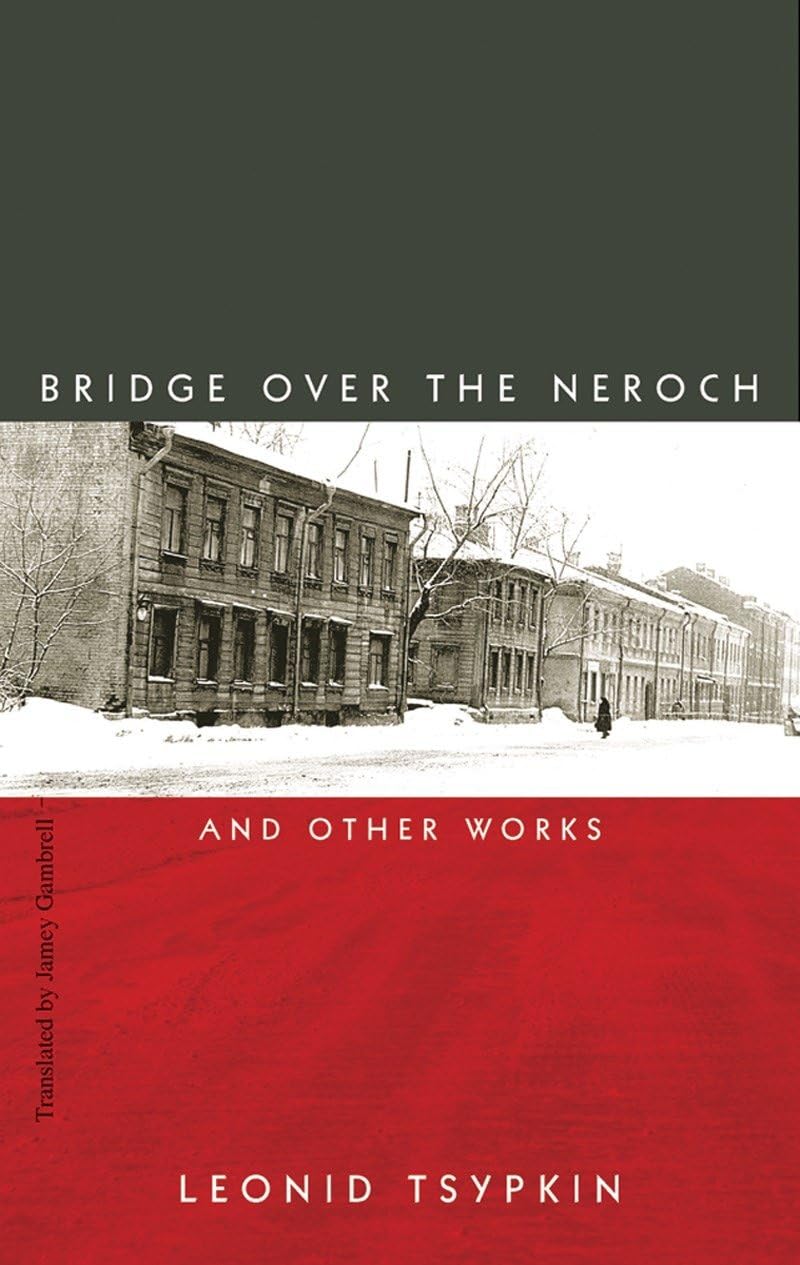



From the acclaimed author of Summer in Baden-Baden , a collection of short work finally in English. Leonid Tsypkin’s novel Summer in Baden-Baden was hailed as an undiscovered classic of 20th-century Russian literature. The Washington Post claimed it “a chronicle of fevered genius,” and The New York Review of Books described it as “gripping, mysterious and profoundly moving.” In her introduction,Susan Sontag said: “If you want from one book an experience of the depth and authority of Russian literature, read this book.” At long last, here are the remaining writings of Leonid Tsypkin: in the powerful novella Bridge Across the Neroch , the history of four generations of a Russian-Jewish family is seen through the lens of a doctor living in Moscow. In Norartakir , a husband and wife on vacation in Armenia bask in the view of Mt. Ararat and the ancient history of the land, until they are unceremoniously kicked out of their hotel and returned to Soviet reality. The remaining stories offer knowing windows into Soviet urban life. As the translator Jamey Gambrell says in her preface: "For Tsypkin's narrator, history is a tightrope to be walked every minute of every day, in both his internal and external world." This volume of two novellas and five stories includes almost everything left of Tsypkin’s work to be translated into English. A pathologist with two PhDs, Tsypkin (1926–82) was denied a visa to emigrate from the Soviet Union. He never saw any of his work in print, dying a week after his only novel, Summer in Baden-Baden, began to appear, serialized in a New York émigré journal. Those versed in such kindred literary spirits of Tsypkin’s as Javier Marías, W. G. Sebald, and Thomas Bernhard have acquired a taste for long, winding, sentences. But there is no prose quite like Tsypkin’s. Inside his dependent clauses, nested in his parentheses, the past is preserved, intact, contemporary with the present. The effect is vertiginous and profoundly moving. In the title novella, the chronicle of a Jewish family, a couple’s vacation goes terribly wrong, and Tsypkin’s sentences are the thread we follow deep into the labyrinth of human feeling. “Ave Maria” is an incredible, shattering look at a single death; “The Cockroaches” is a slapstick take on the same subject. Tsypkin was a genius. --Michael Autrey "Excellent translations of Tyspkin's...small literary oeuvre of astonishing originality." ― Rachel Polonsky, New York Review of Books "The word “Jewish,” as translator Jamey Gambrell points out in the introduction, appears rarely for how often the story concerns otherness within one’s own country and family. The narrator’s son is beaten up, held down in front of the girls during a jokey teenage gathering because he is Jewish, though the reason is never made explicit. That’s the book for you―the surreal treated as commonplace and vice versa until it’s all the same." ― Dan Duray, New York Observer "There is no prose quite like Tsypkin’s. Inside his dependent clauses, nested in his parentheses, the past is preserved, intact, contemporary with the present. The effect is vertiginous and profoundly moving." ― BookList "One of the great pleasures of seeing The Bridge Over the Neroch become available is that it should make clear that Tsypkin’s novel was not an aberration. The seven stories collected here will, I hope, confirm Tsypkin’s reputation as a writer of peculiar distinction." ― The Quarterly Conversation "Tsypkin’s prose glows with ingenuity and experimentation as he creates a chaotic, raging river of consciousness in which present, past, and future; dream, reality, and memory all collide within the same paragraph, even within the same sentence." ― The Jewish Book Council Leonid Tsypkin was born in Minsk in 1926 of Russian-Jewish parents, both physicians. His last book, Summer in Baden-Baden, is the culmination of a passionate, clandestine literary vocation; a distinguished medical researcher by profession, Tsypkin never saw a page of his literary work published during his lifetime. The manuscript of Summer in Baden-Baden was smuggled out of the Soviet Union in 1981, and the novel was first published in a Russian-émigré weekly in the United States. Tsypkin, who had been twice denied permission to leave the Soviet Union with his family, died of a heart attack in Moscow in 1982.