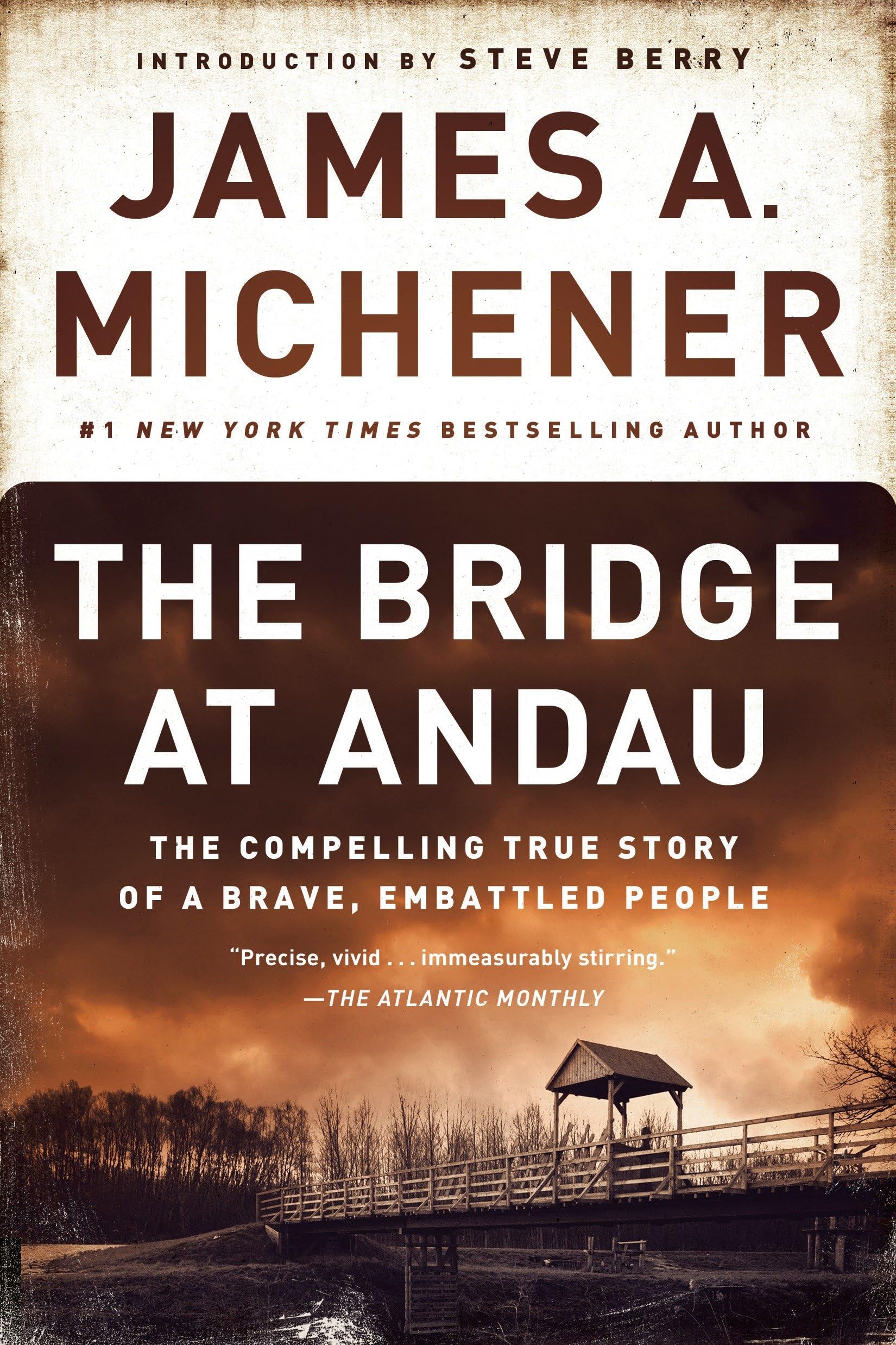
The Bridge at Andau: The Compelling True Story of a Brave, Embattled People
$15.50
by James A. Michener



The Bridge at Andau is James A. Michener at his most gripping. His classic nonfiction account of a doomed uprising is as searing and unforgettable as any of his bestselling novels. For five brief, glorious days in the autumn of 1956, the Hungarian revolution gave its people a glimpse at a different kind of future—until, at four o’clock in the morning on a Sunday in November, the citizens of Budapest awoke to the shattering sound of Russian tanks ravaging their streets. The revolution was over. But freedom beckoned in the form of a small footbridge at Andau, on the Austrian border. By an accident of history it became, for a few harrowing weeks, one of the most important crossings in the world, as the soul of a nation fled across its unsteady planks. Praise for The Bridge at Andau “Precise, vivid . . . immeasurably stirring.” — The Atlantic Monthly “Dramatic, chilling, enraging.” — San Francisco Chronicle “Superb.” — Kirkus Reviews “Highly recommended reading.” — Library Journal “Precise, vivid . . . immeasurably stirring.” — The Atlantic Monthly “Dramatic, chilling, enraging.” — San Francisco Chronicle “Superb.” — Kirkus Reviews “Highly recommended reading.” — Library Journal James A. Michener was one of the world’s most popular writers, the author of more than forty books of fiction and nonfiction, including the Pulitzer Prize–winning Tales of the South Pacific, the bestselling novels The Source, Hawaii, Alaska, Chesapeake, Centennial, Texas, Caribbean, and Caravans, and the memoir The World Is My Home . Michener served on the advisory council to NASA and the International Broadcast Board, which oversees the Voice of America. Among dozens of awards and honors, he received America’s highest civilian award, the Presidential Medal of Freedom, in 1977, and an award from the President’s Committee on the Arts and Humanities in 1983 for his commitment to art in America. Michener died in 1997 at the age of ninety. On Tuesday evening, October 23, 1956—a day which the world will be slow to forget—a boy of eighteen interrupted his work on the early-evening shift and entered the foreman’s office in the locomotive factory on Kobanyai Street in the Hungarian capital of Budapest. “You must attend more meetings of the communist study group,” his foreman warned him abruptly.” Because the boy was young, he was tempted to argue back, but something in the foreman’s cold stare warned him and he accepted the reprimand. Outside the office he thought, “I work ten hours a day and don’t get enough food. Why should I have to attend communist meetings after work?” He was a handsome youth, blond, straight, gray-eyed, and with a skin that was spotted for the time being but which seemed to be clearing up as he approached manhood. He wore cheap corduroy pants, a very cheap windbreaker with a zipper that rarely worked, and heavy, warm shoes. In his locker he had a stiff overcoat that was not warm, and a cap. Apart from one very thin Sunday suit, at his father’s, those were all the clothes he owned, although he had worked for nearly four years. Bad food, trolley fare, and a little money to help his father accounted for all his wages, which were pitifully low. Josef Toth had no mother. She had died two years before, mysteriously, and her death had been not only a family tragedy, but an economic hardship as well. It had happened this way. His mother was a big, jovial, talkative woman who could never resist a joke, and one of the reasons why her son Josef had such a ready smile was his long acquaintance with this warm-hearted woman. But one day she had said, sitting in a casual group which had been having supper in her home, “Everywhere you look you see the Russian flag. I long for the old Hungarian flag.” Someone in the group that night, some trusted friend, had sought temporary advantage in Budapest’s bitter struggle for food by reporting Mrs. Toth to the AVH (Allam Vedelmi Hatosag, State Protecting Organization), who were generally known as the AVO (Allam Vedelmi Osztag, State Protecting Special Group), which had originally been a highly selected group within the AVH. Next day, a small truck called at the Toth home and two AVO agents hauled Mrs. Toth away. Nobody saw her for six months, and when she returned home the terror of her situation became apparent. She smiled and assured her family that nothing had happened to her while she was in the hands of the AVO. Resolutely she met all queries with one reply, “Nothing happened,” but when she fell sick from the exhaustion, starvation and torture she had suffered in prison, and when it became apparent that she was certainly going to die, she let drop a few hints—not enough to imperil the safety of her family, should there happen to be another unsuspected spy in its midst, but enough to give her son Josef some idea of what had happened. Once she said to him, “I had to stand on one foot for hours every da