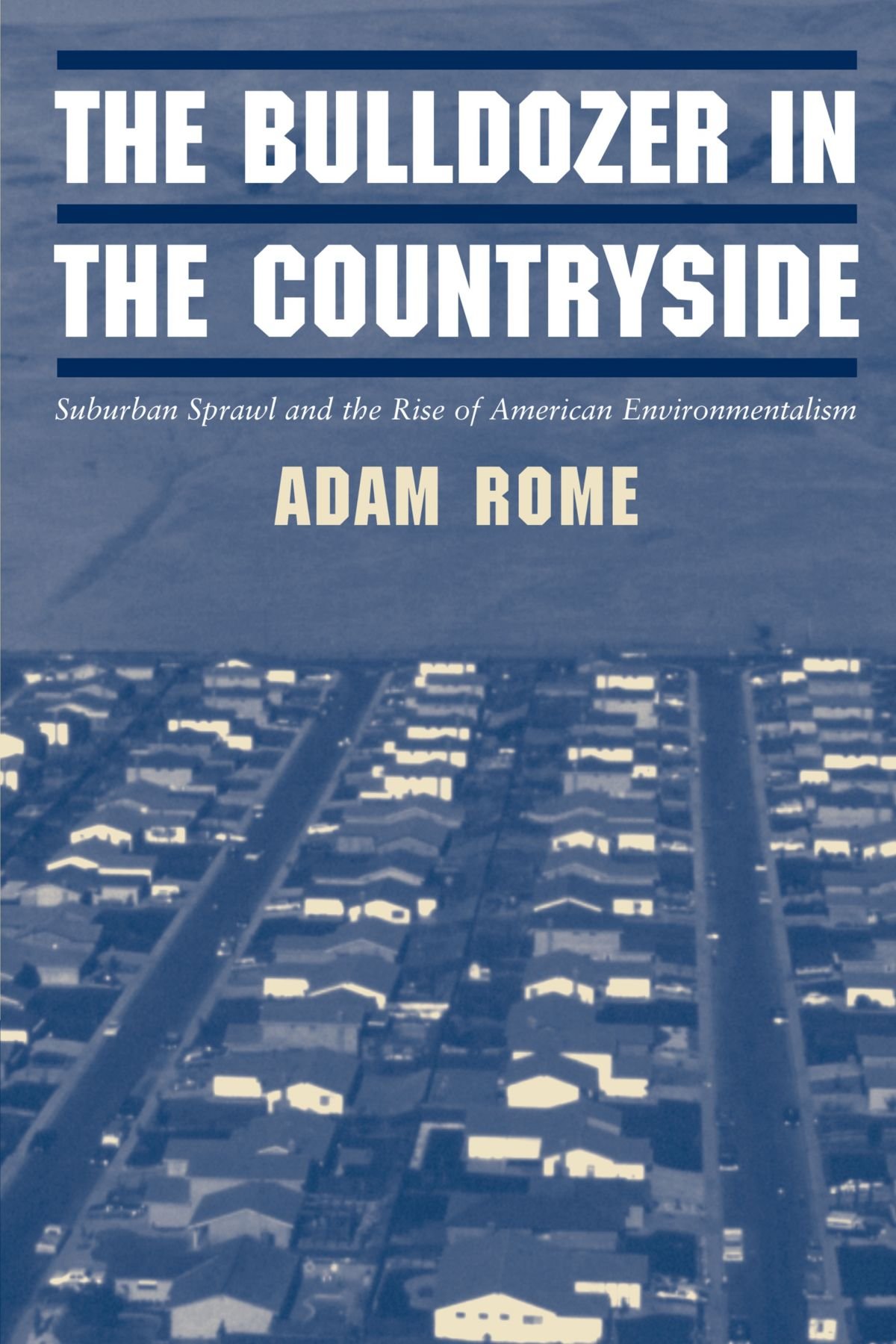



The Bulldozer in the Countryside is the first scholarly history of efforts to reduce the environmental costs of suburban development in the United States. The book offers a new account of two of the most important historical events in the period since World War II--the mass migration to the suburbs and the rise of the environmental movement. This work offers a valuable historical perspective for scholars, professionals, and citizens interested in the issue of suburban sprawl. Modern American environmentalism owes much to such predecessors as Henry Thoreau, John Muir, and Theodore Roosevelt. But it owes much more, suggests historian Adam Rome, to the sprawling suburbs of the postwar era, when great sections of the country fell under the bulldozer to make way for the vaunted American Dream. Homebuilders of the immediate postwar era did not, as a rule, take into account the environmental costs of their work--nor did they have to. "To take advantage of the cheap, unsewered land at the fringes of cities," writes Rome, they could install septic tanks on tiny lots, in unsuitable soils, or near streams and wells. To reduce land-acquisition costs, builders also could level hills, fill wetlands, and build in floodplains. To maximize the number of lots in a tract, they could design subdivisions with no open space. Such actions improved a builder's chances of making a profit, to be sure, but in the coming years they yielded significant opposition--and not just from the occasional birdwatcher or hiker. Activist citizen groups and government agencies began demanding responsible building and zoning practices. In the end, non-urban America's onetime habit of letting landowners do what they would on their land gave way to "an explosion of codes, regulations, and guidelines," the product of a growing awareness of environmental problems and the need to solve them--and an extraordinarily far-reaching shift in public policy. Rome's well-written book makes a welcome addition to the history of environmental thought, one to shelve alongside the best of Lewis Mumford and Jane Jacobs. --Gregory McNamee "The Bulldozer in the Countryside is solid environmental history, telling a remarkably broad story of political economy, culture, and physical environments on a national scale...Rome writes gracefully, with a sense of drama that makes the book hard to put down." Journal of American History "Serving as an essential corrective to the belief that environmentalism has only lately come around to confronting the ecological consequences of urban land use, Adam Rome's The Bulldozer in the Countryside: Suburban Sprawl and the Rise of American Environmentalism uncovers a largely forgotten history of political controversy surrounding the explosive growth of suburbia in the decades following World War II...The Bulldozer in the Countryside is important reading, which shows conclusively that the urban environmental agenda has a longer and deeper history than even its most fervent advocates may have realized." Urban Ecology "This book is a valuable resource for those interested in urban, growth management and environmental policy, especially those involved in dealing with the sprawl-related issues of today." Ecoscience "Too often, we forget that the history of environmentalism has as much to do with cities and suburbs - the places where most people now live - as it does with the rural or wild landscapes where many efforts to protect non-human nature have focused. In this important book, Adam Rome explores the complex processes by which rural areas were converted to suburban tract housing in the decades following World War II - transforming not just the American landscape, but American politics as well. It is a story with profound implications for the environmental challenges we now face." William Cronon, University of Wisconsin-Madison "Rome's is an important tale, clearly told and well-argued...this is a significant contribution both to the history of suburban homebuilding and to the history of environmentalism. It is also worthy of consideration as a course text..." Technology and Culture "In this brilliant and original book, Adam Rome proposes both a new significance for postwar American suburbia and a new interpretation of postwar American environmentalism. Arguing that the uncontrolled spread of tracthouse suburbia was a driving force behind a new environmental consciousness,...Rome offers a profound insight into the development of an American land ethic." Robert Fishman, Taubman College of Architecture and Planning University of Michigan, Ann Arbor "His book has the virtues and limits of good histories. It is smoothly written and thoroughly documented...a good solid story about an interesting phase in American history. Whether you lived through it or study it or both, you will learn much." American Journal of Sociology "Romes's book provides an excellent outline of the emerging postwar conflict over the surburban environment...dese