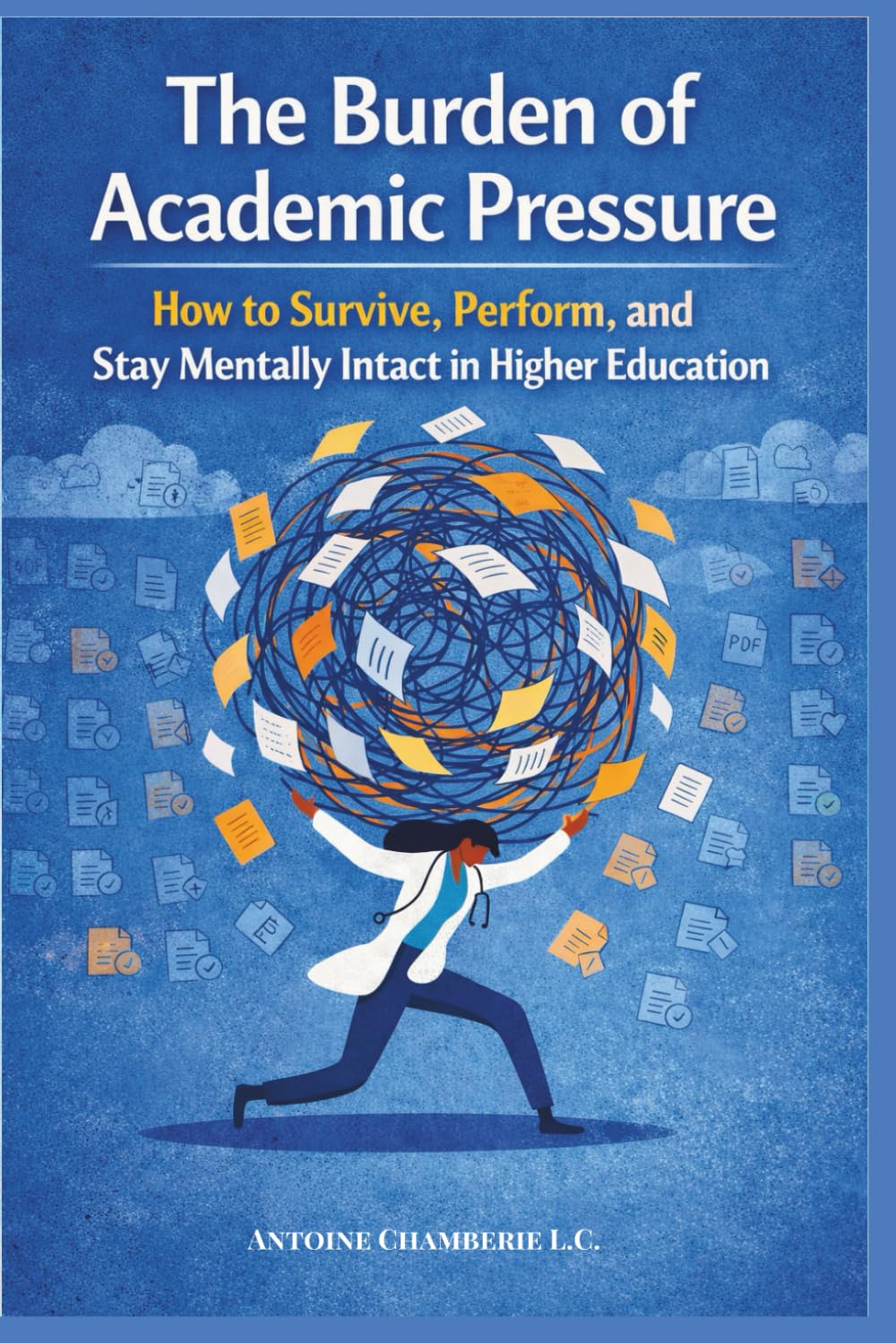
The Burden of Academic Pressure: How to Survive, Perform, and Stay Mentally Intact in Higher Education
$12.99
by ANTOINE CHAMBERIE



How to Survive, Perform, and Stay Mentally Intact in Higher Education Academic pressure isn’t just about exams, deadlines, or grades. For many students, it becomes the environment they live in. From university to graduate and postgraduate study, the pressure to perform rarely ends—it intensifies. Expectations accumulate. Evaluation becomes constant. And slowly, learning begins to feel less like curiosity and more like survival. This book explains why. The Burden of Academic Pressure explores how modern academic systems shape stress, motivation, identity, and mental health—especially for high-achieving students who appear to be “doing fine” while feeling exhausted, anxious, or emotionally flat beneath the surface. Rather than offering productivity hacks or motivational slogans, this book focuses on what most students are never taught: how chronic academic pressure actually affects the brain, nervous system, and capacity to learn. Inside, you’ll discover: • Why constant evaluation shifts the brain from learning mode into threat mode • How academic pressure slowly turns performance into identity • Why working harder often stops working under sustained stress • The difference between intellectual rigor and cognitive overload • How burnout can develop even when you are disciplined, capable, and committed • Why loss of motivation is often physiological—not a personal failure Grounded in psychology, neuroscience, and lived academic experience, this book reframes stress as a systemic condition , not an individual weakness. It is written for: University students feeling overwhelmed or anxious - Graduate and postgraduate students experiencing burnout or emotional exhaustion - High-achievers who are still performing but feel increasingly hollow - Students who love learning—but feel disconnected from it This is not a workbook. It does not demand hustle, optimization, or relentless resilience. Instead, The Burden of Academic Pressure helps you understand what pressure is doing to you—so it loses its power. Because when stress is finally understood, it stops feeling like a personal failure and starts making sense. And nothing is wrong with your ability to learn. In The Burden of Academic Pressure , Paulina Falcón Lara offers a rare and necessary examination of higher education not as a neutral site of learning, but as a chronic stress system that reshapes cognition, physiology, and identity over time. Rather than framing academic distress as a failure of resilience, motivation, or discipline, this book exposes how modern universities normalize sustained evaluation, ambiguity, and scarcity—conditions that prevent stress from ever resolving. Drawing on stress physiology, cognitive science, and systemic analysis, the book explains why working harder often leads to diminishing returns, why rest stops feeling restorative, and why capable students begin to experience anxiety, cognitive fatigue, emotional flattening, or disengagement despite outward success. It challenges the deeply entrenched myth that pressure equals rigor, showing how chronic threat undermines the very learning processes higher education claims to cultivate. Importantly, this is not a productivity manual, nor a call to disengage from learning. It is a reframing. By treating academic pressure as an environmental condition rather than a personal shortcoming, the book restores clarity, reduces self-blame, and opens space for more sustainable ways of thinking, studying, and defining success. For university students, graduate researchers, postdocs, and early-career academics who feel persistently behind, depleted, or numb inside systems that reward endurance over depth, The Burden of Academic Pressure offers something rare: an explanation that actually fits their experience—and a framework that allows learning to become possible again. This book was written for people who are told—explicitly or implicitly—that feeling exhausted, anxious, or depleted in academia is normal, temporary, or a sign that they are doing something wrong. I wrote The Burden of Academic Pressure because those explanations never matched reality. Across universities and postgraduate environments, I saw the same pattern repeated: intelligent, motivated, capable people working harder than ever while learning less, enjoying achievements less, and resting without recovery. They were not failing to cope. They were adapting to systems that require sustained performance without safety, clarity, or resolution. Academic pressure is rarely accidental. It is built into structures of evaluation, comparison, scarcity, and ambiguity. Over time, these conditions stop feeling situational and begin shaping how the nervous system functions—how attention narrows, how motivation shifts from curiosity to fear, how identity becomes tied to output, and how rest loses its restorative power. This book does not ask why individuals struggle to manage stress. It asks what happens to the human body and mind w