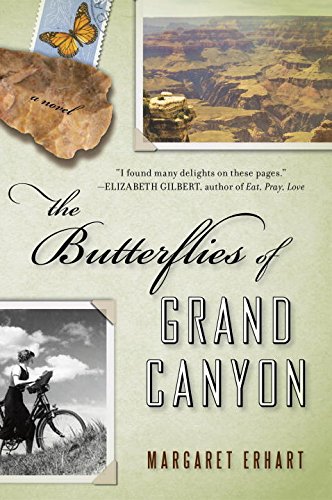



Set against the backdrop of the brooding and sensual canyon, a young woman's heart awakens and a decades-old mystery is solved When Jane Merkle arrives in the tiny town of Flagstaff, Arizona, with her much older husband on a summer day in 1951, she hasn't any idea that her life is about to change forever. After all, one of Jane's favorite sayings is "When in Rome, remember that you're from St . Louis." But over a summer spent with her sister-in-law, Dotty, and Dotty's lepidopterist husband, Oliver, in a village perched on the rim of the Grand Canyon, Jane discovers her latent ability with a butterfly net and her attraction to a handsome young ranger. Meanwhile, an unidentified skeleton is found on the premises of one of the village's most cantankerous citizens. With the help-and hindrance-of a colorful cast of historical characters, including an eccentric botanist who moonlights as an amateur sleuth, the murder mystery that has haunted the town for years is solved. In her latest novel, set in the quintessential landscape of the Southwest, Margaret Erhart weaves history, science, and an intimate knowledge of the human heart to tell a fast-paced tale. Versatile novelist Erhart (Crossing Bully Creek, 2005) is also a river and hiking guide in the Grand Canyon, the inspiration for this confident and acerbically hilarious foray into cozy crime fiction. Four visitors converge on Flagstaff, Arizona, in the summer of 1951. Morris has brought his much younger wife, pretty Jane, to visit his secretive sister and her gallant, butterfly-mad husband, who senses that Jane is about to emerge from her cocoon. The park superintendent has summoned the distinguished and grumpy botanist and gumshoe Elzada Clover (a devotee of Ngaio Marsh mysteries) and her sharp-tongued assistant, Lois, to help figure out why a skeleton has ended up in a mutual friend’s garage. Elzada, who loves women and cacti, is a marvelously smart, thorny sleuth, while Jane’s adventures make for keen screwball comedy. With ricocheting dialogue, a spectacular setting, uproarious scenes of love gone askew, and sparkling tributes to the wonders of nature and sharp observations of its endangerment, Erhart’s clever, energetic tale of passions innocent and deadly both intrigues and entertains. --Donna Seaman "The desert air can do funny things to a person, and soon this respectable woman falls in love with another man. It all feels like an E.M. Forster novel, but set in the scenic American West." -Elizabeth Gilbert, author of Eat, Pray, Love "In this deceptively gentle, wise novel, Margaret Erhart, who's been compared to Faulkner and Austen, somehow channels Ngaio Marsh and Vladimir Nabokov as well. With collecting net and heart in hand, she and her characters snare some beautiful mysteries." -Alan Weisman, author of The World Without Us "Contrasting the puritan restraint of the fifties and the savored sensuality of the American West, The Butterflies of Grand Canyon creates a wonderful new genre that exemplifies the readability of a mystery with the acute eye and true voice of literary fiction." -Craig Johnson, author of Another Man's Moccasins and The Dark Horse "[Erhart] so vividly evokes the beauty, majesty, and purity of the land around the Grand Canyon that she made me want to go back there for the first time in twenty years." -Eric Simonoff, author of Sleepaway "Like white wine picnics in films, and the music of Sade pretty much anywhere, if you stumble on lepidopterists (butterfly enthusiasts) in a novel it's a sure sign things are going to get steamy." -John Freeman, literary critic Margaret Erhart is a river and hiking guide in the Grand Canyon and southern Utah. Her essays have appeared in The New York Times, The Christian Science Monitor, and in several anthologies, and her commentaries have aired on National Public Radio. She lives in Flagstaff, Arizona, and teaches creative writing.