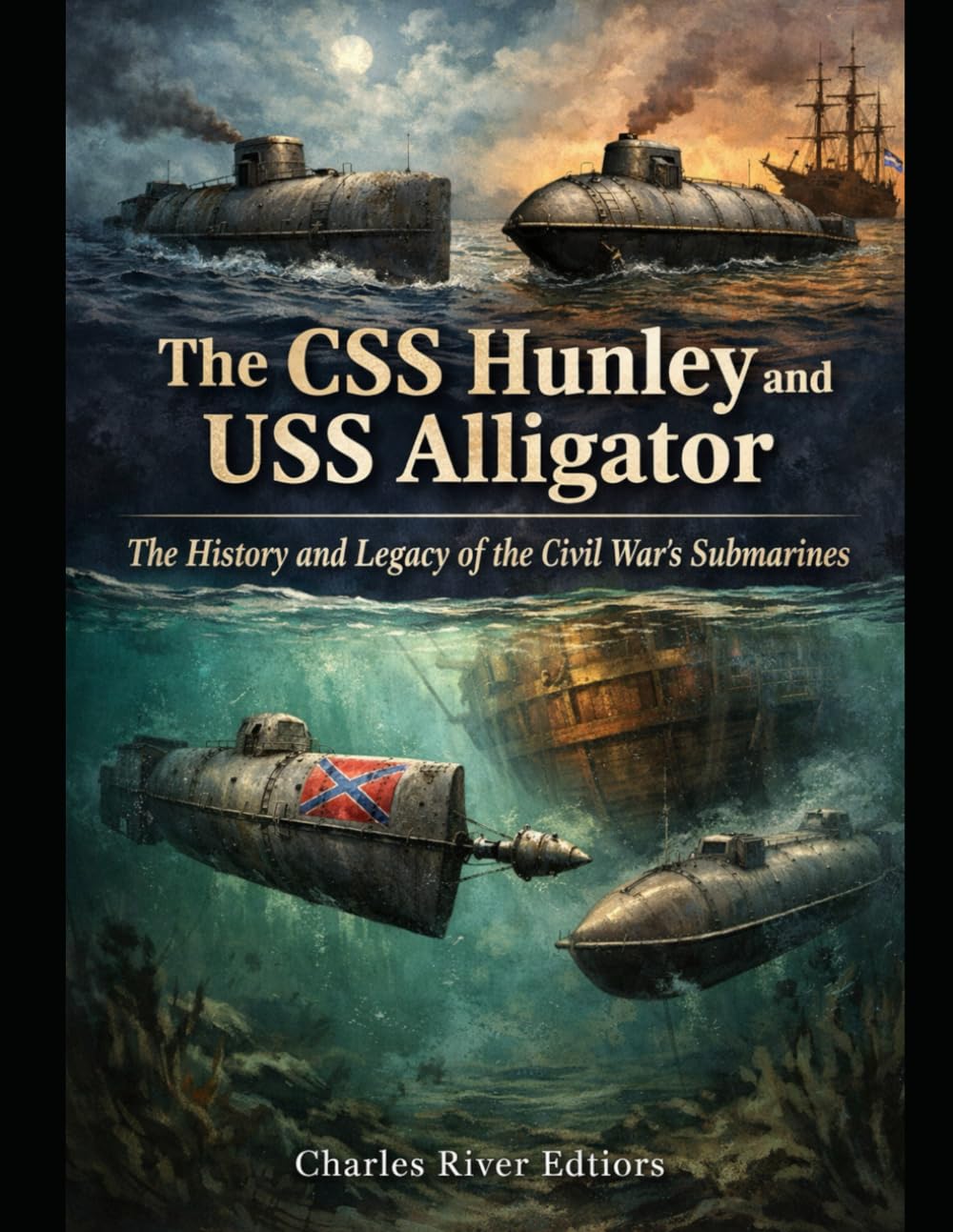
The CSS Hunley and USS Alligator: The History and Legacy of the Civil War’s Submarines
$10.99
by Charles River Editors



While people often tend to think of submarines as a modern invention, inventors created several prototypes from 1580 onward, and they even attempted to use them. Some of the designs remained theoretical and never got off the drawing board, but as time went on, several Europeans built and tested primitive submarines. Most of these early subs were made of wood and often possessed an awkward shape, but a French priest first proposed the now familiar cylindrical layout in 1634. He determined that this shape would make it easier for the submarine to withstand water pressure, while likewise improving maneuverability. Propulsion proved a major obstacle for early submarines. David Bushnell encountered this problem when he built a submarine in 1776 with the intention of drilling holes in the hulls of British ships during the Revolutionary War. In order to approach the ships, however, the Turtle , as Bushnell dubbed it, had to be towed right up to the intended target ship by rowboats. Dr. Benjamin Gale described the curious method by which the submarine would theoretically attach a waterproofed explosive charge, or “magazine,” to the target ship, in a letter to future Congressman Silas Deane: “The magazine for the powder is carried on the hinder part of the machine, without-board, and so contrived that, when he comes under the side of the ship, he rubs down the side until he comes to the keel, and a hook so fixed that when it touches the keel it raises a spring which frees the magazine from the machine, and fastens it to the side of the ship; at the same time it draws a pin, which sets the watch-work a-going, which, at a given time, springs the lock, and an explosion ensues.” Nonetheless, the earliest efforts spurred others to persevere in the goal of underwater travel. During the French Revolution, another American named Robert Fulton wanted to construct “a Mechanical Nautilus. A Machine which flatters me with much hope of being Able to Annihilate their (the British) Navy.” This design actually met with some degree of success, and is probably best described as an upgrade to the original Turtle . Fulton’s machine proved capable of moving underwater, and he took it down to 25 feet for periods up to 6 hours as he had an air hose connecting the device to the surface. Fulton’s attempts to drill into British naval vessels proved a failure since the ships simply got out of the way when their crews saw the submarine coming. The French eschewed the submarine, so Fulton finally broke it up in disgust and sold the remnants for scrap. The Civil War witnessed new designs and prototypes of submarines appearing on American naval drawing boards. These subs had the “cigar shape” familiar throughout history from that point forward. Most of them failed for one reason or another, but one, the CSS Hunley , actually succeeded in using a “spar torpedo” to sink the USS Housatonic . It was the first time a submarine successfully sank a ship, but as historic and groundbreaking as the Hunley and its mission was, all of that was overshadowed by the lingering debate over just what happened to the Confederate submarine, which never made it back to port after the attack. As historic and groundbreaking as the Hunley and its mission was, all of that may be overshadowed by the lingering debate over just what happened to the submarine. The submarine was eventually found, but historians still continue to look at all the evidence, including the positions of the crew, in an effort to conclusively determine how the Hunley sank. Although the Hunley remains the most famous submarine of the Civil War, the Union Navy attempted to create and use a submarine years before the Hunley embarked on its historic operation, and though it’s widely forgotten today, the first Union submarine, the Alligator , also had a fascinating history.