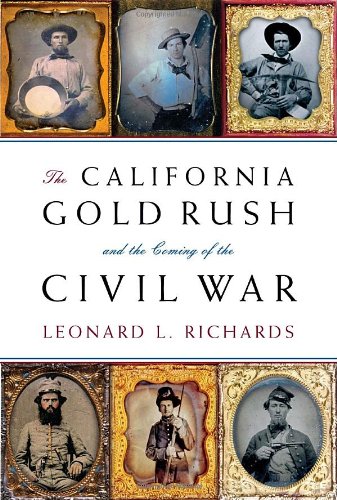



It has always been understood that the 1848 discovery of gold in the foothills of the Sierra Nevada influenced the battle over the admission of California to the Union. But now, in this revelatory study, award-winning historian Leonard L. Richards makes clear the links between the Gold Rush and many of the regional crises in the lead-up to the Civil War. Richards explains how Southerners envisioned California as a new market for slaves and saw themselves importing their own slaves to dig for gold, only to be frustrated by California’s passage of a state constitution that prohibited slavery. Still, they schemed to tie California to the South with a southern-routed transcontinental railroad and worked to split off the southern half as a separate slave state. We see how the Gold Rush influenced the squabbling over the Gadsden Purchase, the Kansas-Nebraska Act, the repeal of the Missouri Compromise, and various attempts to take Cuba and Nicaragua. We meet David Broderick, a renegade New York Democrat who became a force in San Francisco politics in 1849, and his archrival William Gwin, a major Mississippi slaveholder and politician who arrived in California with the intent of making it a slave state and himself one of its first senators. Richards recounts the Washington battles involving Taylor, Clay, Calhoun, Douglas, Davis, Webster, Fillmore, and others, as well as the fiery California political battles, feuds, duels, and perhaps outright murder as the state came shockingly close to being divided in two. When war did break out efforts were made to push California to secede, but there was little general enthusiasm for secession, and many prominent Southerners went off to join the Confederate Army. And with the South out of the Union, the Pacific Railroad Act passed, insuring a comfortably northern route. After the victory in the Mexican War, both northerners and southerners viewed California as the prize acquisition. With its lush, fertile soil, southerners saw the great agricultural potential, especially if California was open to slavery. Northern merchants envisioned the building of numerous ports and the chance to dominate the China trade. Of course, the discovery of gold at Sutter's Mill in January 1848 dramatically magnified the hopes and dreams of Americans devoted to "Manifest Destiny." The gold rush launched a sort of national madness that populated the West, turned some into instant millionaires, and others into frozen corpses. As Richards illustrates, it also intensified the hostility between the North and South; at a minimum, it was a contributing factor in causing the Civil War. Richards offers a broad panorama that moves seamlessly from the goldfields to the halls of Congress. This is an excellent work of popular history that will add to the appreciation of a critical epoch in our national development. Jay Freeman Copyright © American Library Association. All rights reserved “Richards, a leading historian of 19th century America superbly illuminates gold rush California as a land in contention between national pro– and anti–slavery lobbies in the decade leading up to the Civil War.” — Publishers Weekly (starred review) “Richards offers a broad panorama that moves seamlessly from the gold fields to the halls of congress. This is an excellent work of popular history that will add to the appreciation of a critical epoch in our national development.” — Booklist “Brings to life a population of scheming officeholders, xenophobic Californians and frantic slaveholders, all of whom resorted to the ultimate frontier solution: violence.’ — Kirkus Reviews “An engrossing chronicle of the political intrigues that engulfed California in the 1850s, when pro-Southern legislators there angled to turn the state’s newfound wealth to the benefit of the slave economy.” — The Atlantic “The important back-story of the Gold Rush, according to gifted historian Leonard Richards, is political and racial. Mr. Richards contends in this insightful new book, The California Gold Rush and the Coming of the Civil War that for every fortune seeker who viewed California as a place to get rich discovering gold, another believed it a place to get rich exporting, utilizing, or trafficking in human slaves. . . . [A] gripping book.” — The New York Sun “Richards meticulously catalogs details of 19th-century American legislation that nonspecilaists won’t have thought about since high school: the Missouri Compromise, the Gadsden Purchase, the Kansas-Nebraska Act. But when he places the actors center stage to reveal the motives behind the politics, the narrative approaches the Shakespearean.” — Tennessean “With a mastery that brings even his bit players to life, Leonard Richards tells a gripping story about politics, business, violence, and the scoundrels who almost destroyed the United States. If you think you already know this story, you're in for some nice surprises. And if you don’t, there’s no better guide.” —Robin L. E