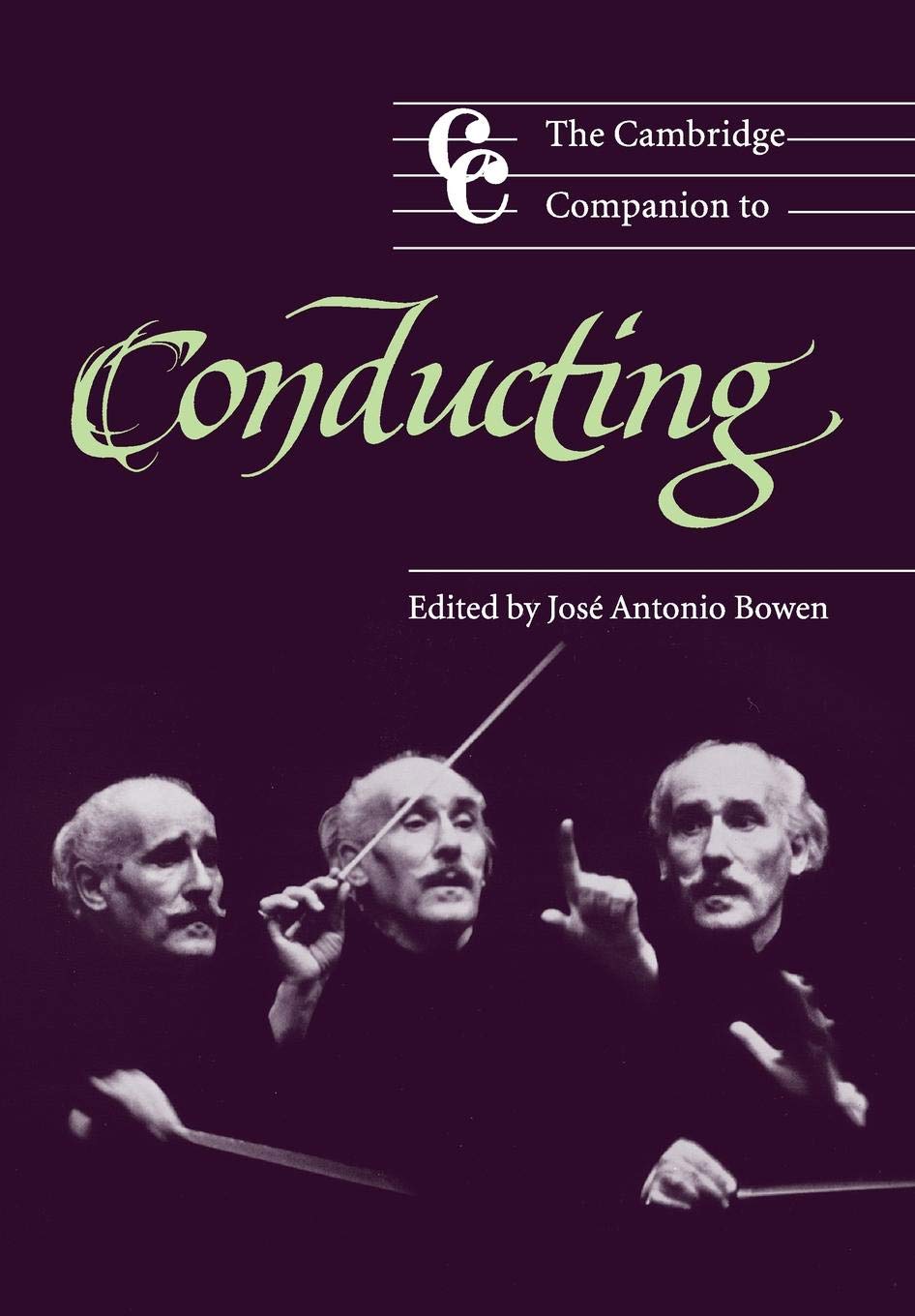
The Cambridge Companion to Conducting (Cambridge Companions to Music)
$23.42
by José Antonio Bowen



Written by many working conductors, this book considers all facets of musical conducting. It includes practical advice on how to conduct different groups (choral, opera, symphony, early music) and a history of conducting presented as a study of national traditions. Designed for the lay reader who wants an inside look at the world of conducting as well as for potential students, it is a revealing study about a secretive industry. Managers, artistic directors, soloists, players and conductors openly discuss their different perspectives in this comprehensive work. "Fascinating reading...Dozens of absorbing topics make this collection a page turner. Highly recommended." --Opera Journal These essays, brought together by José Antonio Bowen, are exploratory rather than didactic…Of particular use are the two bibliographies…By chossing practical musicians as his contributors, Bowen ensures that the vast majority of the commentary is perceptive and relevant to working musicians as well as to the interested reader. The essays are pithy, touching on a massive range of subjects without becoming stuck in a bog of polemics. Perhaps most admirably, Bowen is not afraid of opposing points of view…This is a rewarding and often revealing read. Robin Newton, Classical Music This volume presents a comprehensive (sometimes intersecting, sometimes contradictory) range of views about conducting. … [Bowen] provides depth and informed criticism of the conducting styles of different conducting luminaries…[and] meticulously detail how these conductors handled tempi, marking, the rehearsal process, a conducting ethos, realization of the composer's intentions, and sonic ideals…The American tradition as Bowen and David Mermelstein suggest, is unique in the paradox of its simultaneous rootedness in European origins and struggle to become independent of them…Their approach is original: they reference cities and their orchestras, instead of prominent conductors, as the central core of conducting traditions…As a whole, this volume clearly succeeds in providing illuminating insight, practical advice and insider information that is otherwise unavailable in academic circles…Most notably, however, this collection of essays displays the fundamental impact the conducting profession has had, and continues to have on fostering creativity and engendering social and cultural change. Dr. Joel Novarro, 19th-century Music Review The essays on national traditions in the Companion are rich in anecdote…The 'Issues' section is also unusually interesting. Richard Osborne, The Oldie This is a very comprehensive, honest and highly interesting book , both for a broad public who wants to see behind the face off this profession and for practicing conductors: dieses Buch nur also sehr umfassend, ehrlich und hoch interessant ansehen kann, sowohl, für ein breites Publikum, das etwas hinter die Fassade dieses Berufs sehen will, als auch für angehended Dirigenten. Pizzicato 5 José Bowen's aim is to bridge the gap between textbooks on conducting and biographies of conductors through the combination of practical details with a fresh look at the musical, social, and economic history of conducting (pp. xvi xvii). The result is a highly engaging and colorful book, reflecting the complexity of the subject… Bowen avoids the danger of overlap in the use of so many different voices… Bowen's opening chapter to Part II of the book on The Rise of Conducting is an excellent brief historical introduction to the ensuing six chapters on the most influential conducting traditions… Bowen did a superb editing job, avoiding redundancy as the contributors offer their individual perspectives… The Cambridge Companion to Conducting delivers on its promise to be an unusually honest book about the secretive industry, (in which) managers, artistic directors, soloists, players, and conductors openly discuss their different perspectives for the first time (p. i). It is highly recommended for any serious conducting student and the sophisticated musical layperson. The broad range of essays will raise more questions than the book itself can answer, which seems appropriate and necessary. Because Bowen and his contributors identify many of the important issues to be considered before entering the complex and exceptional world of conducting, this volume will be an important companion and catalyst for further discussions in the near future. " Dr Siegwart Reichwald, Journal of Musicological Research The Cambridge Companion to Conducting, edited by José Antonio Bowen, offers tangible observations on the real world of conducting. This is a welcome addition to the current choice of conducting texts, which consist mainly of extensive description and illustrations of conducting technique. Paula Zerkle, IAWM Journal This book falls into three parts 'Practice', 'History' and 'Issues' which is as good a way as any of getting this almost unwieldy subject into some kind of order…I welcome the contributio