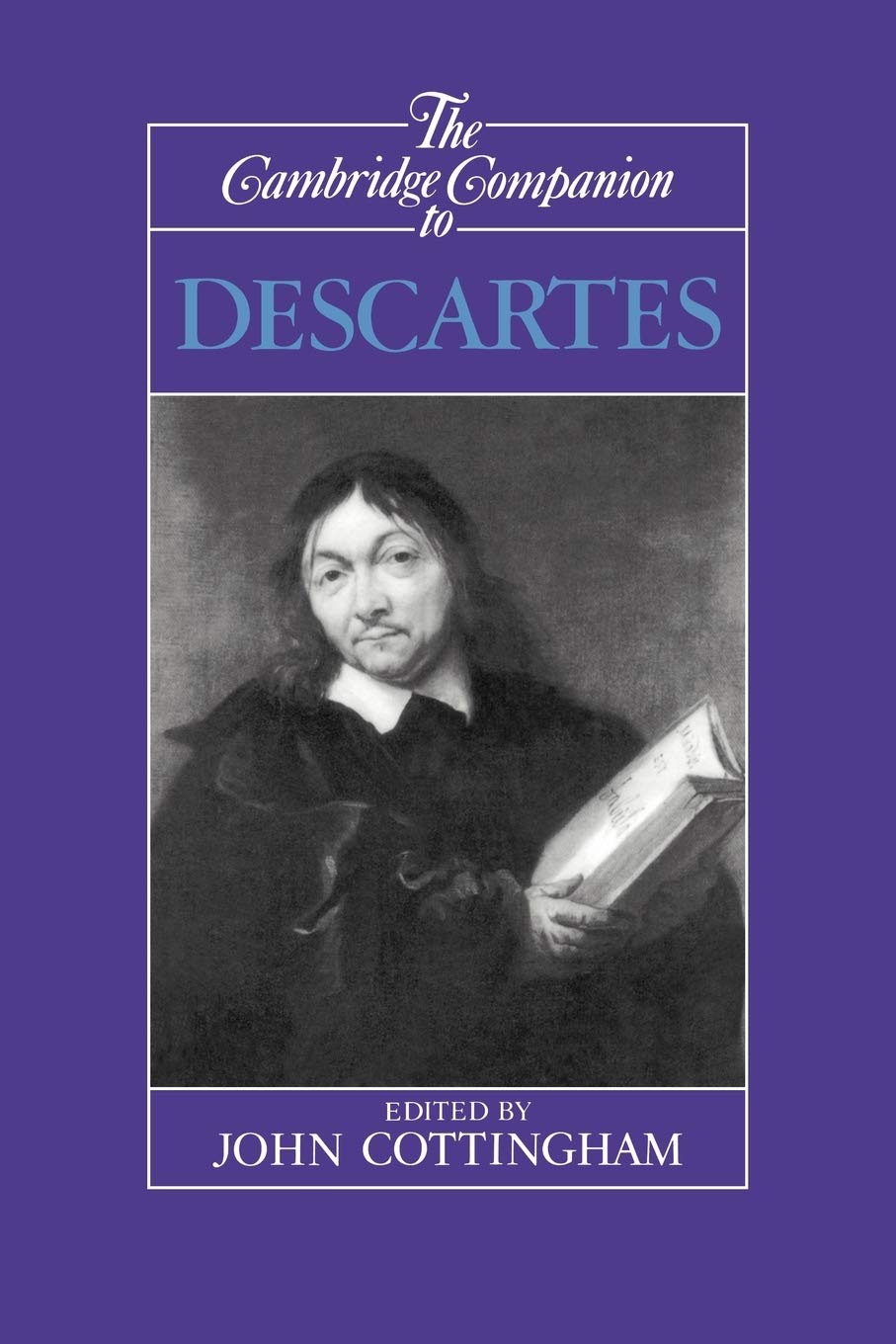
The Cambridge Companion to Descartes (Cambridge Companions to Philosophy)
$23.07
by John Cottingham



Descartes occupies a position of piviotal importance as one of the founding fathers of modern philosophy; he is, perhaps the most widely studied of all philosophers. In this authoritative collection an international team of leading scholars in Cartesian studies present the full range of Descartes' extraordinary philosophical achievement. His life and the development of his thought, as well as the intellectual background to and reception of his work are treated at length. At the core of the volume are a group of chapters on his metaphysics: the celebrated "Cogito" argument, the proofs of God's existence, the "Cartesian circle" and the dualistic theory of the mind and its relation to his theological and scientific views. Other chapters cover the philosophical implications of his work in algebra, his place in the 17th century scientific revolution, the structure of his physics, and his work on physiology and psychology. "Descartes is still rightly called the father of modern philosophy," John Cottingham explains in his introduction to The Cambridge Companion to Descartes , for "without Descartes's philosophy, the very shape of the problems with which we still wrestle, about knowledge and science, subjectivity and reality, matter and consciousness, would have been profoundly different." Thus it is not only the philosophy of Descartes that is illuminated by the 14 essays contained herein, but also the philosophical predicament of today. The contributors are among the most eminent scholars of Descartes's philosophy, including Cottingham, Roger Ariew, and Stephen Gaukroger (whose biography of Descartes should not be missed). Not all of the essays discuss Descartes's philosophy, however. Indeed, as Daniel Garber remarks, "in the seventeenth century Descartes was at very least equally well known for his mechanistic physics" as for any of his philosophical writings. The essays on his scientific work in algebra, psychology, and physiology are also fascinating. Still, at the heart of the Companion are the essays on Descartes's metaphysics. Peter Markie's careful discussion of the most famous sentence in philosophy--" cogito ergo sum "--is especially rewarding. Also worthwhile is Louis E. Loeb's thoughtful exploration of the Cartesian circle, which Descartes raises in his Meditations by arguing from God's existence to the trustworthiness of clear and distinct beliefs while also relying on the trustworthiness of such beliefs in order to prove that God exists. --Glenn Branch "...a collection of unusually fine papers....a valuable guide to contemporary interpretations of Descartes." Canadian Philosophical Reviews "The Cambridge Companion to Descartes is designed to provide an overview of the scholarly conversation about Descartes's writings and make them accessible without trivialization. This book admirably fills its purpose." Emily R. Grosholz, Isis Leading scholars present the full range of Descartes' philosophical achievement in the context of his life and the development of his thought. Each volume contains specially commissioned essays by an international team of scholars together with a substantial bibliography and will serve as a reference work for students and nonspecialists. Used Book in Good Condition