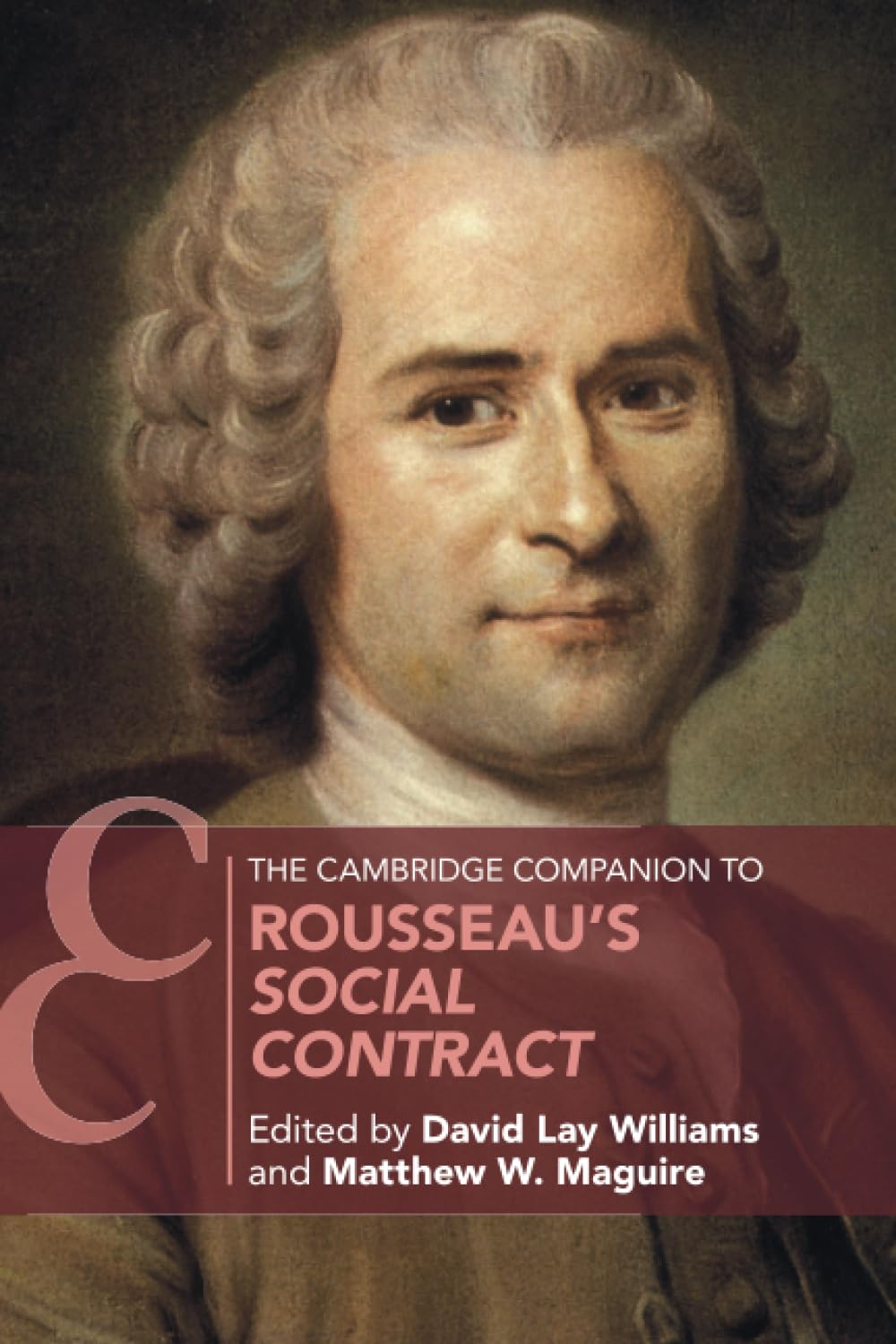
The Cambridge Companion to Rousseau's Social Contract (Cambridge Companions to Philosophy)
$34.99
by David Lay Williams



What is freedom? What is equality? And what is sovereignty? A foundational text of modern political philosophy, Rousseau's Social Contract has generated much debate and exerted extraordinary influence not only on political thought, but also modern political history, by way of the French Revolution and other political events, ideals, and practices. The Social Contract is regularly studied in undergraduate courses of philosophy, political thought, and modern intellectual history, as well as being the subject of graduate seminars in numerous disciplines. The book inspires an ongoing flow of scholarly articles and monographs. Few texts have offered more influential and important answers to research questions than Rousseau's Social Contract, and in this new Cambridge Companion, a multidisciplinary team of contributors provides new ways to navigate this masterpiece of political philosophy- and its animating questions. ‘An instantly indispensable guide to the Social Contract, this Cambridge Companion delves deeply into Rousseau’s magnum opus to explore themes such as political psychology, civil religion, sovereignty, government, and negative versus positive liberty. Moreover, the volume investigates the Social Contract’s intricate relationship with Rousseau’s other works such as Émile, and his essays on political economy, Poland, Corsica, and D’Alembert. A landmark moment in Rousseau studies.’ John P. McCormick, University of Chicago ‘Rousseau’s masterpiece, the Social Contract is, by all accounts, his most important contribution to political philosophy. But it is also a notoriously paradoxical and difficult text, which has both inspired, enraged, and confounded its readers since its publication 250 years ago. David Lay Williams and Matthew W. Maguire have here assembled an outstanding team of experts to help us understand why it continues to fascinate.’ Helena Rosenblatt, The Graduate Center, City University of New York ‘This sterling volume gathers a range of insightful commentary on a notoriously slippery text. A fitting companion to Rousseau’s masterwork, it will be of immense value to all those who read, teach, and struggle with this foundational intervention in modern political thought.’ Darrin M. McMahon, Dartmouth College ‘The essays are self-contained and maintain a high quality throughout the text, which will be useful primarily to scholars conducting research on Rousseau and secondarily to those who do research in political theory on the topics covered here … Highly recommended.’ M. A. Michael, Choice ‘This Companion cannot be faulted for ignoring Rousseau’s pleas to pay due attention to his discussion of institutions, and for that alone, it should be housed on the shelves of Rousseau scholars. More than this, the volume communicates that Rousseau is not frozen in the eighteenth century, his work remains relevant to democratic thought, and the text contains a depth that has not yet been fully plumbed. This Companion feels fresh, and these scholars add deep meaning to the ‘Social Contract’ by revealing a great mastery over Rousseau’s body of work.’ Sara Furnal, History of European Ideas Opens up a masterpiece of political philosophy for a new generation, including influential arguments about justice, equality, and freedom. David Lay Williams is a Professor of Political Science at DePaul University. He is the author of Rousseau's Platonic Enlightenment (2007) and Rousseau's 'Social Contract': An Introduction (CUP, 2014), as well as the co-editor of The General Will: The Evolution of a Concept (CUP, 2015). He is presently completing a book on economic inequality in the history of political thought. Matthew W. Maguire is a Professor of History and Catholic Studies at DePaul University. He is the author of The Conversion of Imagination: From Pascal through Rousseau to Tocqueville (2006) and Carnal Spirit: The Revolutions of Charles Péguy (2019), in addition to essays about diverse topics in European intellectual history. His is now writing a book about autonomy and freedom.