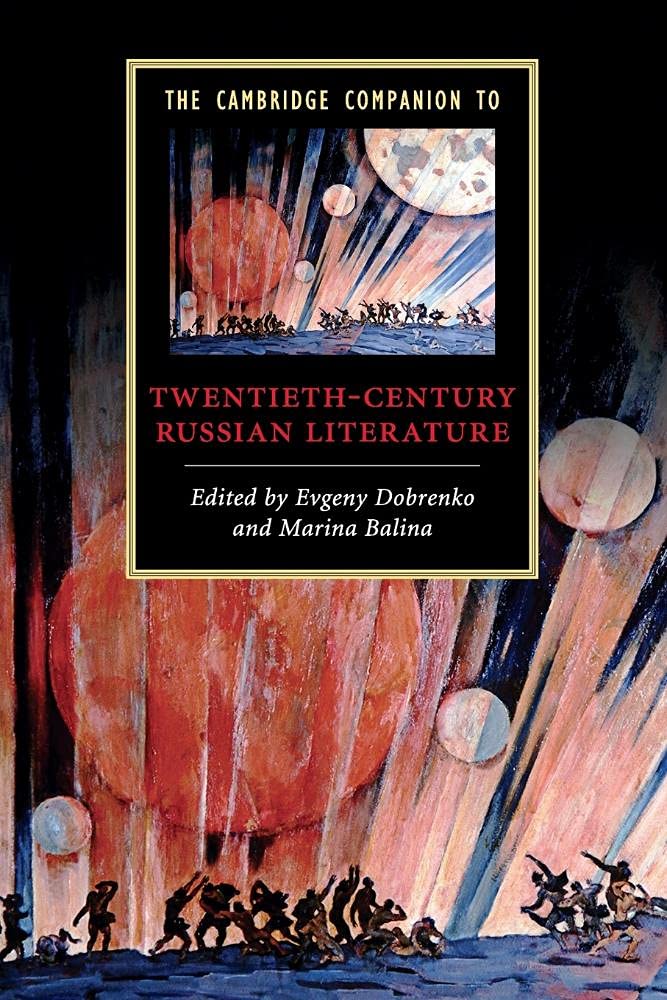
The Cambridge Companion to Twentieth-Century Russian Literature (Cambridge Companions to Literature)
$31.62
by Evgeny Dobrenko



In Russian history, the twentieth century was an era of unprecedented, radical transformations – changes in social systems, political regimes, and economic structures. A number of distinctive literary schools emerged, each with their own voice, specific artistic character, and ideological background. As a single-volume compendium, the Companion provides a new perspective on Russian literary and cultural development, as it unifies both émigré literature and literature written in Russia. This volume concentrates on broad, complex, and diverse sources – from symbolism and revolutionary avant-garde writings to Stalinist, post-Stalinist, and post-Soviet prose, poetry, drama, and émigré literature, with forays into film, theatre, and literary policies, institutions and theories. The contributors present recent scholarship on historical and cultural contexts of twentieth-century literary development, and situate the most influential individual authors within these contexts, including Boris Pasternak, Alexander Solzhenitsyn, Joseph Brodsky, Osip Mandelstam, Mikhail Bulgakov and Anna Akhmatova. "Teachers should find the current companion to be an extremely valuable resource. Each chapter contains both a set of notes accompanying the text and a list for further reading on the given topic. These lists could be very useful for those who wish to pursue it in more detail." --Slavic and East European Journal An overview of the main literary schools, authors and works in modern Russia and the Soviet Union. Evgeny Dobrenko is Professor of Russian at the University of Sheffield. Marina Balina is Isaac Funk Professor of Russian Studies at Illinois Wesleyan University.