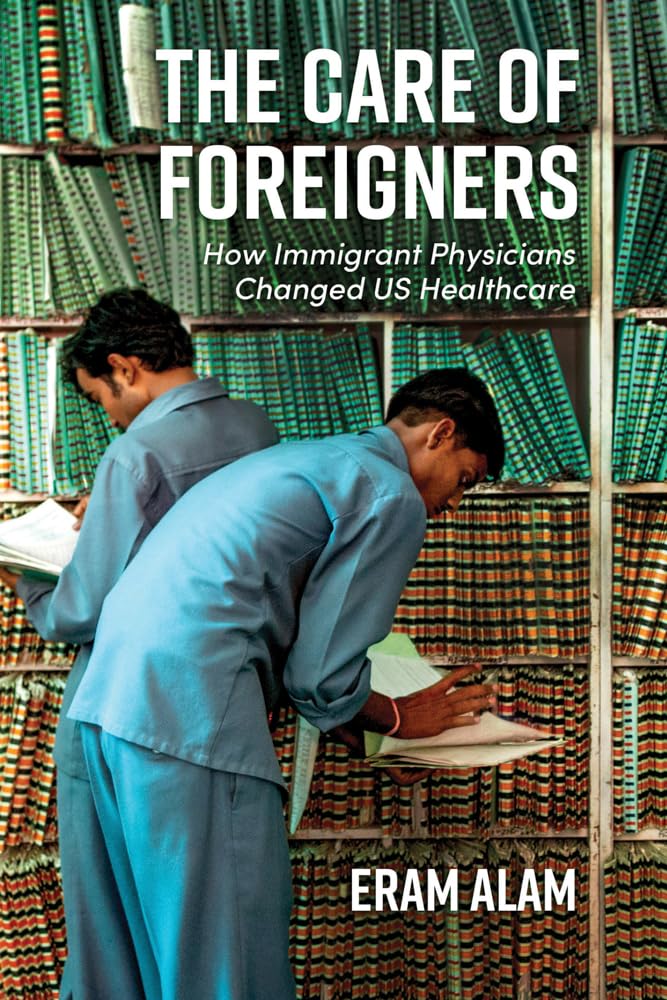



Why did South Asian physicians become essential to US health care starting in 1965? For more than 60 years, the United States has trained fewer physicians than it needs, relying instead on the economically expedient option of soliciting immigrant physicians trained at the expense of other countries. In The Care of Foreigners , Eram Alam examines this migratory dynamic that began during the Cold War. The passage of the Hart–Celler Immigration and Nationality Act of 1965 expedited the entry of foreign medical graduates (FMGs) from postcolonial South Asia and sent them to provide care in shortage areas throughout the United States. Although this arrangement was conceived as temporary, over the decades it has become a permanent fixture of the medical system, with FMGs comprising at least a quarter of the physician labor force since the act became law. This cohort of practitioners has not been extensively studied, rendering the impacts of immigration and foreign policy on the everyday mechanics of US health care obscure. Alam foregrounds global dynamics embedded in the medical system to ask how and why Asian physicians—and especially practitioners from South Asia—have become integral to US medical practice and ubiquitous in the US public imaginary. Drawing on transcripts of congressional hearings; medical, scientific, and social scientific literature; ethnographies; oral histories; and popular media, Alam explores the enduring consequences of postcolonial physician migration. Combining theoretical and methodological insights from a range of disciplines, this book analyzes both the care provided by immigrant physicians as well as the care extended to them as foreigners. I have long wished for a book that comprehensively explored the history, the political machinations, and the personal experiences of foreign-trained physicians like me. The Care of Foreigners is that book. Alam's writing is clear, her research thorough, and her conclusions deeply insightful. ―Abraham Verghese, MD, Stanford School of Medicine, author of Cutting for Stone We've needed a book like this for a long time, and it has been worth the wait! Brilliantly researched and beautifully written, The Care of Foreigners is a major contribution to the histories of migration and medicine. ―Erika Lee, Harvard University, author of The Making of Asian America: A History The Care of Foreigners is a book that finds the world in the proverbial speck of sand. The world is postcolonial and the speck of sand, US healthcare. Tragically, the sand was also wedged in the eye of US racial commonsense that scourged the careers of immigrant physicians. Alam's book is an accessible and ringing indictment of how cash-strapped postcolonial nations have subsidized the coloniality of US healthcare based as it is on the racialized extraction and subordinated use of medical skill. ―Projit Bihari Mukharji, Ashoka University, author of Brown Skins, White Coats: Race Science in India, 1920-66 In this remarkable book, Eram Alam makes clear that the history of US healthcare can't be told apart from the history of immigration. By centering the experiences of immigrant physicians, The Care of Foreigners reveals how government policy, global politics, and local inequality have long converged to shape who provides care in America―and for whom. Meticulously researched and powerfully argued, it fills a striking gap in both postcolonial immigration history and the history of medicine, opening an urgent conversation about the future of US healthcare. ―Dorothy E. Roberts, University of Pennsylvania Carey Law School, author of Killing the Black Body: Race, Reproduction, and the Meaning of Liberty Why did South Asian physicians become essential to US health care starting in 1965? Eram Alam is an assistant professor in the Department of the History of Science at Harvard University.