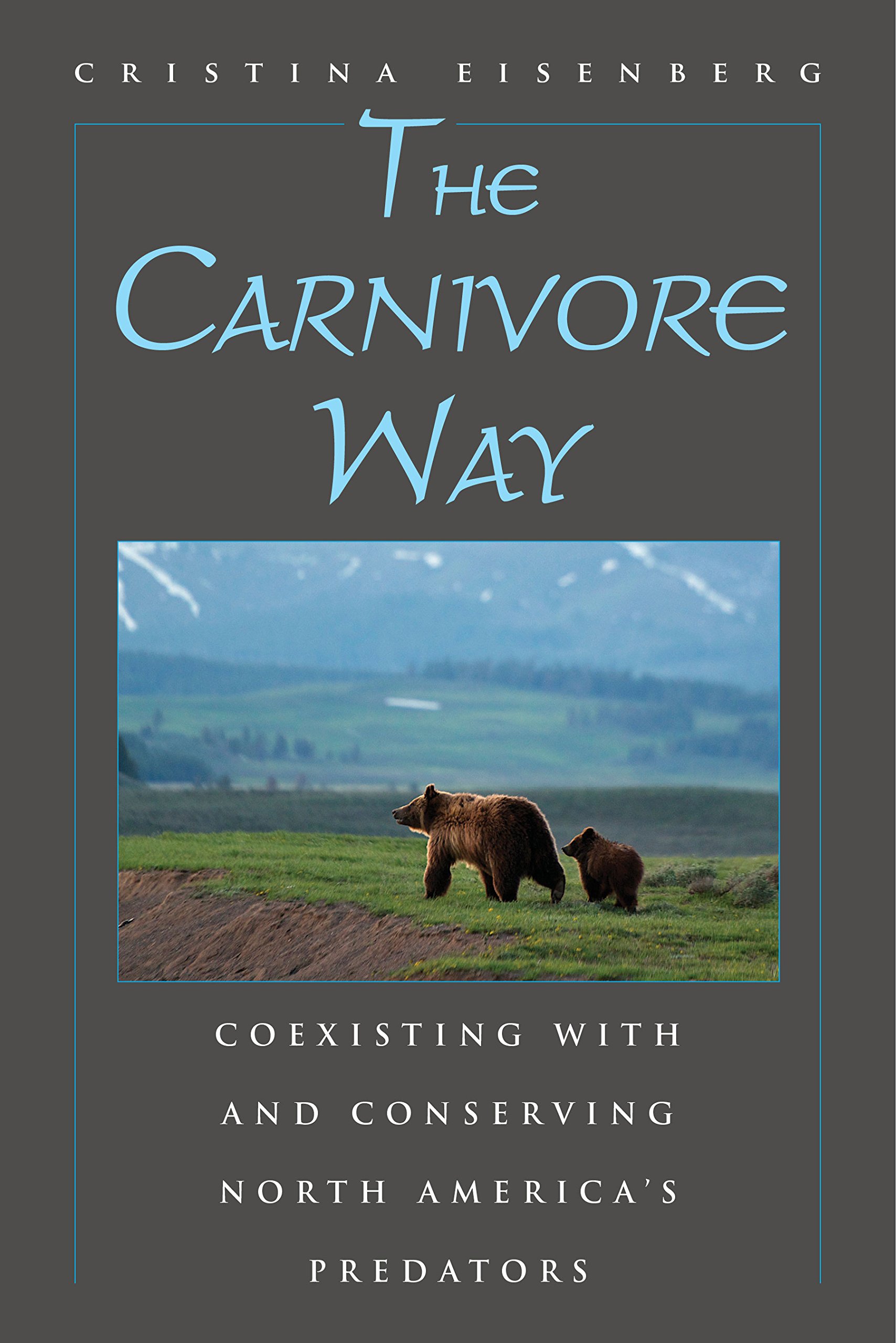
The Carnivore Way: Coexisting with and Conserving North America's Predators
$36.00
by Cristina Eisenberg



What would it be like to live in a world with no predators roaming our landscapes? Would their elimination, which humans have sought with ever greater urgency in recent times, bring about a pastoral, peaceful human civilization? Or in fact is their existence critical to our own, and do we need to be doing more to assure their health and the health of the landscapes they need to thrive? In The Carnivore Way , Cristina Eisenberg argues compellingly for the necessity of top predators in large, undisturbed landscapes, and how a continental-long corridor—a “carnivore way”—provides the room they need to roam and connected landscapes that allow them to disperse. Eisenberg follows the footsteps of six large carnivores—wolves, grizzly bears, lynx, jaguars, wolverines, and cougars—on a 7,500-mile wildlife corridor from Alaska to Mexico along the Rocky Mountains. Backed by robust science, she shows how their well-being is a critical factor in sustaining healthy landscapes and how it is possible for humans and large carnivores to coexist peacefully and even to thrive. University students in natural resource science programs, resource managers, conservation organizations, and anyone curious about carnivore ecology and management in a changing world will find a thoughtful guide to large carnivore conservation that dispels long-held myths about their ecology and contributions to healthy, resilient landscapes. "Using personal anecdotes of encounters with North America predators, supplemented by the results of a number of studies, Eisenberg makes a case for the place of carnivores in the wild." ― Publishers Weekly "“Eisenberg is a fine writer...Examining each species separately, [she] is able to deftly touch on diverse themes: border fences; species life histories; ranching; hunting; and trapping; reintroduction efforts; drought and fire; public land availability and management; ranging and dispersal tendencies; and environmental laws and legal structures. The book, like its focal species, roams widely. The author is at her best when telling stories. By discussing how individual animals use their landscape, Eisenberg paints a picture of their trials and tribulations and how they make a living in an increasingly human-dominated environment.”" ― Science "Ecologist Cristina Eisenberg travels wildlife corridors between Alaska and northern Mexico, focusing on six species: the grizzly bear, wolf, wolverine, lynx, cougar and jaguar. Examining the science and public policy surrounding these majestic creatures, she argues that we need to give them room to roam—and we can do it in a way that allows us to peacefully coexist." ― Conservation "[A]n eminently readable primer on predator ecology." ― Booklist "[T]his fascinating book...offers a blend of research and narrative that will appeal to lay readers..." ― Library Journal "Unfortunately, the topic of large predators can draw plenty of passion and emotion, but that often leaves little room for clear thinking. That's why Cristina Eisenberg's The Carnivore Way is so refreshing. It brings science and rational thought to the issue and shows that we can indeed coexist with large, carnivorous animals—and that most of the issue is with us, not them." ― The Nature Conservancy's Cool Green Science Blog "In this call for a unified vision in conservation, ecologist Cristina Eisenberg argues that big carnivores such as grizzly bears underpin the corridor's ecological health, and need it in turn for dispersal into new territory. She interweaves multiple skeins of science—on predator population resilience, the success of wildlife crossings and more—to build a putative scenario of human-carnivore coexistence." ― Nature "In The Carnivore Way , ecologist Cristina Eisenberg argues for the protection of North America's big predators and their expansive habitats. As a researcher, she illustrates the creatures' ecological importance as linchpins of their ecosystems, affecting the populations and dynamics not only of their prey, but of trophic levels throughout the system. She also urges cooperation among the various stakeholders whose livelihoods are impacted by the presence of large carnivores. Coexistence with carnivores is her steady mantra." ― The Scientist "Her doctoral research at Oregon State University and her 2011 book The Wolf’s Tooth made her a leading spokeswoman for the ecological roles of carnivores. Now, in The Carnivore Way , Eisenberg gathers her most compelling stories and the latest science from the Mexico to Alaska to help human beings learn how to coexist with the key carnivores in the Greater Rocky Mountains — the wolf, cougar, grizzly bear, lynx, wolverine and jaguar." ― High Country News ""Eisenberg is showing us the greatest hope that may exist for a "carnivore way"--the people among us who care enough about the wildlife in their backyards to become engaged in a large carnivore conservation on their own terms." " ― Ecology, Ecological Socie