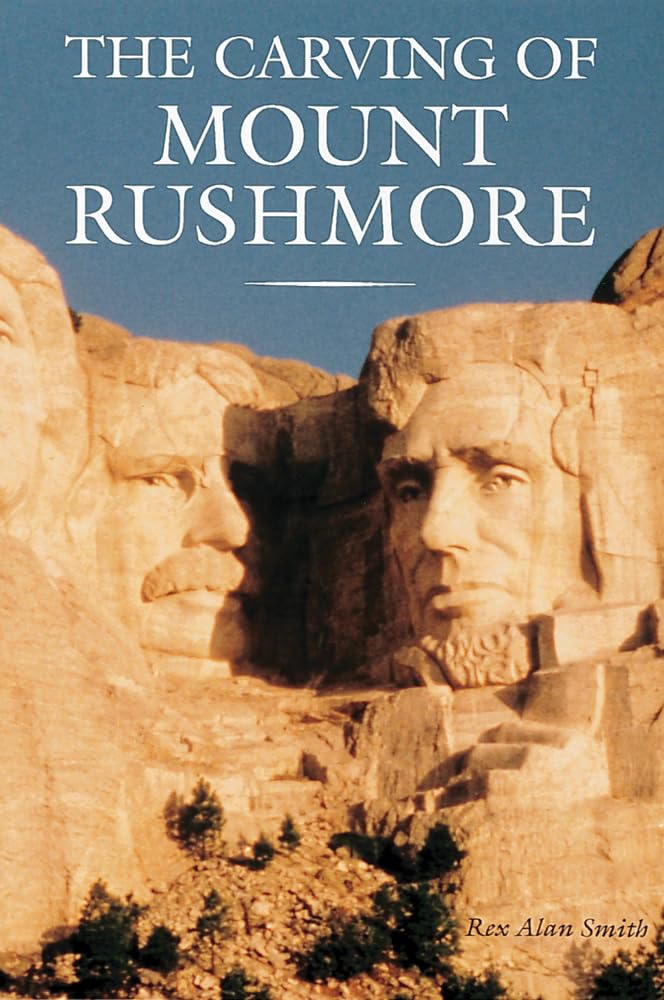



The first book to tell the complete story of Rushmore. "I had seen the photographs and the drawings of this great work. And yet, until about ten minutes ago I had no conception of its magnitude, its permanent beauty and its importance." ―Franklin Delano Roosevelt, upon first viewing Mount Rushmore, August 30, 1936 Now in paperback, The Carving of Mount Rushmore tells the complete story of the largest and certainly the most spectacular sculpture in existence. More than 60 black-and-white photographs offer unique views of this gargantuan effort, and author Rex Alan Smith―a man born and raised within sight of Rushmore―recounts with the sensitivity of a native son the ongoing struggles of sculptor Gutzon Borglum and his workers. "A brief and elegiac memoir of a life lived in its shadows and cracks." ― Artforum "As cryptic and self-effacing a self-portrait as can be found anywhere … Panegyric is almost purely literary, in the sense that one need know or care nothing of the author to be captured by it: Debord is seeking to hijack his era into timelessness." ― Greil Marcus, London Review of Books "These concise but extremely rich and provocative memoirs are the product of ... a philosopher whose scathing pen has never been so sharp." ― John Taylor, San Francisco Chronicle Rex Alan Smith is the author of The Carving of Mount Rushmore and Moon of Popping Trees: The Tragedy at Wounded Knee and the End of the Indian Wars. He also co-authored Pacific Legacy: Image and Memory from World War II in the Pacific (Abbeville). Smith is a veteran of thirty-six months with the Army Engineers in the Pacific. He lived in Box Elder, South Dakota. Foreword High on a pine-clad mountain in South Dakota's Black Hills are the carved faces of four presidents of the United StatesGeorge Washington, Thomas Jefferson, Abraham Lincoln, and Theodore Roosevelteach chosen for such commemoration because of his unique contribution to the building and shaping of his country. Created as a monument not only to those men but also to the aspirations and ideals of the nation they did so much to mold, the four faces together constitute the world's most gigantic piece of sculpture. Eight hundred million pounds of stone were removed in its carving, and so huge are the faces that from brow to chin each is as tall as the entire Great Sphinx in Egypt. Ordinary men of the same proportions would stand shoulder-even with a forty-story building and could wade the Mississippi River without dampening their knees. Yet, so skillfully are the faces carved that to an observer viewing them from across the canyon they do not appear massive or coarse or even heavy. On the contrary, they look as graceful and lifelike as the finest busts sculpted in a studio. Carved upon a cliff that has changed but little since mankind first appeared on earth and has worn down less than the thickness of a child's finger since Moses led the Israelites out of Egypt, the faces will still be there, looking much as they do now, long after man has gone. All things considered, Mount Rushmore National Memorial is not only America's greatest and most enduring monument, it is all of mankind's as well. Today the memorial is visited by well over two million people a year. When these visitors ask, as most do, "Who created it?" they are answered almost invariably with, "The sculptor, Gutzon Borglum." In a limited sense that answer is true, but only in a limited sense. Certainly it is true that without Borglum's genius and stubborn dedication the monument might never have been carved, and the Rushmore cliff might look little different now than it did a million years ago. But that is only part of the story. The Rushmore monument also came from the dreams of a gentle, aging scholar named Doane Robinson, and from the levelheaded judgment and legislative skill of United States Senator Peter Norbeck. Equally important was the down-to-earth business sense of Jon Boland, a dealer in farm implements, and the integrity and legislative ability of William Williamson, a United States congressman and attorney. Just as Borglum brought to the work talents these men did not possess, they brought to it talents Borglum did not possess. All together these men are to the Rushmore work as legs are to a table. It rests upon them all. Lacking any one of them it would have fallen, yet no single one of them could claim credit for the fact that it did not fall. And there is more to the story, for the Rushmore memorial to a substantial extent is also the product of a United States president who learned how to fish, and to a very great extent that of a bunch of hard-working, hard-playing, drill-dusty miners who did the actual work of the carving. They came not even qualified to learn the art of mountain-carving, but learn they did, and the monument stands as everlasting evidence that they learned it well. Beyond what it owes to these men, the memorial is a creation of two brief consecutive momen