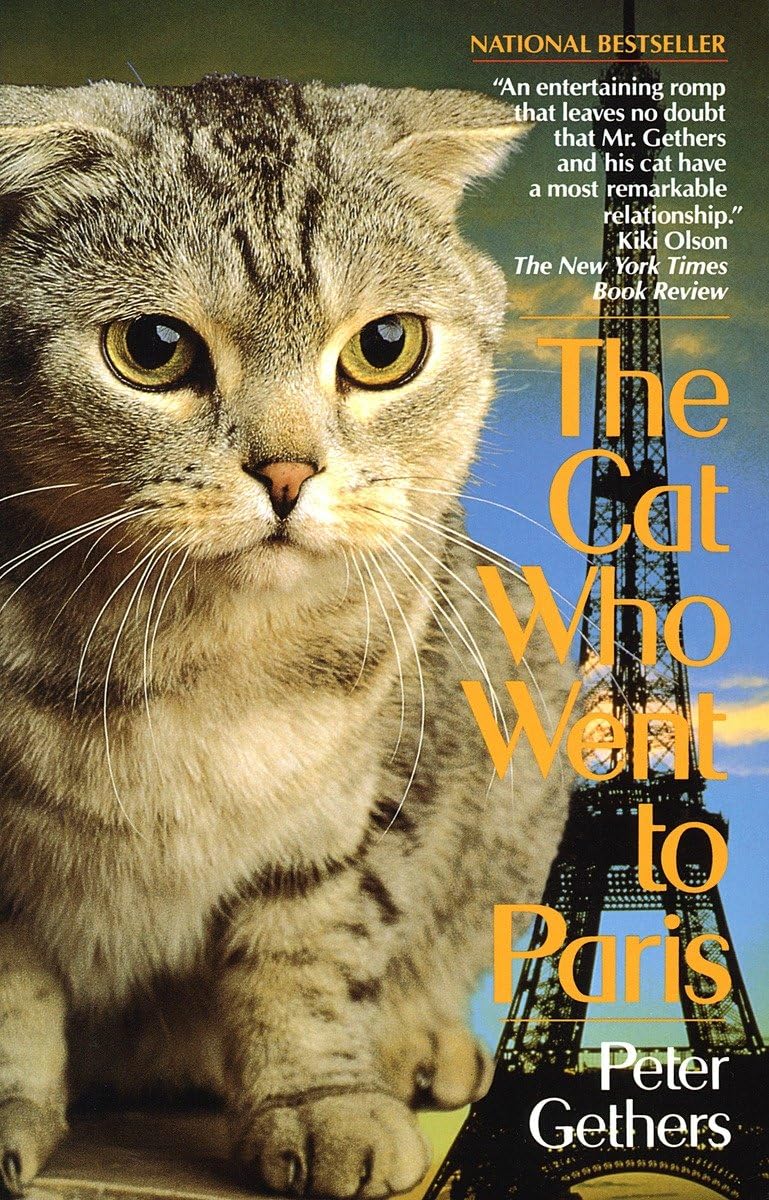



NATIONAL BESTSELLER • When the world is your oyster, you need a cat to enjoy it with you. “An entertaining romp that leaves no doubt that Mr. Gethers and his cat have a most remarkable relationship.”—Kiki Olson, The New York Times Book Review At one time in his life, Peter Gethers, publisher, screenwriter, and author, was a confirmed loner and cat hater. All that changed when a Scottish Fold kitten named Norton entered his life. Peter opened his heart to Norton and soon they were inseparable. Together they rode the ferry to Fire Island, traversed the subways of Manhattan, traveled on the Concorde to Paris, dated beautiful women, and even dined in the world’s finest restaurants. Norton knows how to impress simply by being himself—an amusing and intelligent companion who understands silence, enjoys the thrill of the chase, and gladly accepts the devotion of man and womankind. He also teaches his fallible owner how to live, love, and be a compassionate human being. The Cat Who Went to Paris proves that sometimes all it takes is paws and personality to change a life. “Peter Gethers’ trio of books about the globe-trotting Norton are witty and warm. One not only learns of Norton’s sweet personality but also about the author’s not-so-cynical genuine feelings about what really matters when it comes to love and cats.”—Vicki Myron-,author of Dewey: the Small Town Library Cat who Touched the Worllk Peter Gethers has spent almost a decade chronicling the life of his extraordinary cat. When he has some free time, he's also a novelist, publisher, and screenwriter. Under the pseudonym Russell Andrews, he has written the bestselling thrillers Gideon and Icarus . He lives in New York City, Sag Harbor, and, luckily, Sicily. Foreword A few weeks ago, I made out my first-ever will. At thirty-six, it left me feeling slightly melancholy, more than slightly middle-aged, and somewhat sentimental. Looking to share my sentiment, I mentioned to my mother that I had—quite magnanimously, I thought—left my New York City apartment to my brother Eric’s one-year-old son, Morgan. Instead of the expected motherly glow of affection and pride, she looked at me as if I were an insane person. “Can you do that?!” she asked. I didn’t understand her wide-eyed confusion, especially since, on the scale of human accomplishment, my mother ranks her small grandchild somewhere between Mahatma Gandhi, Thomas Jefferson, and Bo Jackson. “Why not?” I said, just a tad confused. “I mean, I hope he doesn’t get to use it for another forty or fifty years, but if he does, it’ll go to Eric first and he can—” “Did you say Morgan?” she interrupted. “Yeah. Who else?” “I thought you said Norton,” dear old Mom told me. “My cat? You thought I left my apartment to my cat?” “Well,” she said, in a particularly wise moment, and shrugged, “with Norton, you never know.” 1 Before the cat who went to Paris This is a book about an extraordinary cat. However, the extraordinary thing about any cat is the effect it has on its owner. Owning a cat, especially from kittenhood, is a lot like having a child. You feed him, do your best to educate him, talk to him as if he understands you—and, in exchange, you want him to love you. He can drive you mad with his independence. He can, just as surely as a child, create a tremendous desire to protect him from anything bad. He is small, vulnerable, wonderful to hold—when he lets you. And he throws up on just about the same regular schedule. Like children, cats exist on a separate and probably higher plane than we do, and like children, they must be at least partially defined by their relationship with their parents. And though they can do all sorts of amazing things such as hiding in the tiniest room imaginable and refusing to be found no matter how late you are for wherever it is you have to take them, they cannot write their autobiographies. That is left to humans. So this, as it must be, is also a book about people. And thus about relationships. And all sorts of other things cats have no business being involved with but can’t seem to help themselves. My involvement with a cat was strictly accidental. In fact, I had to be dragged into it kicking and screaming. By way of example, a little over seven years ago, someone asked me to name ten things that I believed were truly self-revealing, deeply heartfelt, and absolutely irrevocable. This person, a woman I was going out with, asked me to do this, I believe, because she thought I was a person without much emotion, without a lot of passion. She had, I also believe, been through way too many years of Upper East Side New York therapy in which she had made way too many lists like this. The fact of the matter was that I had plenty of emotion and plenty of passion. I just didn’t have much for her. People often seem to fall into this trap in their relationships. They seem to feel that if someone doesn’t do what h