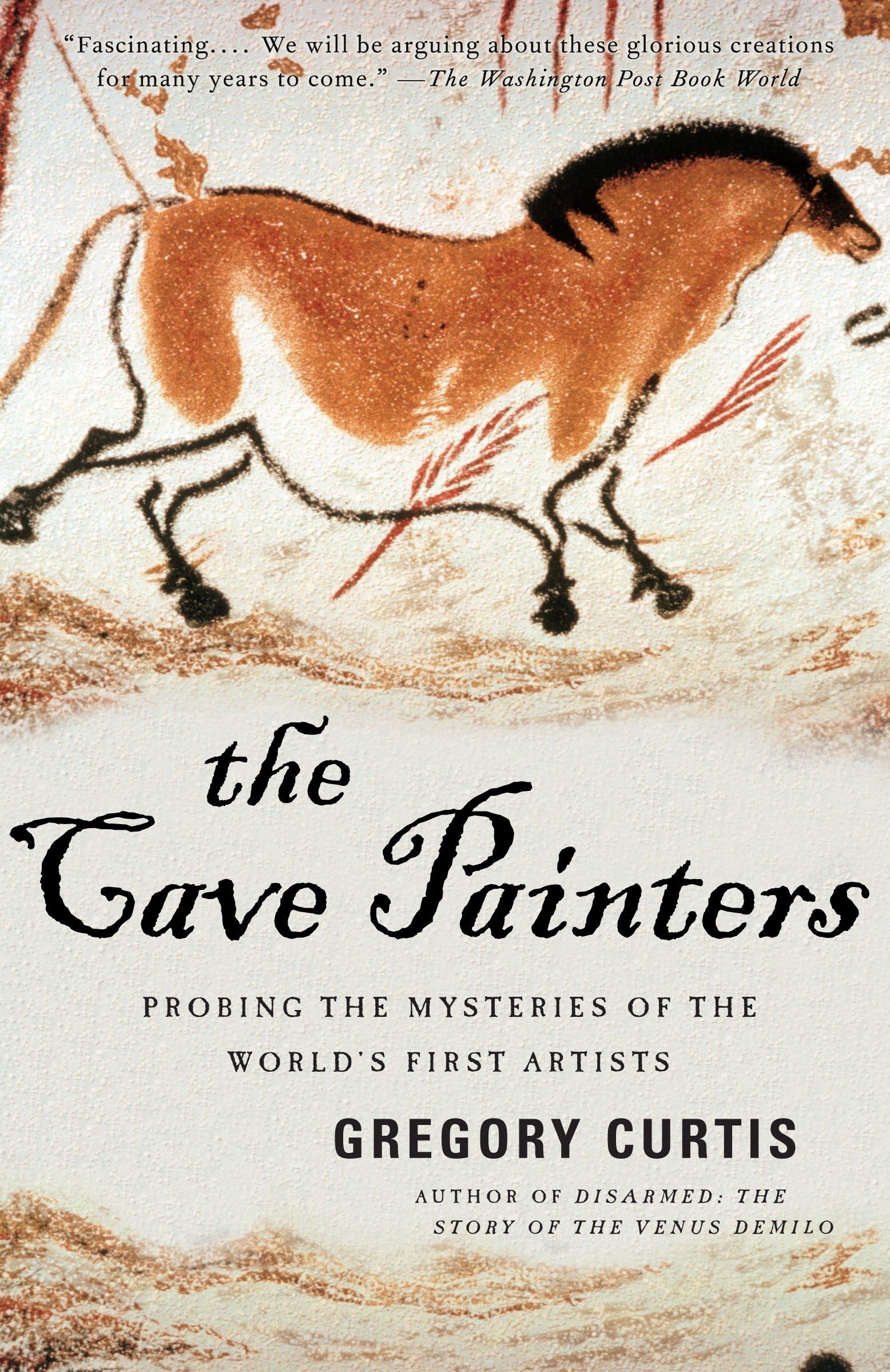
The Cave Painters: Probing the Mysteries of the World's First Artists
$15.80
by Gregory Curtis



The Cave Painters is a vivid introduction to the spectacular cave paintings of France and Spain—the individuals who rediscovered them, theories about their origins, their splendor and mystery. Gregory Curtis makes us see the astonishing sophistication and power of the paintings and tells us what is known about their creators, the Cro-Magnon people of some 40,000 years ago. He takes us through various theories—that the art was part of fertility or hunting rituals, or used for religious purposes, or was clan mythology—examining the ways interpretations have changed over time. Rich in detail, personalities, and history, The Cave Painters is above all permeated with awe for those distant humans who developed—perhaps for the first time—both the ability for abstract thought and a profound and beautiful way to express it. "Fascinating. . . . We will be arguing about these glorious creations for many years to come." — The Washington Post Book World "The beauty of the cave art moves Curtis deeply, and his writing preserves that passionate response." — Seattle Times “Curtis is a good storyteller, and he has good stories to tell about eccentrics of all sorts.” — The Christian Science Monitor “A fascinating survey of the rival theories. . . . [Readers will be] swept up in the beauty of the cave paintings and the persuasive pull of his prose.” — Richmond Times-Dispatch Gregory Curtis is the author of Disarmed: The Story of the Venus de Milo . He was the editor of Texas Monthly from 1981 until 2000. His writing has appeared in The New York Times, The New York Times Magazine, Fortune, Time , and RollingStone , among other publications. A graduate of Rice University and San Francisco State College, he lives with his wife in Austin, Texas. Introduction The Naked Cave Man This book began in 1986 when my daughter Vivian saw a statue she called “a naked cave man.” For several days we had been riding on horseback across the Dordogne, the lovely area of river valleys, rolling hills, and thick forests in south-central France. It was late spring, just before the arrival of the swarms of rowers, hikers, and campers that descend on the region each summer. I did not know at the time that in eons past this appealing landscape had also attracted groups of the earliest humans. Their ancient campsites, usually found under the rock overhangs in the limestone cliffs that line the rivers, have kept archaeologists happily busy since they were first discovered more than 150 years ago. As the archaeologists dig deeper, they find layer upon layer of occupation, the date of each layer receding further into the past. Occasionally, in the upper levels, which can be 15,000 to 20,000 years old, these digs turn up tiny beads patiently crafted from ivory, an engraving of an animal on a rock, or some reindeer’s teeth with a hole drilled at the root that were once part of a necklace. The people who made these delicate objects were the same ones who ventured into the caverns in the hillsides, sometimes crawling through narrow passages for hundreds of yards, to create the paintings, engravings, and bas-relief sculptures that still touch the soul of everyone who sees them. During our trip Vivian and I stopped at Les Eyzies-de-Tyac, a village on the banks of the Vézère River. We turned out our horses in a small pasture conveniently across the road from our hotel and went to visit Font-de-Gaume, then as now the only cave with polychrome paintings that is still open to the public. After a surprisingly steep climb, we arrived at the entrance—a narrow, upright gash in the rock near the top of a cliff. Three or four other tourists were waiting when Vivian and I arrived. In a few moments the guide to the cave arrived and unlocked the metal door that covered the entrance. We walked in single file down a tall, narrow passageway that proceeded roughly in a straight line despite a few slight twists and turns. A narrow metal grille placed in sections along the way protected the cave floor. There were rather dim lights hidden in the walls on both sides. The guide turned them on in a given section as we arrived there and then turned them off as we passed through. After about seventy yards, the guide stopped. Using a red laser as a pointer, she began talking about the first painting. I was tremendously excited. The little I knew about prehistoric painted caves came from photographs in books and magazines. Now, some of the real paintings were right in front of me in all their glory. There were round, fat bison drawn in gentle curving lines. They had deep, expressive eyes and tiny legs drawn in perfect perspective. Mammoths with long, curved tusks stood placidly among the bison. Horses outlined in black, now partially obscured by natural excretions, galloped across the cave wall. Most impressive of all were two large reindeer facing each other. The one on the right, a female, was on her knees. The male on the left, whose antlers formed a magnificent l