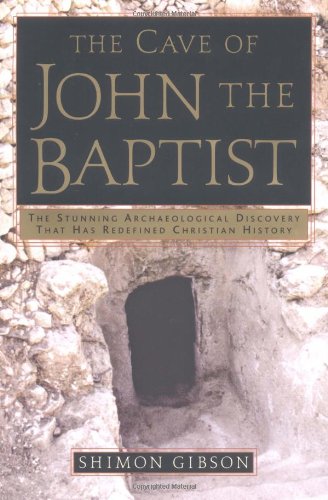
The Cave of John the Baptist: The Stunning Archaeological Discovery that has Redefined Christian History
$29.00
by Shimon Gibson



The first archaeological evidence of the historical reality of the Gospel story. From a historical point of view, the uniqueness of this cave is that it contains archaeological evidence that comes to us from the very time of the personalities and events described in the Gospels. For here is the largest ritual bathing pool ever found in the Jerusalem area, and found in the village where John the Baptist was born, showing unmistakable signs of ritual use in the first century AD. Also in the cave is the earliest ever Christian art, depicting John the Baptist as well as the three crosses of the crucifixion. By using the forensic techniques available to the modern archaeologist, Gibson and his international team have been able to draw information from the drawings, pottery, coins, bones, remains of ritual fire and pieces of cloth found in the cave and match these up with the contemporary literary sources. This is a unique opportunity to build up a picture of the very first Christians, how they lived and even what they believed. As Gibson writes: “By fitting together the new archaeological facts with the historical information available (and sometimes buried) in scholarly literature, I believe I am able to throw an amazing amount of light on the personality and mission of John the Baptist. Who was he? Where did he come from? What were his beliefs and what was the baptism all about?” The subtitle may overstate the case, but this work certainly adds an intriguing piece to the puzzle of biblical archaeology. Gibson, an archaeologist working in Israel, discovered a cave in 1999 that held an image on one of its walls depicting a large figure of a man with a staff or a spear. Further investigation led Gibson to conclude that the subject of the image was John the Baptist and that the cave was used for ritual baptism. Beginning with a you-are-there re-creation of the cave's discovery, he then puts into place the building blocks--such archaeological evidence as coins, pottery, and baptismal elements--that help prove his case. Although the book is quite detailed, it never exceeds the grasp of general readers, who will appreciate the background Gibson supplies on the life of John the Baptist, his relationship to Jesus, and the cult (some would say a cult competitive to Christianity) that grew up around John. Other "stunning" finds in biblical archaeology--the ossuary box thought to hold the remains of Jesus' brother, James, for example--have not held up in the long run. This one, though, seems to be the real deal. Expect plenty of media attention. Ilene Cooper Copyright © American Library Association. All rights reserved The first archaeological evidence of the historical reality of the Gospel story. From a historical point of view, the uniqueness of this cave is that it contains archaeological evidence that comes to us from the very time of the personalities and events described in the Gospels. For here is the largest ritual bathing pool ever found in the Jerusalem area, and found in the village where John the Baptist was born, showing unmistakable signs of ritual use in the first century AD. Also in the cave is the earliest ever Christian art, depicting John the Baptist as well as the three crosses of the crucifixion. By using the forensic techniques available to the modern archaeologist, Gibson and his international team have been able to draw information from the drawings, pottery, coins, bones, remains of ritual fire and pieces of cloth found in the cave and match these up with the contemporary literary sources. This is a unique opportunity to build up a picture of the very first Christians, how they lived and even what they believed. As Gibson writes: “By fitting together the new archaeological facts with the historical information available (and sometimes buried) in scholarly literature, I believe I am able to throw an amazing amount of light on the personality and mission of John the Baptist. Who was he? Where did he come from? What were his beliefs and what was the baptism all about?” Dr. Shimon Gibson is a field archaeologist working in Israel and Palestine. He is currently in charge of excavations on Mount Zion.