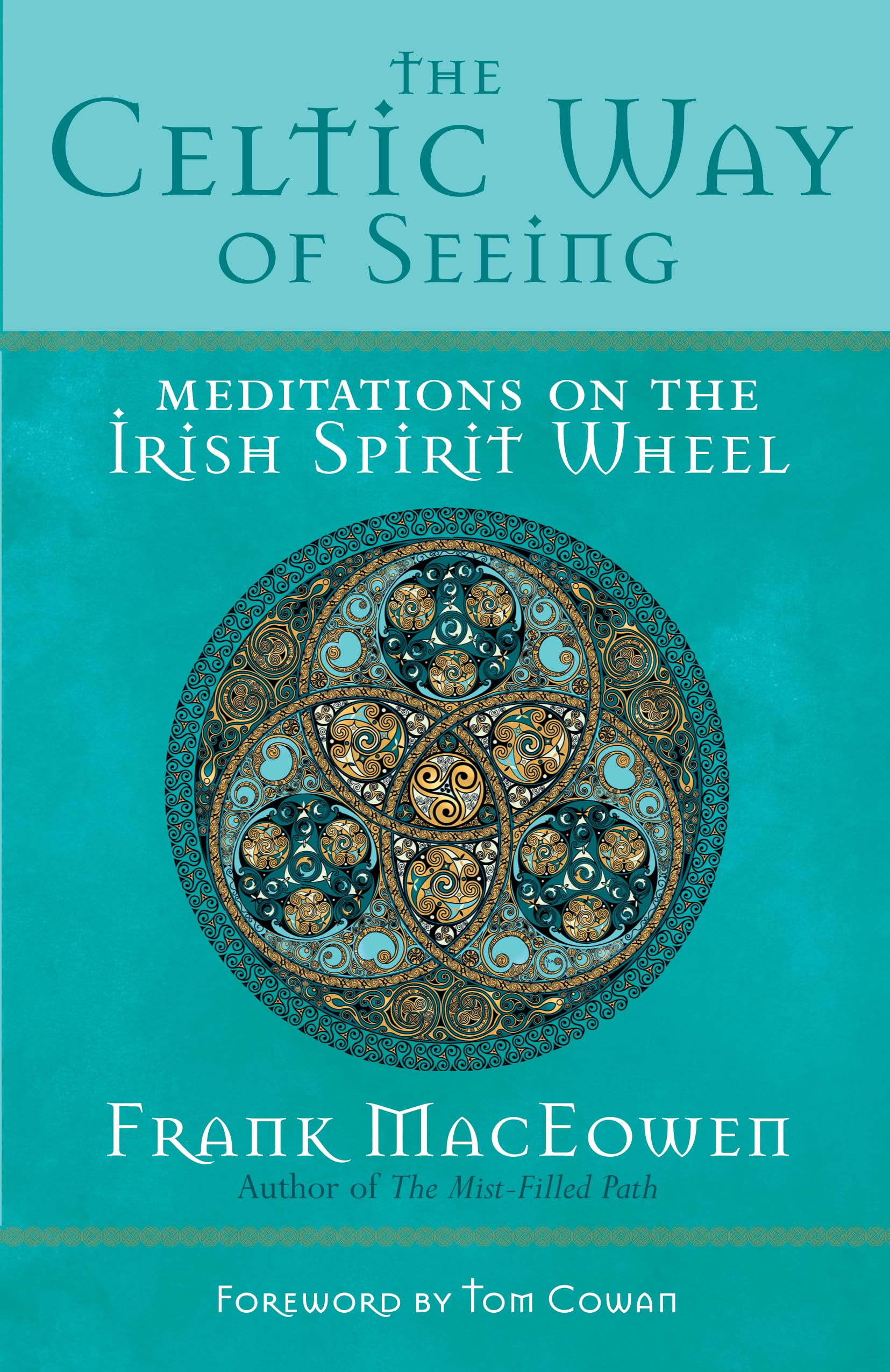
The Celtic Way of Seeing: Meditations on the Irish Spirit Wheel
$14.95
by M.A. Frank MacEowen



The Celtic way of seeing posits a direct link between the eye and the heart, a link that connects seekers to forces, energies, and knowledge that exist beyond the corporeal world. Here, Frank MacEowen explains this intuitive way of seeing by retelling a traditional Irish story, "The Settling of the Manor of Tara." The story is essential because it introduced to Irish culture the concept of the four directions — north, south, east, and west. For the Irish, just as for Native Americans, the directions act as guides and protectors. Once seekers learn to “see” the directions, spirituality becomes a living thing, making each seeker not just an observer but a participant. After retelling the ancient story in beautiful, prose evocative of ancient Ireland, MacEowen then places its wisdom in contemporary terms, and shares exercises and practices that help readers incorporate the teachings into daily life. "Frank MacEowen teaches us to see in the Irish way: within and beyond and through. He is a great and generous guide to the mysteries. His words open doors to the past and windows to the future." -- Patricia Monaghan , author of The Red-Haired Girl from the Bog: The Landscape of Irish Myth and Spirit " The Celtic Way of Seeing combines a modern psychological awareness with the language of a poet and the vision of a shaman. As a result, the book is both highly practical and inspiring." -- Philip Carr-Gomm , author of The Druid Way "Frank MacEowen has created a book of both profound and practical truth. As a student of seasons and directions myself, I'm struck by the Celtic twist on circle teachings and energies. Much good to ponder here, and to apply to daily life as well. And, as always, Frank brings a bit of Irish soil in his words, and some fine mist in his phrasing. Beautiful." -- Susan Chernak McElroy , author of Why Buffalo Dance and Animals as Teachers and Healers " The Celtic Way of Seeing inspires and equips all of us, regardless of our personal heritage, to perceive the world around us with wiser and more compassionate eyes. By breathing new, visionary life into the ancient myths and rituals of the Celts, Frank MacEowen helps us map a better future for ourselves and for humankind." -- Jack Maguire , author of Essential Buddhism , Waking Up: A Week in a Zen Monastery , and The Power of Personal Storytelling " The Celtic Way of Seeing is an important contribution to the reclaiming of indigenous wisdom for modern life. Frank MacEowen's deep insights into what he calls the Irish Spirit Wheel places it alongside the medicine wheels, mandalas, and sand paintings of other Earth-honoring cultures. I heartily recommend this book for everyone wanting to deepen their connections to the vast horizon of Celtic spirituality." -- Tom Cowan , author of Yearning for the Wind Frank MacEowen , MA, is the author of three books on Celtic spirituality: The Mist Filled Path , The Spiral of Memory and Belonging , and The Celtic Way of Seeing: Meditations on the Irish Spirit Wheel . After years of facilitating group retreats and overseas travel journeys exploring Celtic spirituality and ecopsychology, Frank turned inward and spent a decade studying East Asian hermit poetry and solitary contemplative Nature spirituality with a wisewoman in New Mexico. He continues to explore and integrate these many themes, East and West, in his work as a poet, publishing poetry under the name Frank LaRue Owen / Hawk of the Pines. The Celtic Way of Seeing Meditations on the Irish Spirit Wheel By Frank MacEowen New World Library Copyright © 2007 Frank MacEowen All rights reserved. ISBN: 978-1-57731-541-4 Contents Foreword by Tom Cowan, Introduction, Part 1. The Celtic Way of Seeing: Orienting to the Spirit of the Wheel, Chapter 1. Mythic Memory and Remembering the Future, Chapter 2. The Knowledge Is in the Directions: An Abbreviated Telling of "The Settling of the Manor of Tara", Chapter 3. Sacred Directions, Life Directions, Part 2. The Irish Spirit Wheel: Reflections And Meditation, Chapter 4. Center, Chapter 5. East, Chapter 6. South, Chapter 7. West, Chapter 8. North, Conclusion: Back to Center, Acknowledgments, Notes, Index, About the Author, CHAPTER 1 MYTHIC MEMORY AND REMEMBERING THE FUTURE * * * The mythic present is continually reshaping events, whereas history alone merely chronicles the tides of time. History deprived of its mythic context becomes petrified into sound bites of the timeline; but when myth inspirits history, we hear the voices of the past with our own ears, see the images with our own eyes. — CAITLI'N MATTHEWS The Celtic traditions are deeply rooted in the power of myth and memory. Indeed, for many Celts — homeland, postdiaspora, urban, and rural alike — myth and memory are inextricably intertwined. This truth does not have to translate into blind or naive literalism for those who practice the traditions deeply. It does mean, however