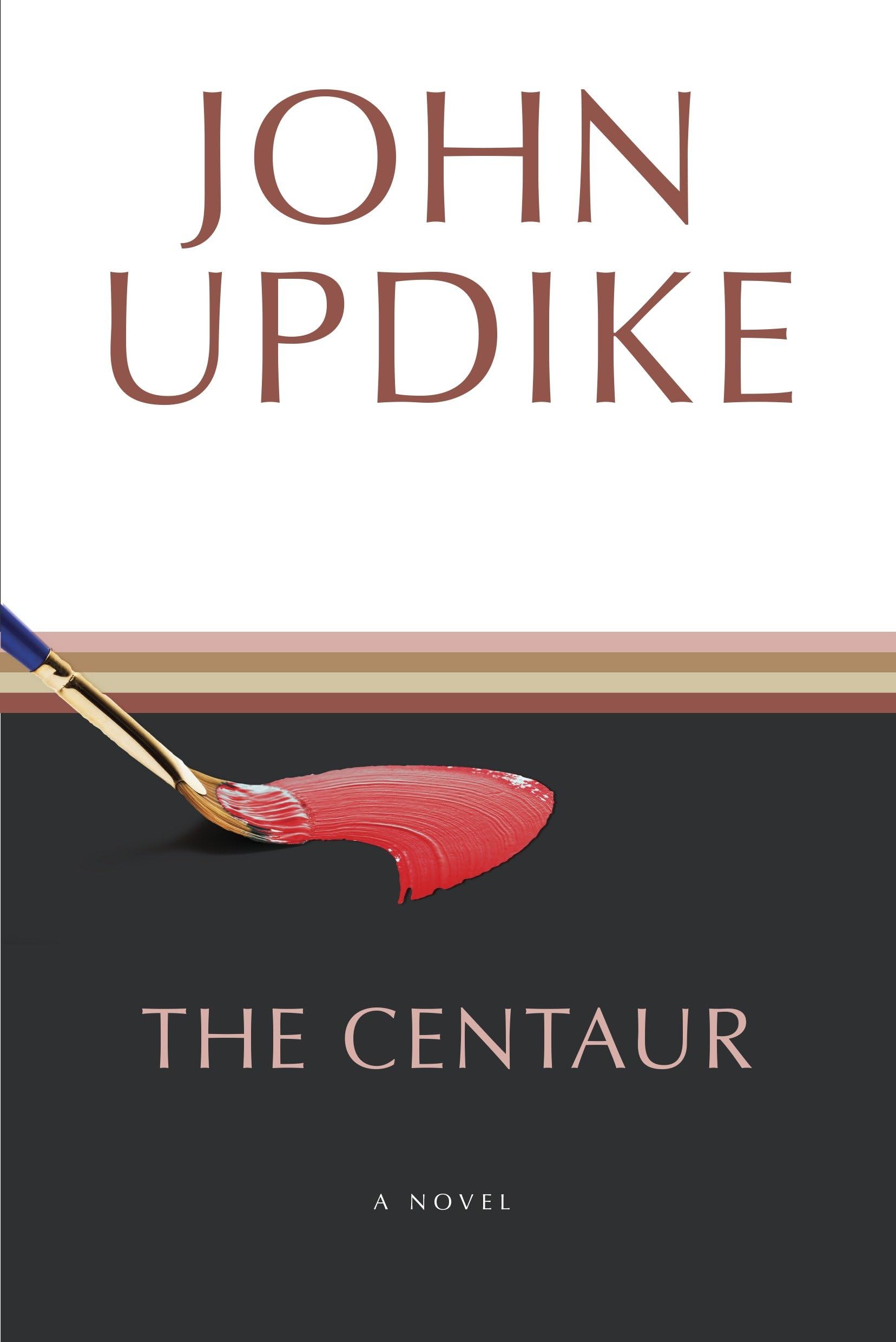



WINNER OF THE NATIONAL BOOK AWARD AND THE PRIX DU MEILLEUR LIVRE ÉTRANGER The Centaur is a modern retelling of the legend of Chiron, the noblest and wisest of the centaurs, who, painfully wounded yet unable to die, gave up his immortality on behalf of Prometheus. In the retelling, Olympus becomes small-town Olinger High School; Chiron is George Caldwell, a science teacher there; and Prometheus is Caldwell’s fifteen-year-old son, Peter. Brilliantly conflating the author’s remembered past with tales from Greek mythology, John Updike translates Chiron’s agonized search for relief into the incidents and accidents of three winter days spent in rural Pennsylvania in 1947. The result, said the judges of the National Book Award, is “a courageous and brilliant account of a conflict in gifts between an inarticulate American father and his highly articulate son.” “A triumph of love and art.”— The Washington Post “A brilliant achievement . . . No one should need to be told that Updike has a mastery of language matched in our time only by the finest poets.”— Saturday Review “Unsurpassed . . . Natural, pertinent, fresh, subtle, and superbly written.”— Newsweek In a small Pennsylvania town in the late 1940s, schoolteacher George Caldwell yearns to find some meaning in his life. Alone with his teenage son for three days in a blizzard, Caldwell sees his son grow and change as he himself begins to lost touch with his life. Interwoven with the myth of Chiron, the noblest centaur, and his own relationship to Prometheus, The Centaur one of John Updike's most brilliant and unusual novels. In a small Pennsylvania town in the late 1940s, schoolteacher George Caldwell yearns to find some meaning in his life. Alone with his teenage son for three days in a blizzard, Caldwell sees his son grow and change as he himself begins to lost touch with his life. Interwoven with the myth of Chiron, the noblest centaur, and his own relationship to Prometheus, The Centaur one of John Updike's most brilliant and unusual novels. John Updike was born in Shillington, Pennsylvania, in 1932. He graduated from Harvard College in 1954 and spent a year in Oxford, England, at the Ruskin School of Drawing and Fine Art. From 1955 to 1957 he was a member of the staff of The New Yorker . His novels have won the Pulitzer Prize, the National Book Award, the National Book Critics Circle Award, the Rosenthal Foundation Award, and the William Dean Howells Medal. In 2007 he received the Gold Medal for Fiction from the American Academy of Arts and Letters. John Updike died in January 2009. Chapter I Caldwell turned and as he turned his ankle received an arrow. The class burst into laughter. The pain scaled the slender core of his shin, whirled in the complexities of his knee, and, swollen broader, more thunderous, mounted into his bowels. His eyes were forced upward to the blackboard, where he had chalked the number 5,000,000,000, the probable age in years of the universe. The laughter of the class, graduating from the first shrill bark of surprise into a deliberately aimed hooting, seemed to crowd against him, to crush the privacy that he so much desired, a privacy in which he could be alone with his pain, gauging its strength, estimating its duration, inspecting its anatomy. The pain extended a feeler into his head and unfolded its wet wings along the walls of his thorax, so that he felt, in his sudden scarlet blindness, to be himself a large bird waking from sleep. The blackboard, milky slate smeared with the traces of last night’s washing, clung to his consciousness like a membrane. The pain seemed to be displacing with its own hairy segments his heart and lungs; as its grip swelled in his throat he felt he was holding his brain like a morsel on a platter high out of a hungry reach. Several of the boys in their bright shirts all colors of the rainbow had risen upright at their desks, leering and baying at their teacher, cocking their muddy shoes on the folding seats. The confusion became unbearable. Caldwell limped to the door and shut it behind him on the furious festal noise. Out in the hall, the feather end of the arrow scraped on the floor with every step. The metallic scratch and stiff rustle mixed disagreeably. His stomach began to sway with nausea. The dim, long walls of the ochre hall wavered; the classroom doors, inset with square numbered panes of frosted glass, seemed experimental panels immersed in an activated liquid charged with children’s voices chanting French, singing anthems, discussing problems of Social Science. Avez-vous une maison jolie? Oui, j’ai une maison très jolie for amber waves of grain, for purple mountain majesties above the fruited plain throughout our history boys and girls (this was the voice of Pholos), the federal government has grown in prestige, power, and authority but we must not forget, boys and girls, that by origin we are a union of sovereign republics, the United God shed his grace on thee, and