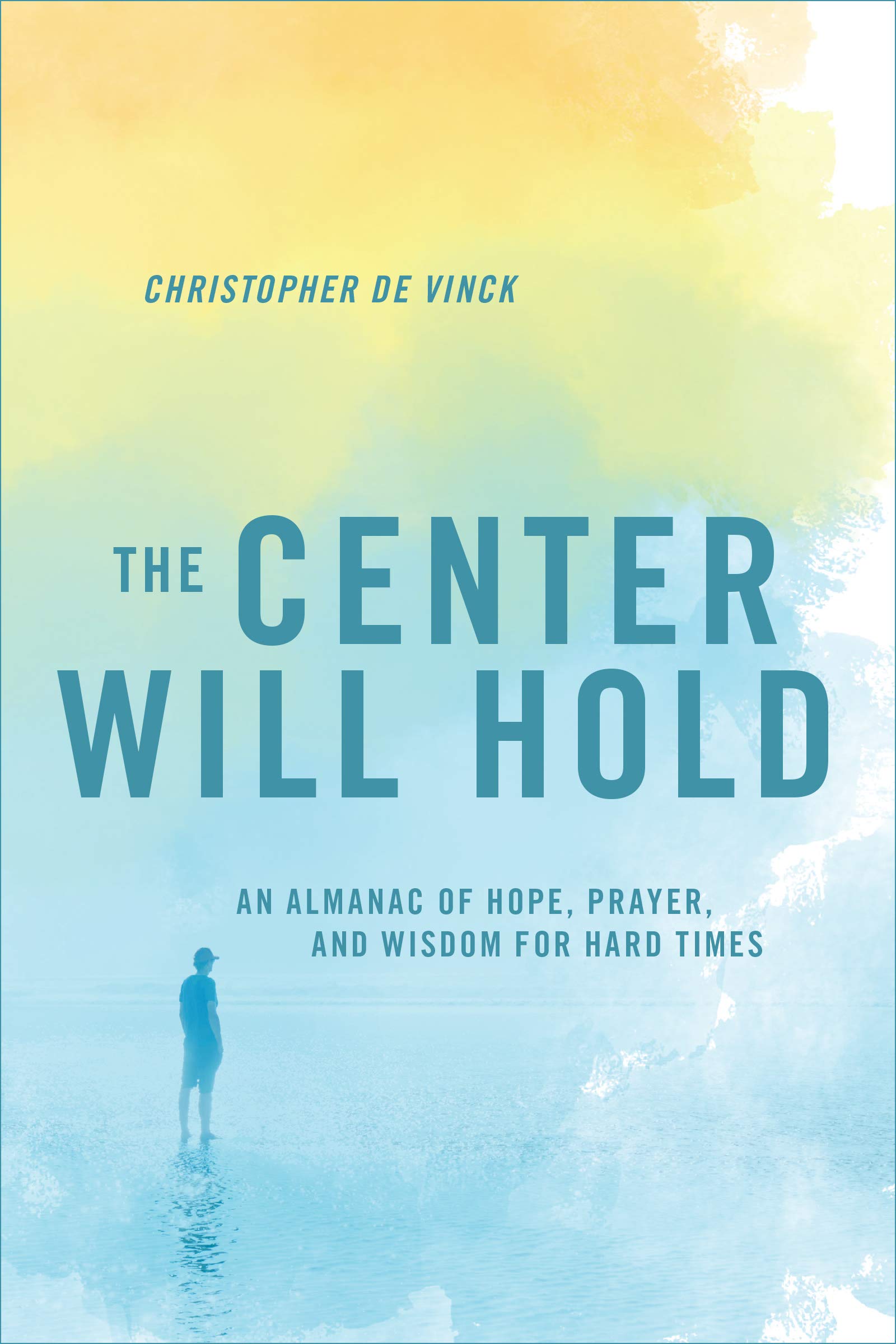
The Center Will Hold: An Almanac of Hope, Prayer, and Wisdom for Hard Times
$16.95
by Christopher De Vinck



2021 Illumination Book Awards, Gold Medal: Christian Living INTERPRETING THE PARABLES OF OUR LIVES By the time most of us reach adulthood, we have experienced enough to begin to understand our own personal narratives. It’s tempting to focus on discouragement or pessimism, even cynicism. But there’s a brighter, better way. In this collection of heartwarming true stories, Christopher de Vinck reminds us of life’s many graces, and he challenges us to embrace our experiences with hope, humor, gratitude, and wonder. Whether revisiting a boyhood hobby of photographing the neighborhood raccoon or musing upon the possible uses of a decades-old Santa suit, de Vinck takes his readers to scenes, sights, and sensations of the daily, ordinary gifts that are not so ordinary after all. Read The Center Will Hold to stir your own poignant memories, or share it with family and friends as an invitation to simple joy. Its pages speak with eloquence, in language common to us all: wisdom, light, and love. CHRISTOPHER DE VINCK —a husband, father, grandfather, novelist, essayist, and poet—earned a doctorate degree from Columbia University, was a public school teacher and administrator for 40 years, and writes every day in the former sunporch, now lined with books and converted into a small room that enjoys a southern exposure. Essay 1: Simplicity For our boast is this, the testimony of our conscience, that we behaved in the world with simplicity and godly sincerity, not by earthly wisdom but by the grace of God, and supremely so toward you. —2 Corinthians 1:12, ESV In February 1948, my mother and father arrived in New York from Belgium on the Queen Elizabeth. They quickly settled into an apartment in New Jersey, and on his first day of work, my father returned home filled with enthusiasm and said to my mother, “I saw a blue bird! A blue bird!” My mother, finding this to be incredulous, listened with eagerness as my father described the color of the bird’s wings and the blue cap of its head. Neither my mother nor my father had ever seen a blue bird before. A few days later, my mother tells me, she too saw the blue bird, and was as amazed as my father. It turned out, of course, that the exotic bird they saw for the first time was the ordinary blue jay. The same thing happened when they saw a red bird. A red bird! They had never seen a cardinal before. If you see an elephant every day, it is just an elephant. If you see an elephant for the first time, it is a giant cartoon with a tail at both ends and ears like pancakes. Aesop wrote that familiarity breeds contempt. Mark Twain wrote that familiarity breeds children. For most of us, familiarity breeds complacency. We do not look at a tree with awe unless we see the giant redwoods for the first time. But an oak tree in the backyard that is eight stories high with a trunk as wide as a washing machine is just a tree that sheds acorns and leaves in the fall. Who looks at an oak tree? But it is a plant right out of a magician’s bag! Maple trees, pine trees—can you imagine seeing a tree for the first time? You would believe that we are still living in the age of the dinosaurs. Do you remember the opening scene in the iconic movie Jurassic Park, when the paleontologist sees, for the first time, the brontosaurus? The man is so stunned that he falls to the ground, the very same reaction my son David had when he was a little boy and saw for the first time the gigantic whale hanging from the ceiling in the New York Museum of Natural History. Sei Shonagon served as lady-in-waiting to the Empress Sadako in Japan a thousand years ago. Little else is known about this woman, except for her pillow book. A pillow book was a collection of notes that captured the day’s events or the thoughts of the writer. Today we call that a diary. What makes Sei Shonagon’s pillow book distinctive is her vision, her wisdom, and her humor—and the fact that this collection of notes was written in the eleventh century. What stands out is her appreciation for ordinary, simple things: “Sparrows feeding their young. To pass a place where babies are playing.” Shonagon admired nature and ordinary objects: “Dried hollyhock. Last year’s paper fan. A night with a clear moon.” She was easily revolted by what she called squalid things: “The back of a piece of embroidery. The inside of a cat’s ear.” Remember, she wrote these things a thousand years ago. She loved “white, purple, and black clouds, and rain clouds when they are driven by the wind.” And she celebrated that “in spring it is the dawn that is most beautiful.” I was startled as I watched each of my children being born. I was startled when I touched a rock from the moon at the Smithsonian Institute in Washington, D.C. I was startled when I helped carry my father’s coffin to the open grave in Vermont. The wood of the box brushed against my thigh. When my cousin came to America for the first time, she called out with glee in the