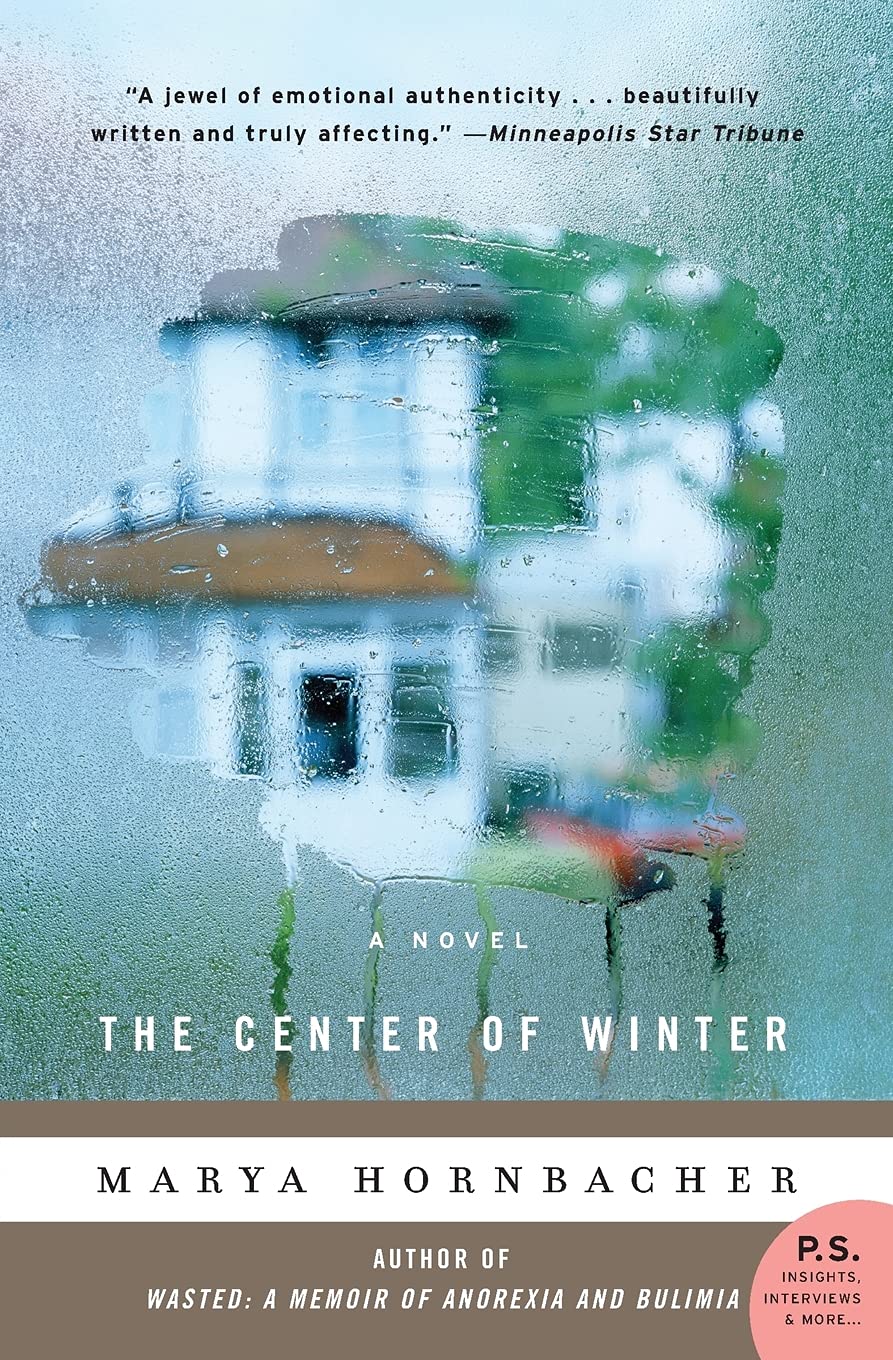
The Center of Winter: A Luminous First Novel - A Family's Moving Passage from Despair to Hope and Solace
$13.59
by Marya Hornbacher



The luminous first novel by Marya Hornbacher, the acclaimed author of Wasted: A Memoir of Anorexia and Bulimia , is a moving and passionate story of a death from despair -- and a stricken family's passage through grief toward the hope, solace, and understanding that waits for them somewhere beyond the center of winter. “Poignant.” - Kirkus Reviews “Genuine, engaging, and unforgettable...With this stunning debut novel, Hornbacher...proves herself to be a master storyteller.” - Booklist (starred review) “Intimate... [Hornbacher’s] description of Claire Shiller’s long, slow return to physical desire is delicious in its restraint and directness.” - New York Times Book Review “Here’s an author who knows suffering and recovery . . . If there’s heartbreak here, there’s also hope--and both ring true.” - People “A truly stunning debut... Chips away at the darkness to reveal the ever-evolving possibilities of the human spirit.” - Minneapolis Star Tribune “Told alternately by Claire, Kate and Esau... Hornbacher finds the perfect pitch for their voices and their stories.” - Baltimore Sun “Hornbacher succeeds marvelously...[She] constructs a kaleidoscope of speakers at times beautiful and often disturbing...[An] adroit first novel.” - Los Angeles Book Review “Powerful.” - Seattle Post-Intelligencer “Hornbacher’s debut novel is one of triumph and survival...A gripping tale of a family that copes despite the odds.” - Library Journal “Uplifting, even humorous. . . . A captivating first novel.” - Philadelphia Inquirer The luminous first novel by Marya Hornbacher, the acclaimed author of Wasted: A Memoir of Anorexia and Bulimia , is a moving and passionate story of a death from despair -- and a stricken family's passage through grief toward the hope, solace, and understanding that waits for them somewhere beyond the center of winter. Marya Hornbacher is an award-winning journalist and bestselling writer. Her books include the memoirs Wasted: A Memoir of Anorexia and Bulimia , which has been published in twelve languages, and the New York Times bestseller Madness: A Bipolar Life ; the recovery books Sane: Mental Illness, Addiction, and the Twelve Steps , and Waiting: A Nonbeliever's Higher Power ; and the novel The Center of Winter . She teaches in the graduate creative writing program at Northwestern University and lives in Chicago. The Center of Winter A Novel By Marya Hornbacher HarperCollins Publishers, Inc. Copyright © 2005 Marya Hornbacher All right reserved. ISBN: 0060929685 Chapter OneKate It begins with a small town, far north. Motley, Minnesota, Pop. 442. Near the headwaters of the muddy Mississippi, past the blue glass of the cities and the stained red brick of the warehouse districts, past the long-abandoned train stations and the Grain Belt sign and the Pillsbury Flour building on the riverbanks, past the smokestacks and hulking wrecks of the industrial section, the town lies past all this, in the center of the prairie that creeps north and west of the river, into the Dakotas. Seen from above, this prairie, its yellow grasses, is dotted sparsely with towns too small for mapmakers' concern. Just south of Staples, on the county road that runs through the center of town, passing the school at the south edge, Norby's Department Store, Morey's Fish Co., the market with the scarred front porch, the old brick storefronts with small wooden signs on hinges, the painted names of businesses faded and flaked. Morrison's Meats, the Cardinal Cafe. By the time you've noticed that you're passing through, County Road 10 swerves sharply to the left, past Y-Knot Liquors, and all semblance of town disappears, leaving you to wonder if there was a town after all. All you see are acres and acres of field. On the corner of Madison Street is a pale eggshell-blue house with three steps leading up from the walk and a postage stamp of yard in the back where my mother, when the spirit moved her, gardened feverishly and then let the garden go sprawling untended in the tropical wet of July. My father would sit on the back porch watching her, sitting the way men here sit: leaned back, feet planted far apart, arms on the arms of the chair, a beer in his right hand. The beer would be sweating. They met in New York, at a club. They met and got married at city hall, and when I had my mother alone, I demanded she tell me again about the dress she made from curtains, and the red shoes, and the garnet necklace she got for a song. They had a party with cheap wine back at the apartment. I picture it all in rich colors. I remember the club for them, with red walls and small, spattered candles on the tables. Whether it had these things or not is of no concern to me, because it's my story, not theirs. The garnet necklace is mine now. I keep thinking I ought to get the clasp repaired. "What were you wearing?" My mother was soaping my head. "Sweetheart, I don't remember. Dunk," she said. I dunked and spl