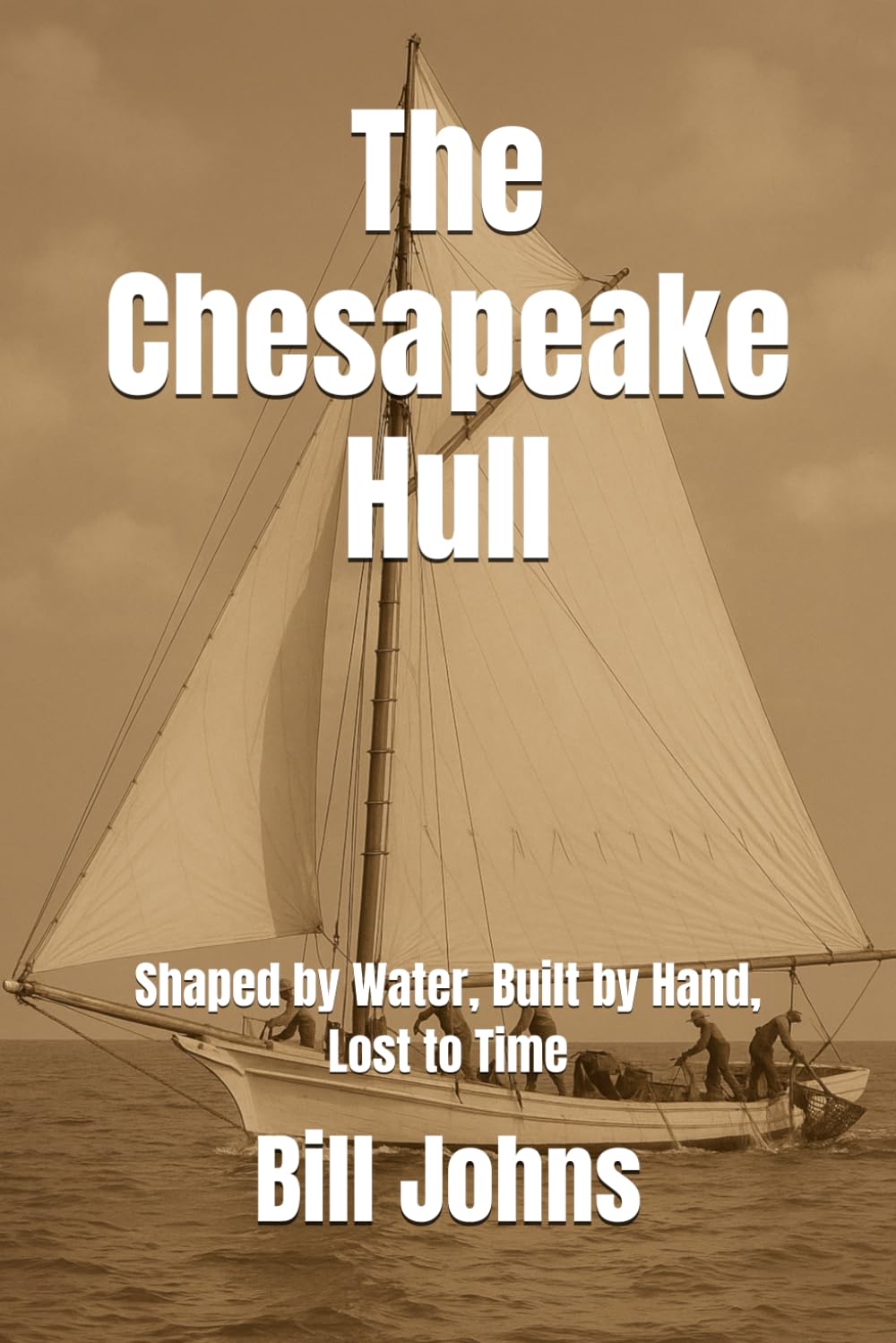
The Chesapeake Hull: Shaped by Water, Built by Hand, Lost to Time (Chesapeake Unwritten)
$19.99
by Bill Johns



The Chesapeake Bay’s workboats were not mass-produced. They were sculpted—drawn by hand, bent by steam, and shaped by water itself. The Chesapeake Hull: Shaped by Water, Built by Hand, Lost to Time is a cultural and environmental history of the boats that once filled the Bay’s creeks and harbors: skipjacks, bugeyes, deadrises, draketails, and dugouts. Combining maritime craftsmanship with the force of natural constraint, these vessels were uniquely adapted to their place. Today, their forms linger only in photographs, museum replicas, and the muscle memory of a vanishing few. This book documents not just the boats, but the people who built them—and the quiet disappearance of both. Drawing from over four centuries of Chesapeake history, this study follows the evolution of hulls from Indigenous dugouts to fiberglass tourist charters. The narrative begins with the environmental demands of the Bay itself: shallow drafts required to navigate oyster bars and shifting channels; flared bows to handle sudden squalls; low freeboards for hand-tonging oysters or setting crab trotlines. Each curve, plank, and fastening served a purpose dictated by tide and task. The Bay’s geography didn’t permit ornamental forms. It demanded functional beauty. From there, the book turns inland, into workshops without blueprints. Chesapeake boats were rarely drawn on paper. Builders chalked lines on shop walls or carved half-models from cedar blocks, their craft taught not by instruction manuals but by watching, doing, and repeating. Apprentices learned by eye and by hand, guided by fathers, uncles, and neighbors. Boatbuilding knowledge was embodied, not archived—a logic of gesture and intuition passed through generations until, quietly, it has nearly disappeared. The Chesapeake hull was never immune to outside forces. Wartime contracts in both World Wars militarized local boatyards, pulling craftsmen from oyster boats to patrol craft. Legal restrictions—not tradition—led to the rise of sail-powered skipjacks and the peculiar seven-log bugeye, both responses to dredging laws that banned powerboats. When internal combustion arrived, it rewrote the hull yet again, as the deadrise workboat rose to dominance. Hull forms shifted not from innovation but from the unrelenting pressures of law, labor, and resource. By the mid-twentieth century, many of these workboats had become ruins. Vessels cracked in the mold, warped in the sun, or burned before completion. Builders shifted from boatyards to carpentry, translating hull-making skills into house framing and pier construction. Others closed their shops entirely as fiberglass hulls rendered wood obsolete. What had once been lived craft became museum exhibit, weekend hobby, or race-day ritual. Chapters trace this aestheticization of labor vessels through log canoe racing and the rise of charter cruises, revealing how functional craft became nostalgic ornament. At its core, The Chesapeake Hull asks what remains when a tradition unrecorded disappears. Drawing lessons from boatbuilding schools and preservation attempts, it questions what can be saved when knowledge was never codified but instead lived, spoken, and felt. The Chesapeake hull is a memory more than a design—a hydrologic adaptation shaped by work and erased by time. Richly researched and written in evocative, clear prose, The Chesapeake Hull: Shaped by Water, Built by Hand, Lost to Time is not just a maritime history. It is a meditation on labor, loss, and the beauty that floats. For readers who care about heritage, about the fragile line between memory and forgetting, this book offers both elegy and record. Step inside the shop, trace the chalked line, and remember a world where boats were born not from plans, but from the water itself.