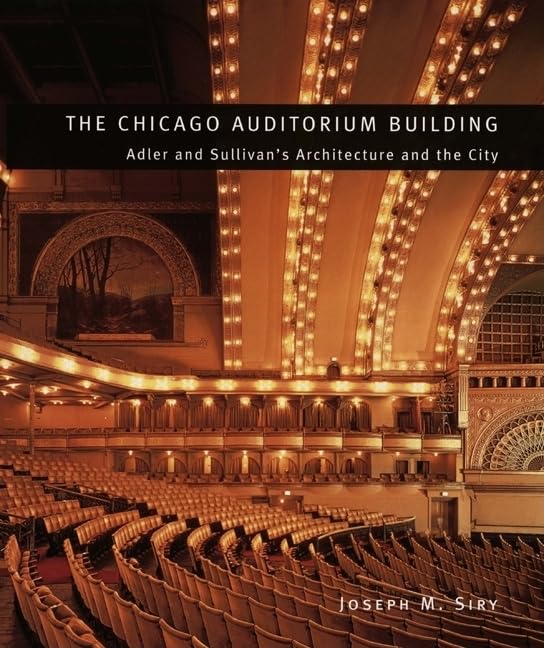
The Chicago Auditorium Building: Adler and Sullivan's Architecture and the City (Chicago Architecture and Urbanism)
$53.19
by Joseph M. Siry



Winner of the Alice Davis Hitchcock Award from the Society of Architectural Historians When the magnificent Auditorium Building opened on Chicago's Michigan Avenue in December 1889, it marked Chicago's emergence both as the leading city of the Midwest and as a metropolis of international stature. In this lavishly illustrated book, Joseph M. Siry explores not just the architectural history of the Auditorium Building but also the crucial role it played in Chicago's social history. Covering the Auditorium from the early design stage to its opening, its later renovations, its links to culture and politics in Chicago, and its influence on later Adler and Sullivan works (including the Schiller Building and the Chicago Stock Exchange Building), this volume recounts the fascinating tale of a building that helped to define a city and an era. "Where the book really shines . . . is Siry's reconstruction of the social and historical context that gave rise to and helped guide the development of the Auditorium Building. This makes the text a true find for architectural historians and worthwhile reading for a much broader audience. . . . The result is a book with a scope and detail to match both the magnificence of the building and the depth of thought that went into its conception, design, and construction." When the magnificent Auditorium Building opened on Chicago's Michigan Avenue in December 1889, American and European newspapers hailed the event as a defining moment for the city, the most important since the Great Fire of 1871. The Auditorium marked Chicago's emergence both as the leading city of the Midwest and as a metropolis of international stature. In this lavishly illustrated book, Joseph M. Siry explores not just the architectural history of the Auditorium Building, but also the crucial role it played in Chicago's social history. Housing a luxurious 400-room hotel, 136 offices and stores, and a theater that could seat 4,200, the Auditorium Building was one of the earliest multipurpose civic centers in the United States, and its many technical and aesthetic innovations launched Dankmar Adler and Louis Sullivan's national reputation as creators of highly innovative architecture for large public buildings. (Frank Lloyd Wright was employed by Adler and Sullivan at the time, serving as Sullivan's draftsman.) But the Auditorium;s importance was not limited to architecture. Envisioned by its principal patron, Ferdinand W. Peck, as a means to counter the violent socialist agitation of the Haymarket era, the Auditorium Theater embodied Peck's capitalist ideal of a democratic variation on the European opera house that could provide affordable, high-class entertainment for the city's skilled workers. Covering the Auditorium from the early design to its opening, its later renovations, its links to culture and politics in Chicago, and its influence on later Adler and Sullivan works (including the Schiller Building and the Chicago Stock Exchange Building), The Chicago Auditorium Building recounts the fascinating tale of a building that helped to define a city and an era. When the magnificent Auditorium Building opened on Chicago's Michigan Avenue in December 1889, American and European newspapers hailed the event as a defining moment for the city, the most important since the Great Fire of 1871. The Auditorium marked Chicago's emergence both as the leading city of the Midwest and as a metropolis of international stature. In this lavishly illustrated book, Joseph M. Siry explores not just the architectural history of the Auditorium Building, but also the crucial role it played in Chicago's social history. Housing a luxurious 400-room hotel, 136 offices and stores, and a theater that could seat 4,200, the Auditorium Building was one of the earliest multipurpose civic centers in the United States, and its many technical and aesthetic innovations launched Dankmar Adler and Louis Sullivan's national reputation as creators of highly innovative architecture for large public buildings. (Frank Lloyd Wright was employed by Adler and Sullivan at the time, serving as Sullivan's draftsman.) But the Auditorium;s importance was not limited to architecture. Envisioned by its principal patron, Ferdinand W. Peck, as a means to counter the violent socialist agitation of the Haymarket era, the Auditorium Theater embodied Peck's capitalist ideal of a democratic variation on the European opera house that could provide affordable, high-class entertainment for the city's skilled workers. Covering the Auditorium from the early design to its opening, its later renovations, its links to culture and politics in Chicago, and its influence on later Adler and Sullivan works (including the Schiller Building and the Chicago Stock Exchange Building), The Chicago Auditorium Building recounts the fascinating tale of a building that helped to define a city and an era. Joseph M. Siry is a professor of art history and American studies at Wesley