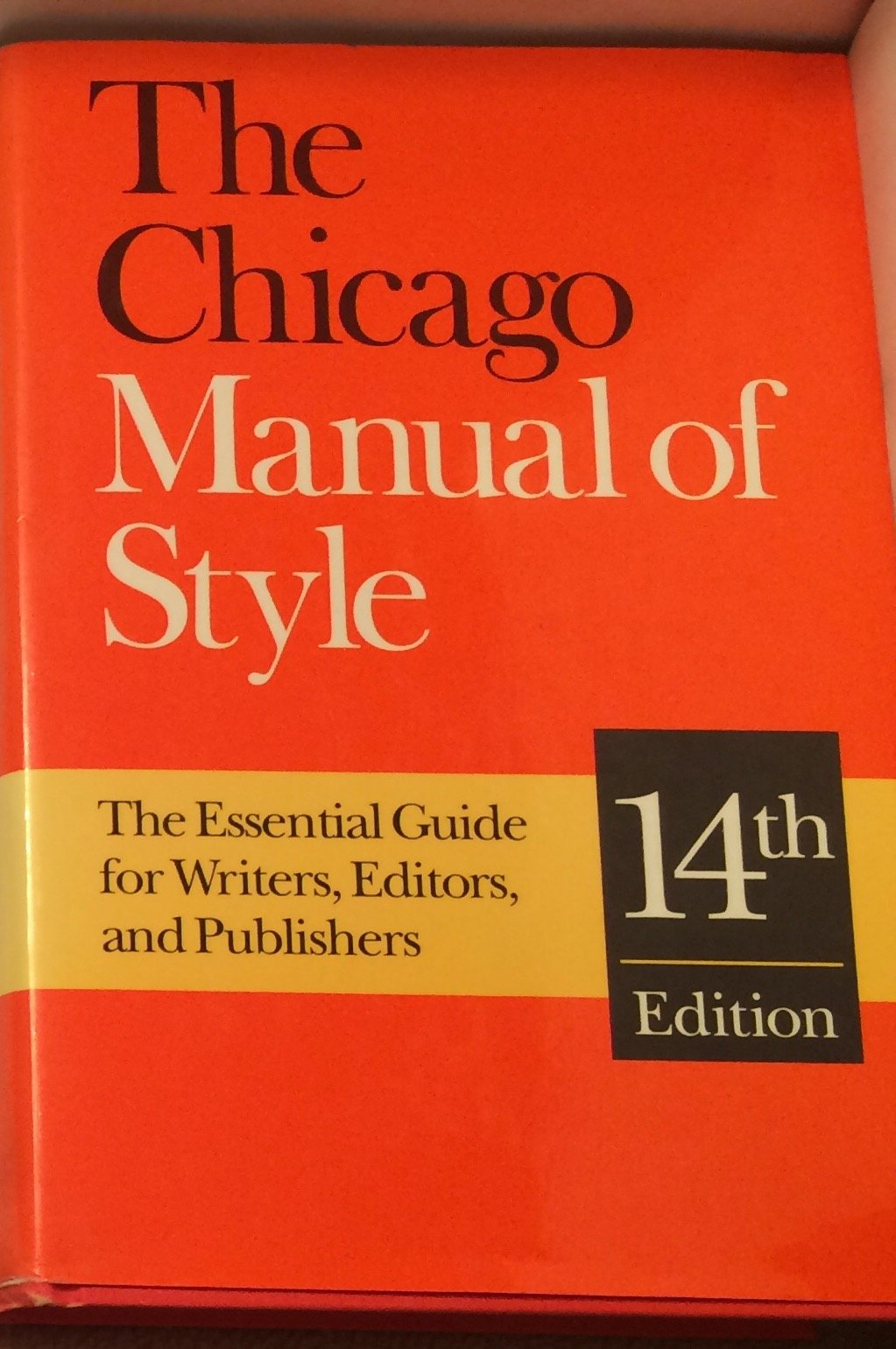
The Chicago Manual of Style: The Essential Guide for Writers, Editors, and Publishers (14th Edition)
$9.32
by Chicago Editorial Staff



The 14th edition of The Chicago Manual of Style has now been superseded by the 15th edition. See below for a link to the new edition. The ISBN of the new 15th edition is 0-226-10403-6. What can we say? This weighty tome is the essential reference for all who work with words--writers, editors, proofreaders, indexers, copywriters, designers, publishers, and students. Discover who Ibid is, how to deftly avoid the split infinitive, and how to format your manuscripts to impress any professor or editor (no, putting it in a blue plastic folder is just not enough). The Chicago Manual of Style has long had a well-deserved reputation as the most important guide for preparing and editing book manuscripts for publication. However, is this 14th edition different enough from the 13th ( LJ 11/1/82) to justify its purchase? The "thoroughly revised" and up-to-date chapter on edition: e.g., Cindex and MACREX replace KWIC as examples of automated indexing tools. The glossary of technical terms has dropped some terms but has also added many more: e.g., ASCII , comb binding , and notch binding. In addition, the editors can be justifiably proud of the significantly revised and improved section on documentation. The organization and examples here are better and the layout makes skimming easier. Significant changes are easy to find: the 13th edition permitted replacing authors' initials with their full names, while the 14th suggests that the exact opposite is sometimes preferred. Ultimately, the 14th edition is different enough from (and some 200 pages longer than) the 13th that it should be acquired by all libraries not suffering serious budgetary shortages. - Peter Dollard, Alma Coll. Lib., Mich. Copyright 1993 Reed Business Information, Inc. This revision of the classic handbook for editors reflects changes in the publishing world since the last edition in 1982. For example, publishers are instructed on including bar codes and a paper-durability statement on their books. The three chapters on documentation have been rearranged into two and now tell how to cite such sources as online databases and Internet. The chapter on copyright has been rewritten to take note of the 1989 changes in the law and offers a fuller interpretation of "fair use." The use of computer technology for manuscript preparation, to create indexes, and for composition, design, printing, and binding is discussed throughout. The quotations chapter has been expanded to treat such forms as interior monologue and stream of consciousness. Many sections have been revised to reflect contemporary usage. The manual now notes that the term black is often capitalized and that African American is also gaining acceptance. (It is unfortunate that the word Kaffir is still given in the list of examples of "specific racial, linguistic, tribal, religious, and other groupings.") The use of split infinitives is no longer listed as an error because "the Press now regards the intelligent and discriminating use of the construction as a legitimate form of expression." The chapter on foreign languages has a new section on Hebrew. Each chapter and section of the manual continues to be identified by a unique number. The book has been so thoroughly revised that, in the majority of cases, sections carried over from the past edition have a different number. The book is almost 200 pages longer than the last edition. Anyone who prepares copy for publication will need to consult this new edition of The Chicago Manual of Style . Sandy Whiteley The definitive writing reference work, revered by scholars, universities, publishers, and editors. -- The Bloomsbury Review