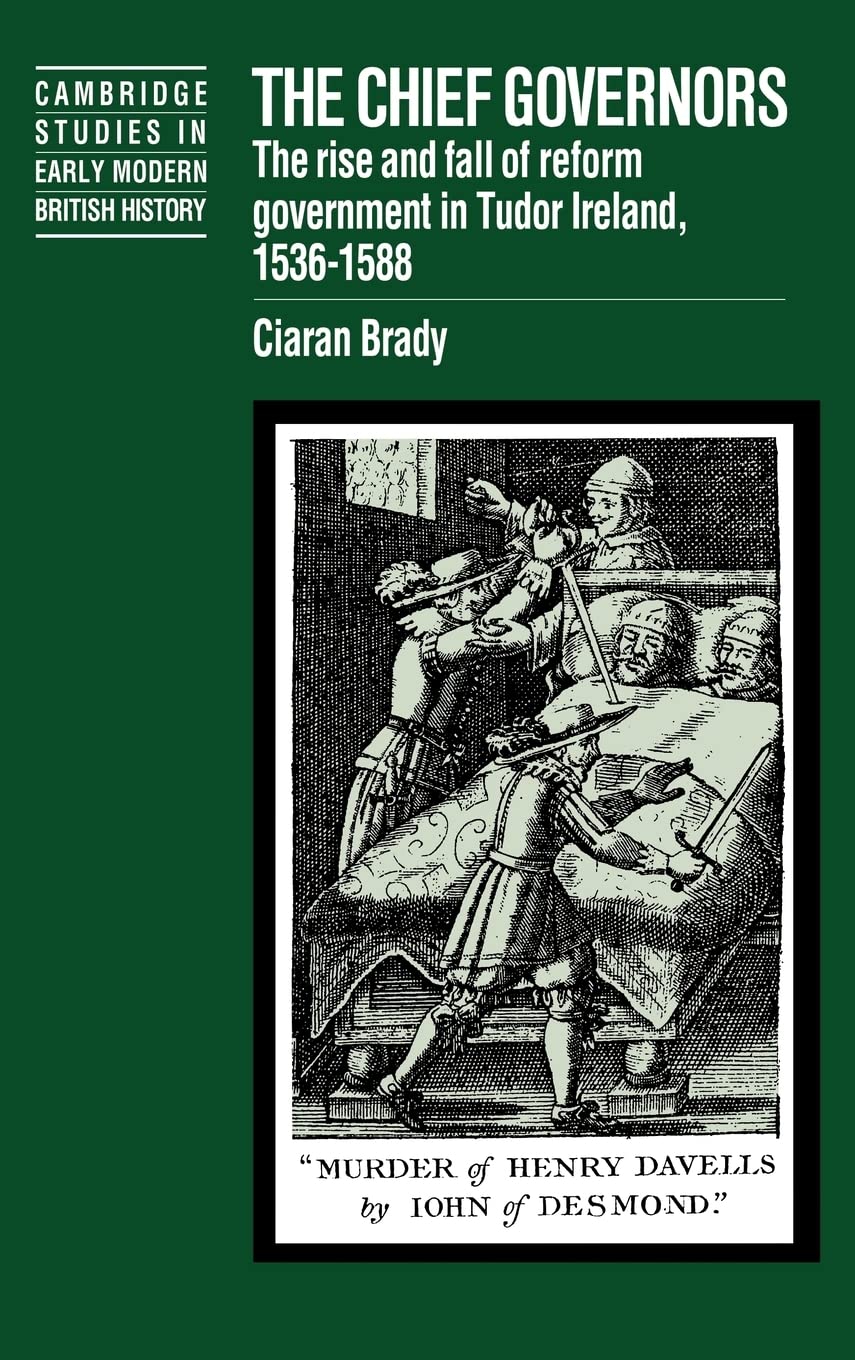
The Chief Governors: The Rise and Fall of Reform Government in Tudor Ireland 1536–1588 (Cambridge Studies in Early Modern British History)
$152.10
by Ciaran Brady



This book offers a fundamental critique of conventional views of sixteenth-century Irish history that have stressed the centrality of colonization and military confrontation. It argues that reform rather than conquest was the aim of Tudor policy-makers, but shows that the immense difficulties faced by the reformers in pursuing their objectives forced them to make administrative innovations that ultimately contradicted and undermined their original policy. "...this book is exceedingly well-documented, clearly written, and purposefully executed...it must be read as an important restatement of the `pattern' of governance in mid-Tudor Ireland." American Historical Review "His conclusions and ideas are sound and well-supported by primary documentation and exhaustive references....This book is a provocative and challenging work that unquestionably fulfills the intention of the Cambridge Historical Series." Irish Literary Supplement "...its finely crafted arguments are an important contribution to the study of multi-national kingdoms in the early modern period and of the British Isles in particular." The Historian "...our perception of Ireland's history during the second half of the sixteenth century will have to be revised." Canadian Journal of History "This scholarly study will be useful to advanced students of Irish history..." Choice "...the argument is bold and iconoclastic indeed....Brady masterfully weaves together the complex and volatile political interaction between the colonial governors and the Old English magnates of Ireland....an excellent study on an underexplored area of early modern history....will certainly force early modern Irish historians to rethink some of the most basic questions of the Tudor period. Without question, The Chief Governors is one of the most important studies of early modern Ireland to appear in recent years, and it is highly recommended not only for specialists in the field, but also for anyone interested in gaining some interesting perspectives on the nature of political reform and the implementation of colonial rule during the early modern period." Samantha A. Meigs, Sixteenth Century Journal "Chief Governors marks a definite advance in the long-running debate on the nature of Tudor government in Ireland." Padraig Lenihan,Law and History Review A revisionist account of Irish history under the Tudors. This book offers an extended reinterpretation of English policy in Ireland over the sixteenth century. It seeks to show that the major conflicts between Tudor governors and native lords which characterised the period were not the result of a deliberate Tudor strategy of confrontation as conventional interpretations have assumed, but argues that they arose from a failed experiment in legal reform and cultural assimilation which had been applied with remarkable success elsewhere in the Tudor dominions. The book seeks to explain the course of this exceptional failure, and it identifies a distinct administrative style which evolved in Irish government during the middle of the century under a complex set of pressures acting on the would-be reformers both in Ireland and at the Tudor court. It argues that it was this distinctive, highly centralised and intensely activist mode of government that inadvertently undermined the aims of reform policy and provoked the alienation and hostility that was precisely the opposite result to that which was originally intended. Used Book in Good Condition