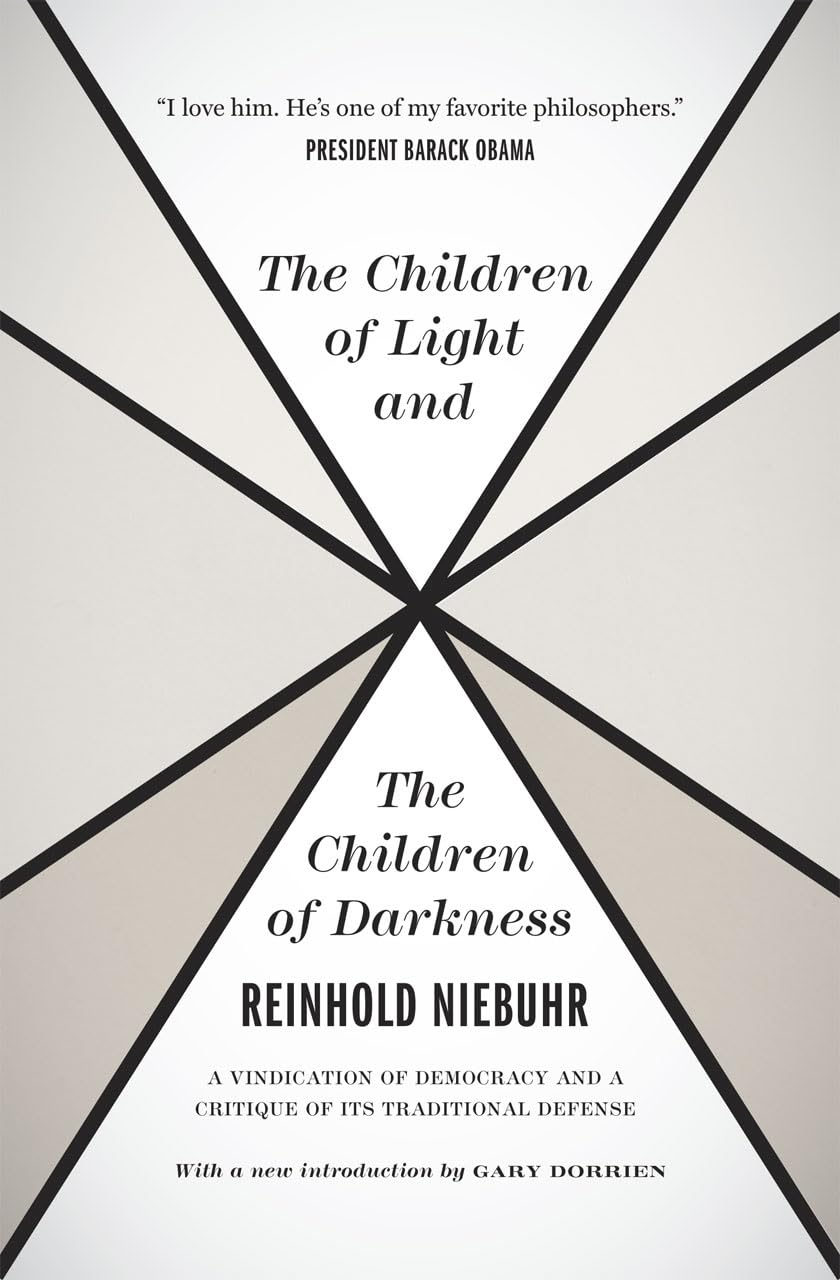
The Children of Light and the Children of Darkness: A Vindication of Democracy and a Critique of Its Traditional Defense
$20.97
by Reinhold Niebuhr



The Children of Light and the Children of Darkness , first published in 1944, is considered one of the most profound and relevant works by the influential theologian Reinhold Niebuhr, and certainly the fullest statement of his political philosophy. Written and first read during the prolonged, tragic world war between totalitarian and democratic forces, Niebuhr’s book took up the timely question of how democracy as a political system could best be defended. Most proponents of democracy, Niebuhr claimed, were “children of light,” who had optimistic but naïve ideas about how society could be rid of evil and governed by enlightened reason. They needed, he believed, to absorb some of the wisdom and strength of the “children of darkness,” whose ruthless cynicism and corrupt, anti-democratic politics should otherwise be repudiated. He argued for a prudent, liberal understanding of human society that took the measure of every group’s self-interest and was chastened by a realistic understanding of the limits of power. It is in the foreword to this book that he wrote, “Man’s capacity for justice makes democracy possible; but man’s inclination to injustice makes democracy necessary.” This edition includes a new introduction by the theologian and Niebuhr scholar Gary Dorrien in which he elucidates the work’s significance and places it firmly into the arc of Niebuhr’s career. “Dr. Niebuhr is in our time one of the ablest spokesmen among theologians. And he brings to his chosen task rare gifts and wide-ranging interests.” ― New Republic “[A] clear and impressive statement of [Niebuhr’s] views on fundamental political and social problems.”— Spectator ― Spectator “He cast an intellectual spell on my generation. . . . Niebuhr made us think anew about the nature and destiny of man.”—Arthur Schlesinger Jr., New York Times ― New York Times “[A] brilliant and creative vindication of democracy . . . a theology of Western culture which remains intellectually unsurpassed.” -- Larry Rasmussen in Reinhold Niebuhr: Theologian of Public Life “I love him. He’s one of my favorite philosophers.”—President Barack Obama -- President Barack Obama “His most lasting political book.” -- Jordan Smith ― Slate Reinhold Niebuhr (1892–1971)taught from 1928 until 1962 at Union Theological Seminary, in New York City. The recipient of the Presidential Medal of Freedom in 1964, he wrote many books, including Moral Man and Immoral Society , The Interpretation of Christian Ethics, The Nature and Destiny of Man , and The Irony of American History (the latter also recently republished by the University of Chicago Press). The Children of Light and the Children of Darkness A Vindication of Democracy and a Critique of Its Traditional Defense By Reinhold Niebuhr The University of Chicago Press Copyright © 2011 Gary Dorrien All rights reserved. ISBN: 978-0-226-58400-3 Contents Introduction by Gary Dorrien, Foreword to the 1960 Edition, Foreword to the First Edition, I. The Children of Light and the Children of Darkness, II. The Individual and the Community, III. The Community and Property, IV. Democratic Toleration and the Groups of the Community, V. The World Community, CHAPTER 1 THE CHILDREN OF LIGHT AND THE CHILDREN OF DARKNESS I Democracy, as every other historic ideal and institution, contains both ephemeral and more permanently valid elements. Democracy is on the one hand the characteristic fruit of a bourgeois civilization; on the other hand it is a perennially valuable form of social organization in which freedom and order are made to support, and not to contradict, each other. Democracy is a "bourgeois ideology" in so far as it expresses the typical viewpoints of the middle classes who have risen to power in European civilization in the past three or four centuries. Most of the democratic ideals, as we know them, were weapons of the commercial classes who engaged in stubborn, and ultimately victorious, conflict with the ecclesiastical and aristocratic rulers of the feudal-medieval world. The ideal of equality, unknown in the democratic life of the Greek city states and derived partly from Christian and partly from Stoic sources, gave the bourgeois classes a sense of self-respect in overcoming the aristocratic pretension and condescension of the feudal overlords of medieval society. The middle classes defeated the combination of economic and political power of mercantilism by stressing economic liberty; and, through the principles of political liberty, they added the political power of suffrage to their growing economic power. The implicit assumptions, as well as the explicit ideals, of democratic civilization were also largely the fruit of middle-class existence. The social and historical optimism of democratic life, for instance, represents the typical illusion of an advancing class which mistook its own progress for the progress of the world. Since bourgeois civilizat