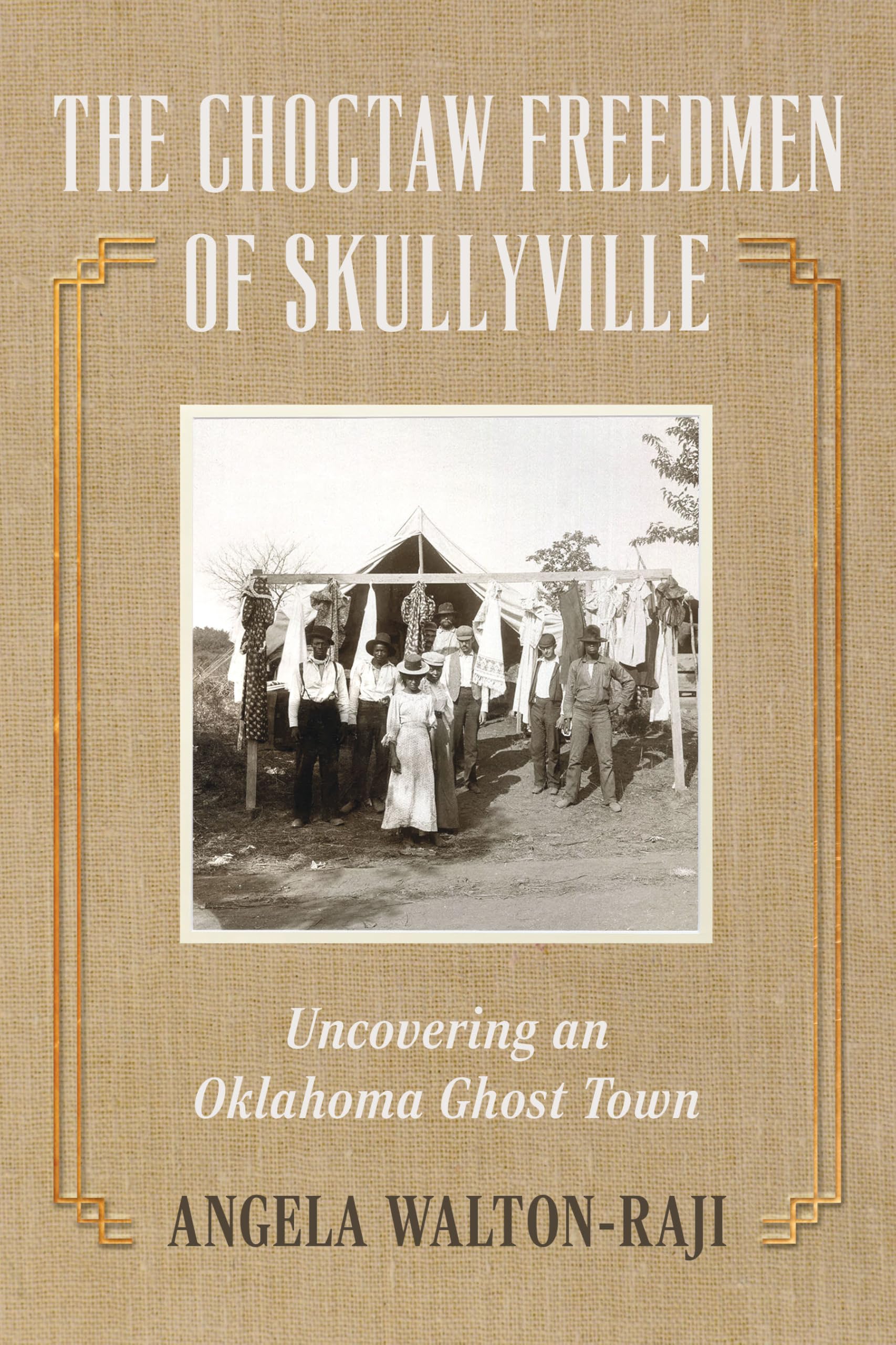
The Choctaw Freedmen of Skullyville: Uncovering an Oklahoma Ghost Town (Lost)
$24.99
by Angela Y. Walton-Raji



From settlement to sediment Unlike the freedman communities in Spiro, Ft. Coffee and Poteau, the town of Skullyville faded into a forgotten ghost town. Dr. G. E. Hartshorne’s 1950 “Skullyville and Its People in 1889” chronicled the inhabitants’ lifestyle and culture. Yet he excluded many that arrived in the 1830s, having survived the long and arduous journey of the Trail of Tears. Enslaved people of African descent, arriving alongside their Choctaw masters, were seldom mentioned in contemporaneous accounts. They labored for decades without pay, or the comforts of freedom. Their tribal oppressors joined the Confederates, vowing to maintain their slaveholding lifestyle. Conversely, some from Skullyville resisted by joining the Union Army. Many lived to see freedom, and established livelihoods after abolition. In April of 1866, Choctaw leaders joined the Chickasaw at Fort Smith to sign a peace treaty that abolished slavery and promised citizenship and suffrage to those once enslaved by their nations. Freedman descendent Angela Walton-Raji resurrects the lost voices of Skullyville and champions a legacy that outlasted the town itself. Angela Walton-Raji is known nationally for her genealogical and historical research and work. In 1991, she located family records reflecting the family’s presence in the Choctaw Nation as Freedmen of that Oklahoma based nation. She discovered a plethora of records reflecting thousands of Indian tribal Freedmen from Eastern Oklahoma. After years of work in higher education, that discovery put on her a trajectory that launched a second career as a specialist in Black and Indian records from the Five Nations of Oklahoma. Her book “Black Indian Genealogy Research”, published in 1993, was the very first book devoted to researching the Freedmen communities of the Five Tribes. Previously, no genealogical publication had ever addressed this large collection of Freedmen records. In 1999, she was selected to be one of eight researchers who shared their history in a special project of the National Endowment of the Humanities, called “My History is America’s History” which was later feature in a November 1999 issue of the weekly Parade Magazine. Her work has placed in her the genealogy community as a unique specialist in the more than 20,000 people classified as Indian Freedmen in the Cherokee, Choctaw, Chickasaw, Creek and Seminole Nations. Ms. Walton-Raji’s research talents were recognized by the Smithsonian Institution in Washington DC, for over a decade. In the 1990s, she was a featured speaker at a number of events sponsored by the Smithsonian Institution. She was the only genealogist in the nation at that time to present regular genealogy lectures at the National Museum of the American Indian, in both the Washington DC and New York facilities. Her work gained her the Milton Stern Lifetime Achievement Award from the National Genealogical Society. Most recently, she served as a historical advisor to the feature film, “Sarah’s Oil”. In addition to her research and writings on Oklahoma Freedmen history, Ms. Walton-Raji has served as an activist for Freedmen over the years, attending special hearings on Capitol Hill in both House of Representatives and the Senate offices in Washington DC. At present, she hosts weekly online meetings for Freedmen descendants and is the host of “The Freedmen Files” a weekly podcast devoted to the history of more than 20,000 people known as Freedmen from the Five Tribes of Oklahoma. Today, her specialties are Oklahoma Native-American records, Arkansas Black history, and Civil war history on the western frontier. She resides in Maryland, where she continues to research and write.