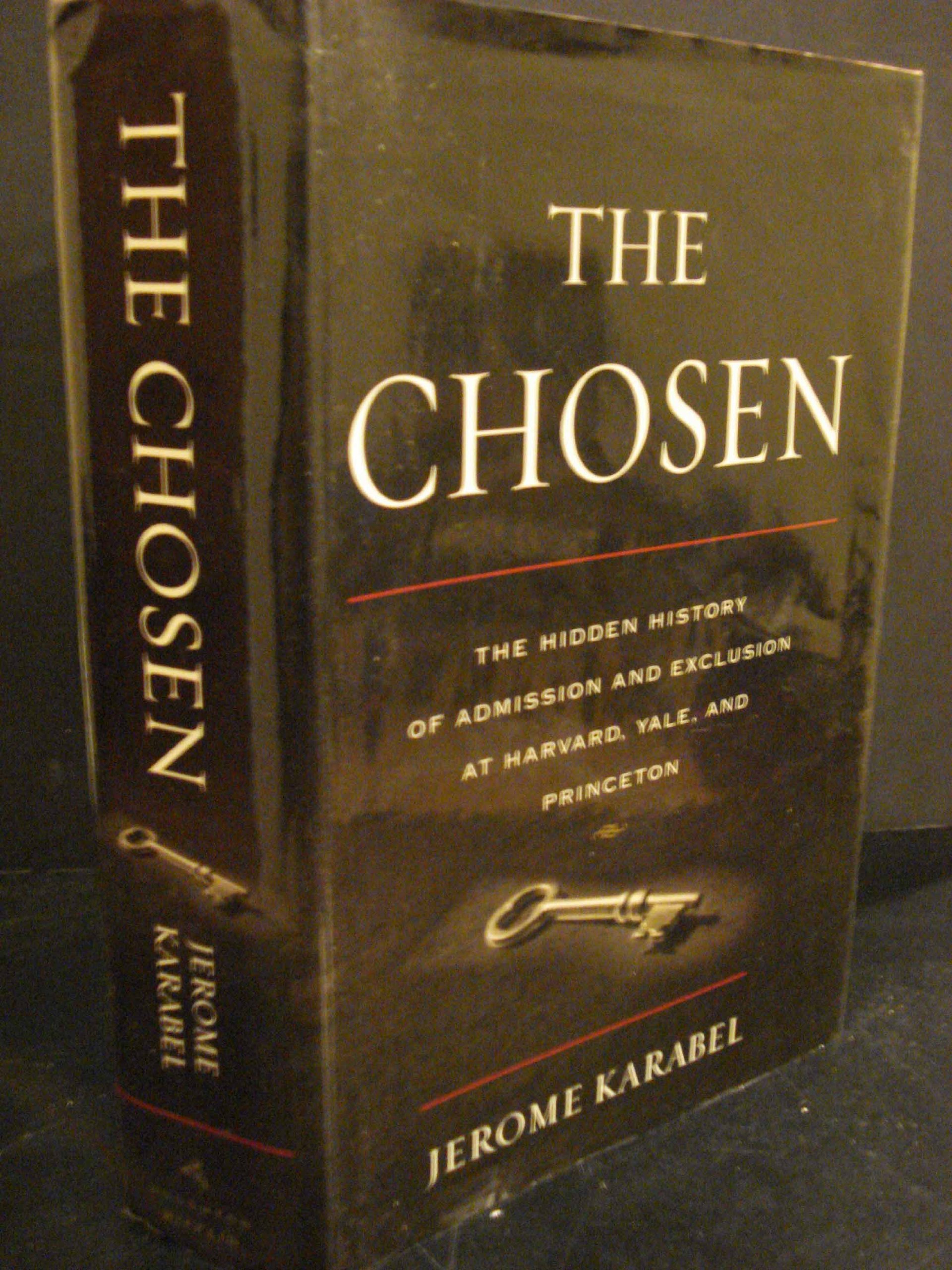
The Chosen: The Hidden History of Admission and Exclusion at Harvard, Yale, and Princeton
$22.14
by Jerome Karabel



A professor of sociology at the University of California presents the findings of his survey of admissions at Princeton, revealing a century of exclusion that cuts to the core of the American experience, while raising important questions about the stratification of higher education in America. 30,000 first printing. When gifted high-school students apply to the nation's most elite universities, they often have no idea just how admissions officers will determine their fate. But after poring over countless applicant files and institutional memos, one relentless Berkeley sociologist has unraveled the mystery. Focusing on America's Big Three (Harvard, Yale, and Princeton), Karabel recounts how the admissions office first emerged in the 1920s as an academic innovation designed to protect WASP privilege against the claims of the bright but socially marginal children of Jewish immigrants. By the time these anti-Semitic admissions policies ended, administrators had discovered the institutional utility of nonacademic admissions standards: Karabel shows in provocative detail how for decades the very university executives who have preached equal opportunity have extended special advantages to the offspring of wealthy alumni. He also addresses the first significant attempts to diversify student bodies in the 1960s and assesses the complex effects of affirmative-action policies. A useful overview of a still-controversial subject. Bryce Christensen Copyright © American Library Association. All rights reserved "An eye-opening examination...Karabel writes clearly and well, and he has dug deep." -- Evan Thomas, Newsweek "An informed and fascinating account of how America's elite universities have selected their student bodies over the past 100 years." -- Nathan Glazer, Professor Emeritus of Sociology and Education, Harvard University "Jerome Karabel's marvelous study traces the titanic struggles that defined -- and re-defined -- the Ivy ideal....Utterly absorbing." -- Kevin Boyle, author of Arc of Justice: A Saga of Race, Civil Rights, and Murder in the Jazz Age "The Chosen is a fascinating study in American cultural history." -- Arthur Schlesinger, Jr. "Vivid...electrifying...The Chosen is a refreshingly candid account of the admissions madness at elite colleges." -- Lani Guinier, Harvard Law School JEROME KARABEL is a professor of sociology at the University of California, Berkeley, and a senior fellow of the Longview Institute, a new progressive think tank. An award-winning scholar, Karabel has appeared on Nightline, Today, and All Things Considered. He has written for the New York Review of Books, the New York Times Book Review, the Nation, the New York Times, and the Los Angeles Times. Proof of extracurricular activities, leadership qualities, letters of recommendation -- we take all these as natural, necessary and even enlightened elements of the college application process, though they cause us endless anxiety. Actually, they don't resemble in the least the way people in Europe or Japan get into college. They're a result of a particular American challenge at the turn of the 20th century, which President A. Lawrence Lowell of Harvard then characterized as follows: how to "prevent a dangerous increase in the proportion of Jews." Prior to the 1920s, Harvard, Princeton and Yale accepted all applicants who met their academic requirements. Adjusting the size of each university's incoming class was not a problem since there were very few such qualified candidates, mostly because only a handful of elite northeastern private schools -- such as Groton and Andover and St. Paul's -- provided the kind of classical education (including Latin and some Greek) that the universities required. Since admissions were not "selective" in any substantial sense, none of the Big Three needed an admissions department. The Chosen is an exhaustive account of how we got from that efficient and cozy arrangement to where we are today. It's particularly fascinating because there is such a growing stake -- and so many stakeholders -- in the process of selecting who gets access to higher education in general and elite education in particular. But beware and rejoice. Beware because this story, alas, is not one about a group of presidents and deans steadily becoming enlightened to the virtues of equal opportunity. And rejoice in the details that Berkeley sociologist Jerome Karabel reveals and the patient analysis that he deploys; he shows how, in spite of an applicant's proven academic performance, the Big Three favored in overwhelming numbers the sons of the Protestant moneyed class because the institutions determined that it was in their self-interest to do so. The way these universities have sometimes answered but mostly resisted societal demands to open their doors turns out to be a juicy story indeed. And "juicy" is not the kind of adjective one customarily uses to describe a book with 557 pages of text and almost 3,000 footnotes.