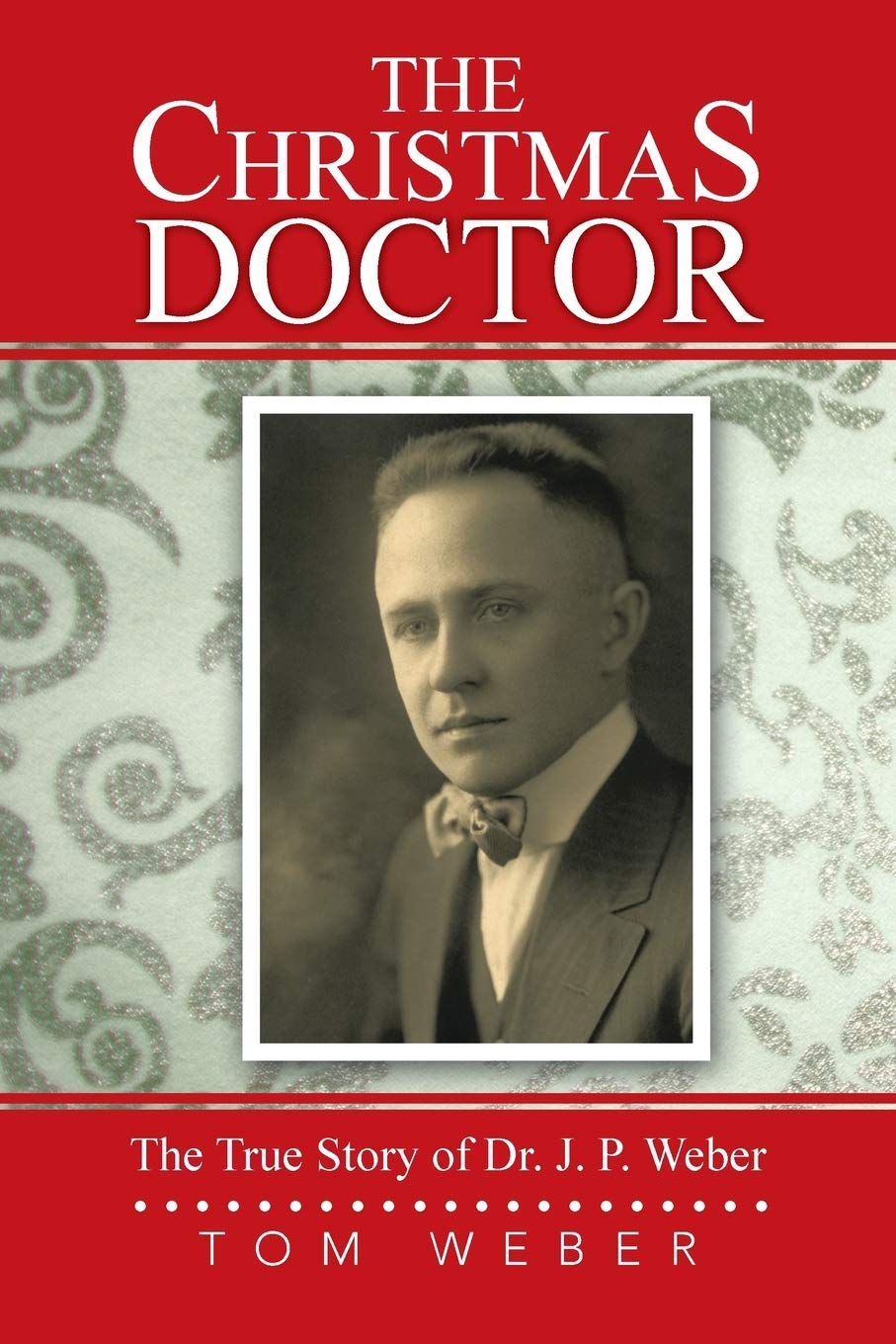



Clive Cussler: "A pity men like him aren't around anymore. He was a giant in his time" Russell Baker: "It makes us remember a time when the doctor was a truly heroic figure" Hugh Sidey: "His kind made this country great" Judy Collins: "Your writing is evocative of my own love of the West" Margaret Chase Smith: "It is certainly something that should be read by everyone" Julie Harris: "What a wonderful doctor. I wish I had known him" Tipper Gore: "Your writing has that special quality that takes a reader to the time, place and mood you describe" Liv Ullmann: "You have a wonderful father to remember. I am very moved" Karl Malden: "A wonderful story" Patricia Neal: "If I were a man, I would love to play him on the screen" Joan Rivers: "If only there were doctors like him today" THE CHRISTMAS DOCTOR The True Story of Dr. J. P. Weber By TOM WEBER AuthorHouse Copyright © 2013 Tom Weber All rights reserved. ISBN: 978-1-4918-1561-8 CHAPTER 1 Peter Weber was trained as a butcher in Germany,but when he and his wife, Augusta, and their fivechildren immigrated to the town of Creston insouthwestern Iowa in 1885, he found work as arailroad laborer. Forty-three when he arrived in theUnited States, the short, hard-working man had areputation for being thoroughly honest. Highly intelligent and deeply spiritual, AugustaMenard Weber came from a family which owned aporcelain factory in Berlin. With blue, flashing eyesand smooth straw-colored hair, she was a beautifulwoman. Augusta was a happy person, one whofrequently burst into gay laughter and who couldquickly charm even the most withdrawn of neighbors. On Monday, May 14, 1888, the forty-four-year-oldAugusta gave birth to John Peter at the Weber homeon Elm Street in Creston. Little Johnny's world was filled with the wonderof the many stories and recollections related by hismother. Every seam on her face held the key to a newand exciting remembrance. How lovely she seemed toJohnny! How talented, how all-knowing, how warm!Never would he forget her captivating smile, herwonderful creamy arms reaching out to embrace him. One afternoon during the Fall of 1899, Johnnybusily loaded canned fruit into the family cellar. Ashe stopped to rest, he sighted the town physician, Dr.Claybaugh, passing in a fine carriage, his dark suitimpeccable, his black brimmed hat straight and proudon his gray-haired head. Johnny's mother had oftenspoken of the spring day in 1888 when Dr. Claybaughcame to the house to deliver him. The old doctor cracked his whip over the flanks ofthe smartly galloping team, no doubt hurrying to apatient who desperately needed him. The air filled withthe rattle of wheels on the sturdy brick road. Leaning against the side of the house to watch,Johnny whispered to himself, "Someday I'm going tobe a doctor." After finishing the eighth grade, John, now fivefeet four inches tall and weighing 135 pounds, heardthat men were being hired to construct railroadtracks across Montana and that the wages were good.Unable to afford a ticket, he decided to ride the railshobo-style to the western state. The young man soon learned there were difficultieswith riding in boxcars. The conductors and brakemenwho patrolled the freight trains always demandedmoney—ten cents, a quarter, sometimes half a dollar—orthey kicked you off. The alternative was riding the rods, the two narrowsteel beams beneath a passenger car. But riding onthe "lower berth" had its problems too. Hanging ontothe rods with his forearms and legs, keeping his eyesshut to avoid the hot blinding cinders, John soonfelt exhaustion setting in. It was all a fellow could dojust to hold on, with the roadbed only inches belowhis back. And you didn't know how long it would bebetween stops. At North Platte, a brakeman saw John duck undera car and stretch out on the rods just as the train wasbeginning to roll. He ran alongside the train cursingJohn's ancestry, pelting him with rocks as long as hecould, but the young man was able to hold on. That evening, the train was going at quite a clipwhen it began a twisting roller-coaster ride throughthe mountains. John's car was rolling and swaying likea ship in a storm as it tore down the hooking track.Jackrabbits scurried off in the dark at the side of therailbed, rattlesnakes jerked and wheeled away fromthe train. John fought the force of the curves, his bodyjolting precariously with the motion of the train, windswelling his clothes like sails. Cinders burned holes inhis pants, grasshoppers and bugs filled his mouth andeyes and shirt while the knife-edged wheel buzzed athis arm. The massive car pitched down the side of amountain, shooting around the curves. Someone wascalling for brakes while the brakeman yelled that thebrakes were frozen. Then, as morning dawned, thetrain squealed deafeningly to a halt, and John rolledout from under the car to gaze at a glorious cathedralof trees. Someone said it was Montana. It was a harsh land, one where the wind sometimesbrought seasonal ch