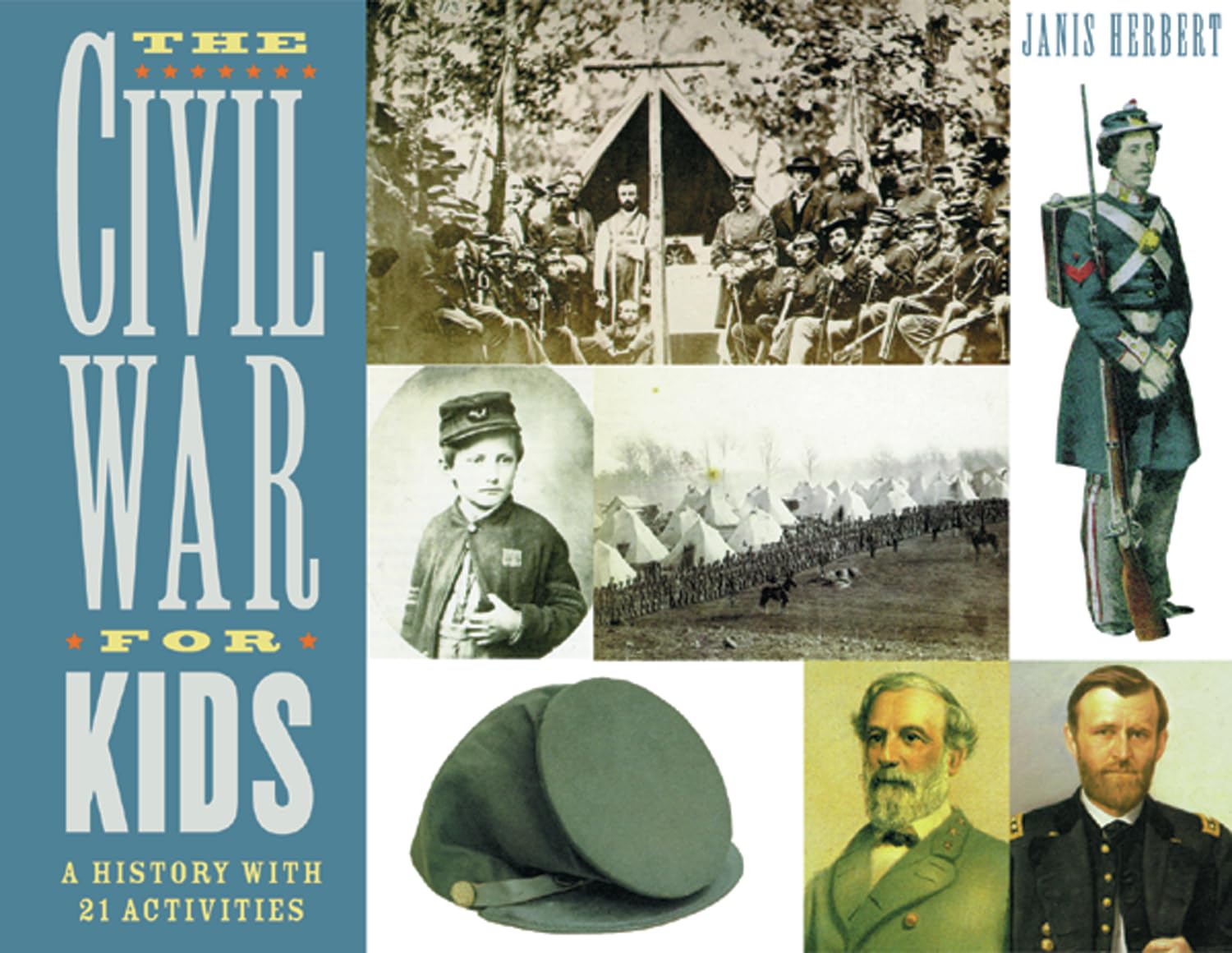
The Civil War for Kids: A History with 21 Activities (14) (For Kids series)
$12.01
by Janis Herbert



History explodes in this activity guide spanning the turmoil preceding secession, the first shots fired at Fort Sumter, the fierce battles on land and sea, and finally the Confederate surrender at Appomattox. Making butternut dye for a Rebel uniform, learning drills and signals with flags, decoding wigwag, baking hardtack, reenacting battles, and making a medicine kit bring this pivotal period in our nation’s history to life. Fascinating sidebars tell of slaves escaping on the Underground Railroad, the adventures of nine-year-old drummer boy Johnny Clem, animal mascots who traveled with the troops, and friendships between enemies. The resource section includes short biographies of important figures from both sides of the war, listings of Civil War sites across the country, pertinent websites, glossary, and an index. Grade 4-8-Using a clear style and lively tone, this book provides a look at the Civil War and its leaders and includes activities such as battle reenactments and recipes for soldiers' rations. The contributions of women, African Americans, and even children are described. Sidebars provide biographical and other information about individual soldiers and events. Occasional quotes provide a humanistic view of the war. Antislavery is offered as the main reason for the war, with only a brief mention that other reasons even existed. Maps and black-and-white reproductions are scattered throughout. A lengthy resource list of historical sites, museums, and Web sites is appended. Most of the activities require adult supervision and are geared toward groups, making them ideal for classrooms. Sarah Smith, Harrison Community Library, MI Copyright 1999 Reed Business Information, Inc. "Offers students a crash course on a subject that has spawned countless books and movies, and it's fun as well as informative." —KLIATT Janis Herbert is the author of The American Revolution for Kids , Leonardo da Vinci for Kids, Lewis and Clark for Kids, and Marco Polo for Kids . The Civil War for Kids A History with 21 Activities By Janis Herbert Chicago Review Press Incorporated Copyright © 1999 Janis Herbert All rights reserved. ISBN: 978-1-55652-355-7 Contents Acknowledgments, Timeline, Note to ReadersI, Introduction, 1 To War!, 2 Drill, Drill, Drill, 3 Battles lest and East, 4 Camp Life, 5 Fight for Freedom, 6 Behind the Battle lines, 7 The Union Struggles, 8 On the March, 9 The Confederacy Falters, 10 Hardships of far, 11 A River of Blood and a Battle Abort Clouds, 12 Chronicles of the war, 13 Flanking South, 14 Taps, Scouting for Civil War Veterans, Glossary, A Guide to Officers, Resources, Bibliography, Index, CHAPTER 1 To War! The Union Is Dissolved In 1861, citizens gathered in town squares all across the country to hear speeches about freedom, states' rights, and glorious death on the battlefield. In the North, bands played rousing versions of "Rally 'Round the .Slag," and young men jumped at the chance to fight for union. In the South, "The Bonny Blue Flag" inspired men to defend their rights and their land. The country was divided in two. The split had been a long time in coming. Many events led to the great Civil War of the United States, but the main reason so many fought and died was the practice of slavery. Slavery — the South's answer to its need for a large, cheap labor force to raise its main crop, cotton — was a source of terrible friction between North and South. Many slaves led lives of backbreaking labor, poor rations, and beatings. Their lives were not their own. They were property, like a horse or a wagon. They could be sold at any time and separated from their spouses and children. The North and South were like two separate countries. The growing North attracted immigrants to its bustling cities and manufacturing jobs. The South was an agricultural land, and its proud and aristocratic people wanted nothing more than for it to remain that way. Not all Southerners were slave owners, but the South's economy depended on the large cotton plantations worked by slaves. Without slavery, Southerners feared their whole way of life would be destroyed. The friction between the regions grew. A group of people began calling for the abolishment of slavery. They became known as "abolitionists." As this abolitionist anti-slavery movement grew, the federal government outlawed importation of slaves and tried to limit slavery to the South. Southerners felt their country was turning against them and threatened to "secede" (withdraw) from the United States and form their own country. To calm them, Congress passed a Fugitive Slave Law in 1850. Under this law, escaped slaves who were captured in the North could be claimed as property and taken back to captivity. People could be jailed for helping slaves escape. Abolitionists were outraged. Harriet Beecher Stowe was so upset that she wrote a novel about the plight of slaves. Her story became the most popu