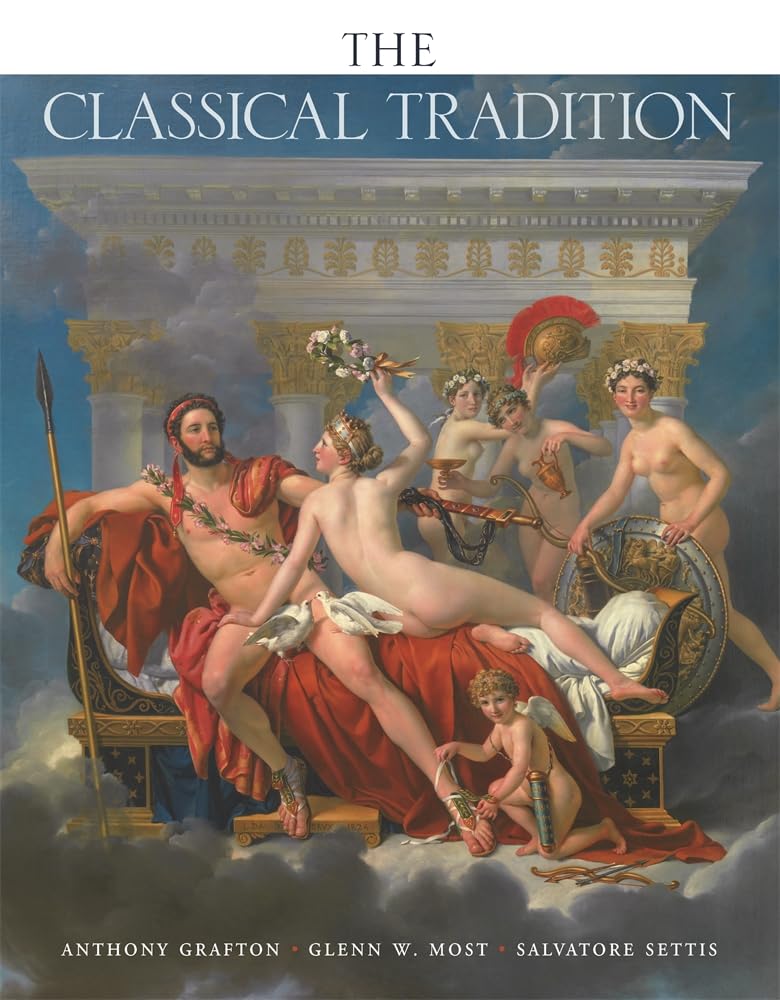
The Classical Tradition (Harvard University Press Reference Library)
$52.99
by Anthony Grafton



“A vast cabinet of curiosities.”―Stephen Greenblatt “Eclectic rather than exhaustive, less an encyclopedia than a buffet.”―Frederic Raphael, Literary Review How do we get from the polis to the police? Or from Odysseus’s sirens to those of an ambulance? The legacy of ancient Greece and Rome is all around us, imitated, resisted, reworked, and misunderstood. In this beautifully illustrated and encyclopedic compendium, a team of leading scholars investigates the afterlife of this rich heritage in the fields of literature, philosophy, art, architecture, history, politics, religion, and science. From Academy to Zoology, Aristotle and the Argonauts to Pegasus and Persia, The Classical Tradition looks at facts and adages, people, places, and ideas to reveal how the Classical tradition has shaped human endeavors from government to medicine, drama to urban planning, legal theory to popular culture. At once authoritative and accessible, learned and entertaining, it illuminates the vitality of these enduring influences. Use of the adjective classical to modify, for example, architecture, dance, or education often denotes some form, style, type, or idea that is archetypal, foundational, ideal, or otherwise worthy of emulation, save by those who find the tradition limiting and wish to break out of the mold. Western cultures have often taken these classical forms from the civilizations of ancient Greece and Rome. Rather than simply defining some of these, this new reference work �aims to provide a reliable and wide-ranging guide to the reception of Graeco-Roman antiquity in all its dimensions in later cultures.� Two examples illustrate this aim quite nicely. The entry for Portico begins with a definition of the Roman original and follows its use in architecture over the centuries. It also describes its lasting legacy as a street-side arcade that finds expression in the front porches of houses today. Gesture and dance describes how ballet grew out of Renaissance-era textual examinations of ancient dramatists and the subsequent desire to combine regulation of physical expression and an ideal vision of the body. These entries are joined by some 500 others, written by an international team of scholars and ranging in subject from Architecture to Zoology, Atlantis to Sparta, and Aeneas to Xenophon. The Classical Tradition demonstrates that vestiges of ancient Greece and Rome are to be found throughout Western societies and often where they might least be expected. The emphasis on the reception history of this rich heritage, showing how generations have glorified, vilified, misunderstood, and retooled this inheritance for their own purposes, makes it a unique resource and sets it apart from such reference standards as the Oxford Classical Dictionary (2003). Recommended for academic and large public libraries. --Christopher McConnell “Over a thousand pages in length, with some five hundred articles surveying the survival, transmission, and reception of the cultures of Greek and Roman antiquity, The Classical Tradition is a low-cost Wunderkammer , a vast cabinet of curiosities… The Classical Tradition should rightly evoke…gratitude. This is a book whose long, learned, and witty essay on Rome could stand alone as a surprisingly comprehensive guide to that city’s ancient relics, but that also has time for entries on Armenian Hellenism, Hunayn ibn-Ishaāq, and Gandhara; carpe diem , deus ex machina , and the translatio imperii ; the Society of Dilettanti, the Grand Tour, and Fascism. It is possible to get pleasantly lost in these pages, as in the internal courtyards of Pompeii, and not emerge for hours.” ― Stephen Greenblatt and Joseph Leo Koerner , New York Review of Books “A heady, hefty new single-volume reference… This is a browser’s paradise… While Greece and Rome are no longer the foundation of education, classical scholarship has never been richer.” ― Steve Coates , New York Times Book Review “Entries of commendable clarity and range include those on Homer, on pastoral, on Catullus, and on the Argonauts. This is a valuable reference work, especially for those new to the classical world.” ― Victoria Moul , Times Literary Supplement “ The Classical Tradition is a guidebook of great erudition that is notably well written and unexpectedly compelling. It definitely is not another of those solemn introductions to ‘the glory that was Greece and the grandeur that was Rome.’ Instead it is a lively compendium of the manifold ways in which the enduring creations of the classical tradition, and the Greek and Latin classics, have been imitated, adulated, denounced and misunderstood―or understood all too well―over the past two millennia… Each article brings some unexpected insight or little known fact into the discussion, to illuminating effect… The scholarship is impeccable, but there is a donnish drollery in many of the articles… [A] marvelous guide.” ― Eric Ormsby , Wall Street Journal “Now here is a fabulo