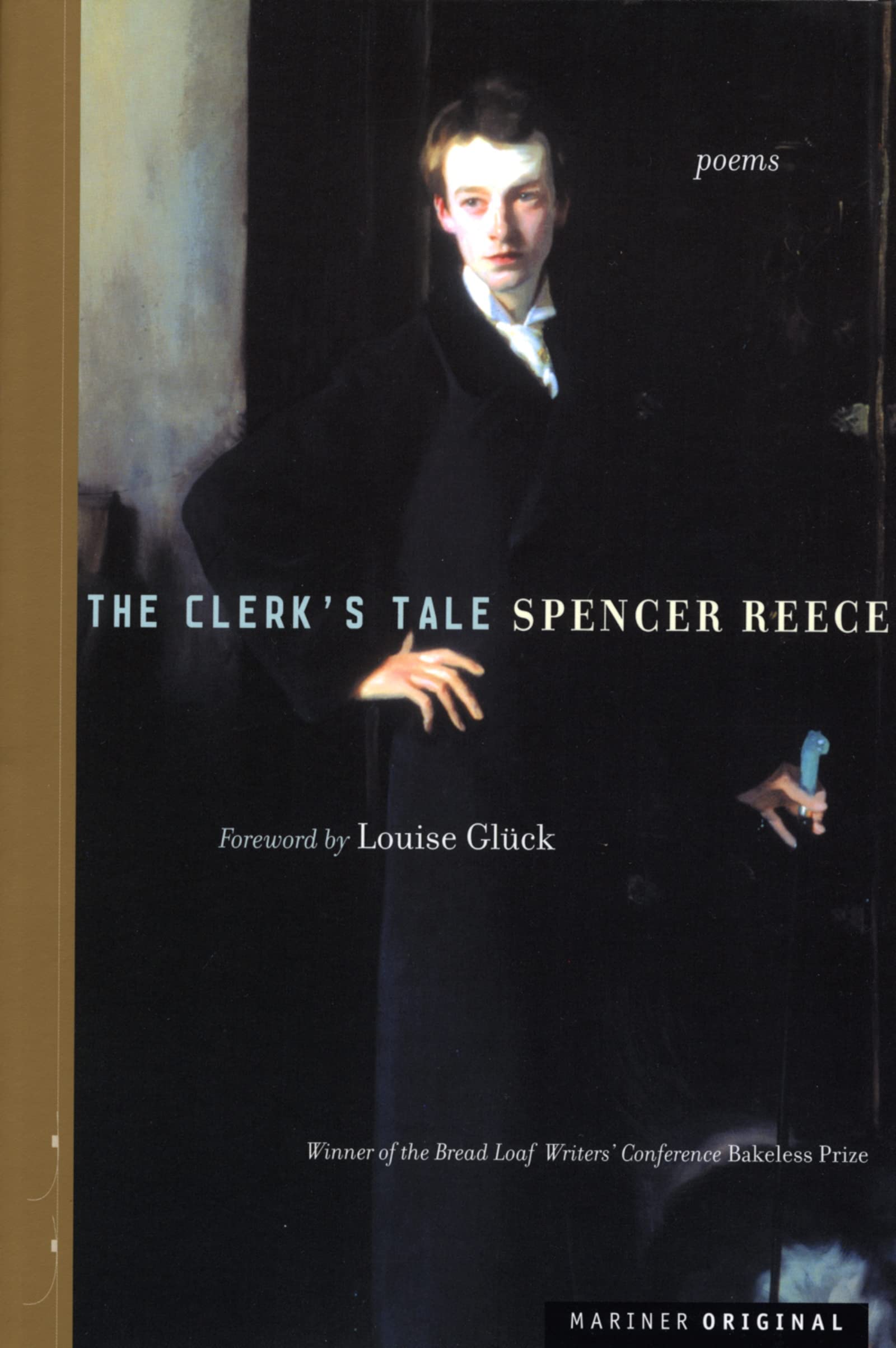
The Clerk's Tale: Poems – An Exquisitely Restrained Literary Debut Shot Through with Longing
$10.86
by Spencer Reece



In a recent double fiction issue, The New Yorker devoted the entire back page to a single poem, "The Clerk's Tale," by Spencer Reece. The poet who drew such unusual attention has a surprising background: for many years he has worked for Brooks Brothers, a fact that lends particular nuance to the title of his collection. The Clerk's Tale pays homage not only to Chaucer but to the clerks' brotherhood of service in the mall, where "the light is bright and artificial, / yet not dissimilar to that found in a Gothic cathedral." The fifty poems in The Clerk's Tale are exquisitely restrained, shot through with a longing for permanence, from the quasi-monastic life of two salesmen at Brooks Brothers to the poignant lingering light of a Miami dusk to the weight of geography on an empty Minnesota farm. Gluck describes them as having "an effect I have never quite seen before, half cocktail party, half passion play . . . We do not expect virtuosity as the outward form of soul-making, nor do we associate generosity and humanity with such sophistication of means, such polished intelligence . . . Much life has gone into the making of this art, much patient craft." "Inside everything was Episcopalian— / the wicker chaise lounges, the small spotted mirrors, / the rattan dining room set, the tears." Reece's evocation of a family house on Cape Cod, eventually sold, exemplifies the twin currents of detached humor and sorrow that run through his début collection. The most effective poems here are autobiographical, recording early family life; a period spent recovering from a nervous breakdown in hospitals and borrowed houses ("My legacy is to leave the room empty"); and a new life in retail—hence the title. Reece's poems are saved from solipsism by a keen alertness to the characters around him and to the consolations of the natural world. Animals please him, because they are happier than people—"The ponies said: This day astounds us. The field is green." And resignation brings with it a kind of peace, as in a poem written on the poet's birthday in a lonely Florida town: "It is not Paris it is not Florence / but it has majesty in its anonymity." Copyright © 2005 The New Yorker Supple, atmospheric, and lucent, Reece's entrancing lyrics evoke the diametrically opposed yet equally affecting landscapes of Minnesota and Florida and consider the axis between solitude and connection, peace and pain, philosophy and madness. Reece's poems are at once splendidly fresh and deeply rooted in poetry's rich loam as he offers a witty yet moving variation on Chaucer's The Clerk's Tale and echoes the work of Elizabeth Bishop, Wallace Stevens, and James Merrill. No academic, Reece is a longtime Brooks Brothers employee, and, accordingly, the title poem, originally published in the New Yorker, portrays two men, including an aging homosexual, who clerk in an upscale men's clothier in the Mall of America, an edifice Reece compares to a Gothic cathedral. Indeed, religious images surface often as the poet summons up childhood memories and evokes resonant vignettes, still lives, and today's cluttered versions of pastorals, subtly tracing the soul's uncertain progress from brute survival to transcendent receptivity and affirmation. Insightfully introduced by poet laureate Louise Gluck, Reece's striking debut yields new revelations with each reading. Donna Seaman Copyright © American Library Association. All rights reserved "Spencer Reece has a fascinating mind and imagination. The poems in The Clerk's Tale will exalt you." Spencer Reece is a poet and priest. His first collection, The Clerk’s Tale , won the Bakeless Prize in 2003, selected by Louise Gluck, and his second collection, The Road to Emmaus , was longlisted for the National Book Award . He has received an NEA grant, a Guggenheim grant, a Witter Bynner Prize from the Library Congress, a Whiting Writers’ Award, and the Amy Lowell Travelling Scholarship. His poems have been published in The New Yorker , Poetry , The American Scholar , and The New Republic . He served at the Honduran orphanage Our Little Roses, and works for the Bishop of Spain for the Reformed Episcopal Church, Iglesia Española Reformada Episcopal. Portofino Promise me you will not forget Portofino. Promise me you will find the trompe l’oeil on the bedroom walls at the Splendido. The walls make a scene you cannot enter. Perhaps then you will comprehend this longing for permanence I often mentioned to you. Across the harbor? A yellow church. A cliff. Promise me you will witness the day diminish. And when the roofs darken, when the stars drift until they shatter on the sea’s finish, you will know what I told you is true when I said abandonment is beautiful. The Clerk’s Tale I am thirty-three and working in an expensive clothier, selling suits to men I call “Sir.” These men are muscled, groomed and cropped— with wives and families that grow exponentially. Mostly I talk of rep ties and bow ties, of full-Windsor k