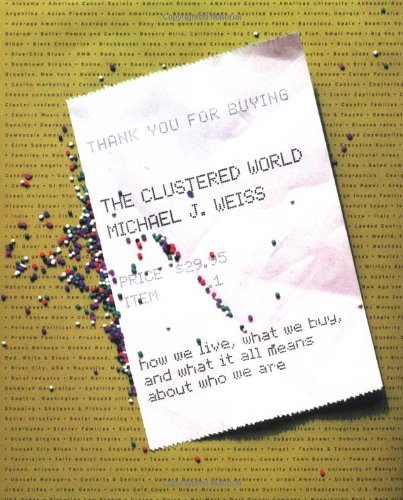
The Clustered World : How We Live, What We Buy, and What It All Means About Who We Are
$25.90
by Michael J. Weiss



Explores how businesses and bureaucrats use clustering systems to influence our opinions and choices "Primary age group: 35-64... Median household income: $80,600... Median home value: $247,000... Predominant ideology: moderate Republican... Preferences: car phones, domestic wine, Land Rovers." If this sounds like you, then you're a part of what's known as the "Winner's Circle" cluster. If not, then you probably fall into one of 61 other lifestyle clusters with names such as "Urban Gold Coast," "Pools & Patios," "God's Country," "Golden Ponds," and "Shotguns & Pickups." In The Clustered World , demographic detective Michael Weiss draws on the work of market research firm Claritas and its PRIZM cluster system to render a richly detailed view of the many neighborhoods and demographic segments that make up the United States. According to Weiss, the image of America as a melting pot is simply inaccurate--think salad bar , instead. He writes, "For a nation that's always valued community, this breakup of the mass market into balkanized population segments is as momentous as the collapse of Communism.... Today, the country's new motto should be ' E pluribus pluriba ': 'Out of many, many.'" In addition to explaining the cluster concept, Weiss shows how marketers can put clusters to work to understand consumers better and sell everything from college educations to Dodge Caravans. Weiss also looks beyond the U.S. population to lifestyle clusters in Canada, France, Germany, Great Britain, South Africa, and Spain. Marketers and social observers will find this pointillist view incredibly useful and perhaps a little disturbing. The overriding truth behind The Clustered World is that, like it or not, " You are like your neighbors ." And in case you're wondering what cluster you belong to, Weiss includes the URL for the Claritas Web site (yawyl.claritas.com), where you can enter your ZIP code to find out more about you and your neighbors. --Harry C. Edwards For the popular market, a demographer's view that people who live in mid-Manhattan may have more in common with amigos in mid-Madrid than with their neighbors in the Bronx. That's not a breakthrough theory, even for those unsophisticated about marketing, but what is both interesting and frightening about this book is how refined demographic breakdowns have become. According to Weiss (The Clustering of America, 1989, etc.), one geodemographics company has divided the population of the US into 62 clusters, that is, a group of people defined by income, spending habits, interests, place and type of residence, and other criteria. They range from ``Blue Blood Estates'' (rich white and Asian professionals) to ``Southside City'' (poor African-American singles), and include such in-between categories as ``American Dreams'' (established immigrants) and ``Blue Highways'' (farm families). (There is actually someone who makes a living thinking up these labels.) Weiss devotes nearly half his time here to unnervingly detailed descriptions of each cluster, highlighting not only age and income, but political leanings, preferences in food, cars, magazines, television, and travel. He adds some social heft by discussing how these clusters have changed in the past decadeAmerica is now a ``salad bar'' rather than a melting potand how they have not changedblacks and whites are still segregated from one another, even in prosperous neighborhoods. Also new: the global village has become a ``clustered world,'' with clusters of yuppies, for instance, identified in at least 19 countries. Weisss reassurance on issues of personal privacy rings hollow after the revelation of how much information is available to the telemarketers who ring at dinner time. A chapter on Canada feels like filler; advice on how to find your own cluster seems to be available only through America Online. Some interesting tidbits for social scientists and a feast for marketing v.p.'sbut then they probably know all this already. (150 two-color maps, illus., and tables) (Author tour) -- Copyright ©1999, Kirkus Associates, LP. All rights reserved. "...a detailed, fascinating demonstration of the importance of marketing." -- The Atlanta-Journal Constitution, 2/6/00 "...give author/journalist Michael J. Weiss a few pieces of information, and he can tell you with great accuracy what you care about, what you watch on TV, what you eat, and for whom you will vote in the next election...an interesting, well-written, and well-researched book." -- Philadelphia Inquirer, 1/30/00 Once, in the not-too-distant past, most Americans read Life magazine, watched the Ed Sullivan Show and drove cars made in Detroit. Today, in a nation of 270 million people, 100 million households, 260,000 Census Block neighborhoods, hundreds of cable TV channels and millions of Web sites, mass culture is but a quaint memory. As author Michael J. Weiss observes: "When you say 'oil' in Rural Industria, a blue-collar Heartland cluster, residents thi