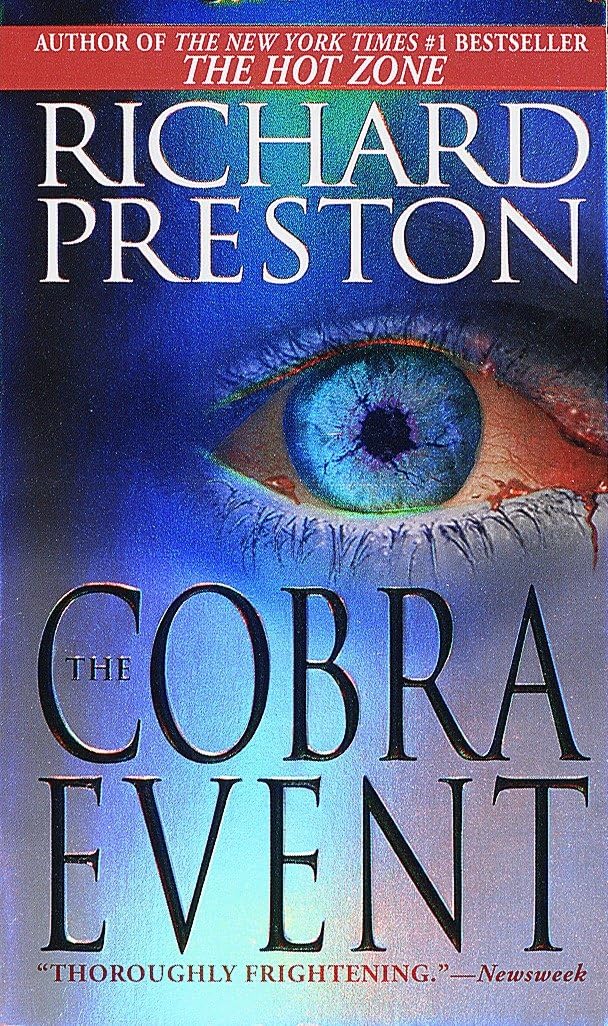



“One of those books you literally can’t put down . . . makes The Hot Zone virus—far away in a rainforest—look like no big deal.”— Detroit Free Press Five days ago, a homeless man on a subway platform died in agony as startled commuters looked on. Yesterday, a teenager started having violent, uncontrollable spasms in art class. Within minutes, she too was dead. Dr. Alice Austen is a medical pathologist at the Centers for Disease Control in Atlanta. What she knows is that the two deaths are connected. What she fears is that they are only the beginning. . . . “Manages to grab you with the authenticity of its scientific detective work and haunt you with its sheer plausibility.”— Entertainment Weekly “Enormously entertaining.” — The New York Times Book Review "A PAGE-TURNER . . . THOROUGHLY FRIGHTENING." --Newsweek "ENORMOUSLY ENTERTAINING." --The New York Times Book Review "THIS BOOK SCARED THE LIVING DAYLIGHTS OUT OF ME. . . . Manages to grab you with the authenticity of its scientific detective work and haunt you with its sheer plausibility." --Entertainment Weekly Five days ago, a homeless man on a subway platform died in agony as startled commuters looked on. Yesterday, a teenager started having violent, uncontrollable spasms in art class. Within minutes, she too was dead. Dr. Alice Austen is a medical pathologist at the Centers for Disease Control in Atlanta. What she knows is that the two deaths are connected. What she fears is that they are only the beginning. . . . "A PAGE-TURNER . . . THOROUGHLY FRIGHTENING." --Newsweek "ENORMOUSLY ENTERTAINING." --The New York Times Book Review "THIS BOOK SCARED THE LIVING DAYLIGHTS OUT OF ME. . . . Manages to grab you with the authenticity of its scientific detective work and haunt you with its sheer plausibility." --Entertainment Weekly Five days ago, a homeless man on a subway platform died in agony as startled commuters looked on. Yesterday, a teenager started having violent, uncontrollable spasms in art class. Within minutes, she too was dead. Dr. Alice Austen is a medical pathologist at the Centers for Disease Control in Atlanta. What she knows is that the two deaths are connected. What she fears is that they are only the beginning. . . . Richard Preston is the author of three nonfiction books, The Hot Zone (about the Ebola virus), American Steel (about a revolutionary steel mill), and First Light (about modern astronomy). He is a contributor to The New Yorker and has won numerous awards, including the McDermott Award in the Arts from MIT, the American Institute of Physics Award in science writing, and the Overseas Press Club of America Whitman Basso Award for best reporting in any medium on environmental issues. The Cobra Event is Richard Preston's first novel. Part One TRIAL Arc of the Circle NEW YORK CITY, LATE 1990S KATE MORAN was an only child. She was seventeen years old and lived with her parents in a loft apartment on the top floor of a handsome old building to the west of Union Square, just on the edge of Greenwich Village. One Wednesday morning in late April, Kate was slow getting up. She had woken in the middle of the night in a sweat, but it went away, and she fell back asleep, into bad dreams that she could not remember. She came awake with a fresh cold, and she could feel her period coming on. "Kate!" It was Nanette, the housekeeper, calling to her from the kitchen. "Katie!" "Okay." She didn't like being called Katie. She sat up and found a Kleenex and blew her nose, and went into the bathroom. She brushed her teeth, then went back into the bedroom and dressed in a flowered dress that she had found in a flea market. The mornings could be chilly this time of year, so she put on a sweater. Kate had wavy russet hair, beautiful hair with natural pale highlights, which she wore medium length. Her eyes were grayish blue or bluish gray, depending on the light and the weather and her mood (or so she liked to think); complicated eyes. Her face was changing fast. She could almost see the bones of the woman emerging, yet she had found that the more she stared at her face in a mirror the less she understood it. She thought about this as she brushed her hair, pushing it back so that the two platinum earrings in her left ear were visible. Kate's mother called her the Packrat, because she accumulated things. The worktable in the corner of her room was littered with old cigar boxes covered with their original illustrations, plastic boxes, metal containers, purses, bags, puzzles. Things that opened and closed. There was an old dollhouse that she had found in a junk shop in Brooklyn and had been taking apart, cannibalizing it for a project. She reached into the dollhouse and pulled out a prism made of glass, and the smooth white skull of a vole, with tiny yellow teeth, that she had bought at a bone shop in SoHo. She held the prism up to the light falling through the skylight of her bedroom, and just to see what it would look like, sh