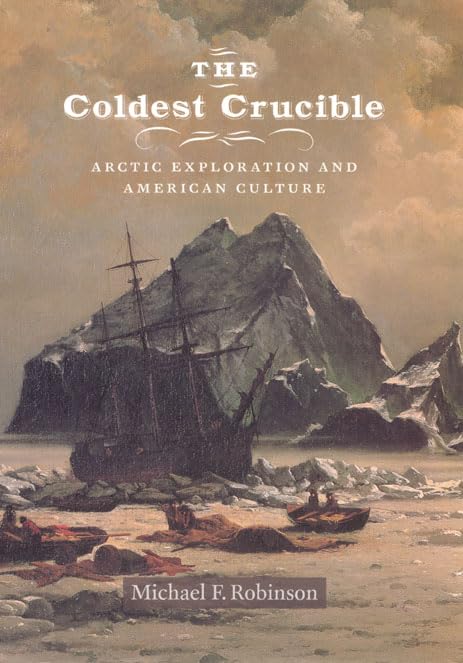
The Coldest Crucible: Arctic Exploration and American Culture
$67.00
by Michael F. Robinson



In the late 1800s, “Arctic Fever” swept across the nation as dozens of American expeditions sailed north to the Arctic to find a sea route to Asia and, ultimately, to stand at the North Pole. Few of these missions were successful, and many men lost their lives en route. Yet failure did little to dampen the enthusiasm of new explorers or the crowds at home that cheered them on. Arctic exploration, Michael F. Robinson argues, was an activity that unfolded in America as much as it did in the wintry hinterland. Paying particular attention to the perils facing explorers at home, The Coldest Crucible examines their struggles to build support for the expeditions before departure, defend their claims upon their return, and cast themselves as men worthy of the nation’s full attention. In so doing, this book paints a new portrait of polar voyagers, one that removes them from the icy backdrop of the Arctic and sets them within the tempests of American cultural life. With chronological chapters featuring emblematic Arctic explorers—including Elisha Kent Kane, Charles Hall, and Robert Peary— The Coldest Crucible reveals why the North Pole, a region so geographically removed from Americans, became an iconic destination for discovery. “A wonderful book to read and ponder. Michael Robinson takes us on an exhilarating voyage into the American encounter with the Arctic from Elisha Kane to Robert Peary and Frederick Cook. The characters are alive, the scenes are vivid, and the stories are riveting. But this is not another book on the Arctic explorer. Robinson has delivered a long-overdue argument, one that is both nuanced and elegant. The lived experience of the explorer began and ended not on the ice floes of the north but in the committee rooms, newspaper offices, lecture halls, sideshows, circuses, and private dining clubs throughout the country. Robinson shows brilliantly that the Arctic explorer reflected the changing culture of the country. Progressively cut off from science, the explorer found himself in the pockets of the great press barons in whose hands scandal and failure made better copy than did geographic success. Like so much of America, the explorer had become a brand, a disturbing sign of the future.” -- Jordan Goodman, author of The Rattlesnake: A Voyage of Discovery to the Coral Sea “Others have investigated how the crucible of Arctic exploration shaped individual explorers, but Michael Robinson imaginatively turns the frame toward an American public that persisted in supporting adventurers from Elisha Kane to Robert Peary. Originally justified as scientific ventures, the expeditions created a palpable ‘Arctic fever’ in American public culture which refracted messages of manliness, the power and limits of technology, and national ambition. In a narrative analysis alert to symbols as well as realities, The Coldest Crucible is ultimately about testing the mettle of the Americans themselves.” -- Sally Gregory Kohlstedt, editor of Women in Science “In this sharply written and lively study, Michael Robinson explains the rise and fall of Arctic explorers as American icons. Robinson humanizes these men by placing them in a much larger web of scientific authority, masculine identity, patronage, and the fickle taste of the general public. What emerges is a much more nuanced view of ‘Arctic fever,’ complete with heroic tales but also human failures.” -- Susan Schulten, author of The Geographical Imagination in America , 1880-1950 "Michael F. Robinson is concerned with the perception of Arctic exploration in the United States, rather than with the exploration itself....Robinson has a real thesis, and he presents it with admirable clarity and a firm understanding of its shadings and nuances." -- Jonathan Dore ― Times Literary Supplement Published On: 2006-12-22 "Robinson casts a fresh light upon some of the most important blanks on our map of the role of popular sentiment, nationalism, and the rising mass media, in the evolution and valuation of Arctic exploration. He demonstrates a keen eye for significant detail, and a deep engagement with his primary sources, which promise strong work to come. It is to be hoped that he will soon make a second and more extended expedition." -- Russell A. Potter ― Arctic Book Review Published On: 2006-10-01 "Robinson's account is full and interpretive. It is both exciting and revealing. It tells us a great deal about the pure scientists (such as those who today fly off on space adventures) and those who stay on Earth but fly high by exploiting the discoveries of their betters." -- Ray B. Brown ― Journal of American Culture Published On: 2007-03-01 "This monograph is clear, detailed, meticulously researched, and elegantly written. . . . [Robinson] offers a new and convincing interpretation of the cultural significance of Americans' devotion to Arctic exploration in this period. . . ." -- Kathryn Morse ― Reviews in American History Published On: 200