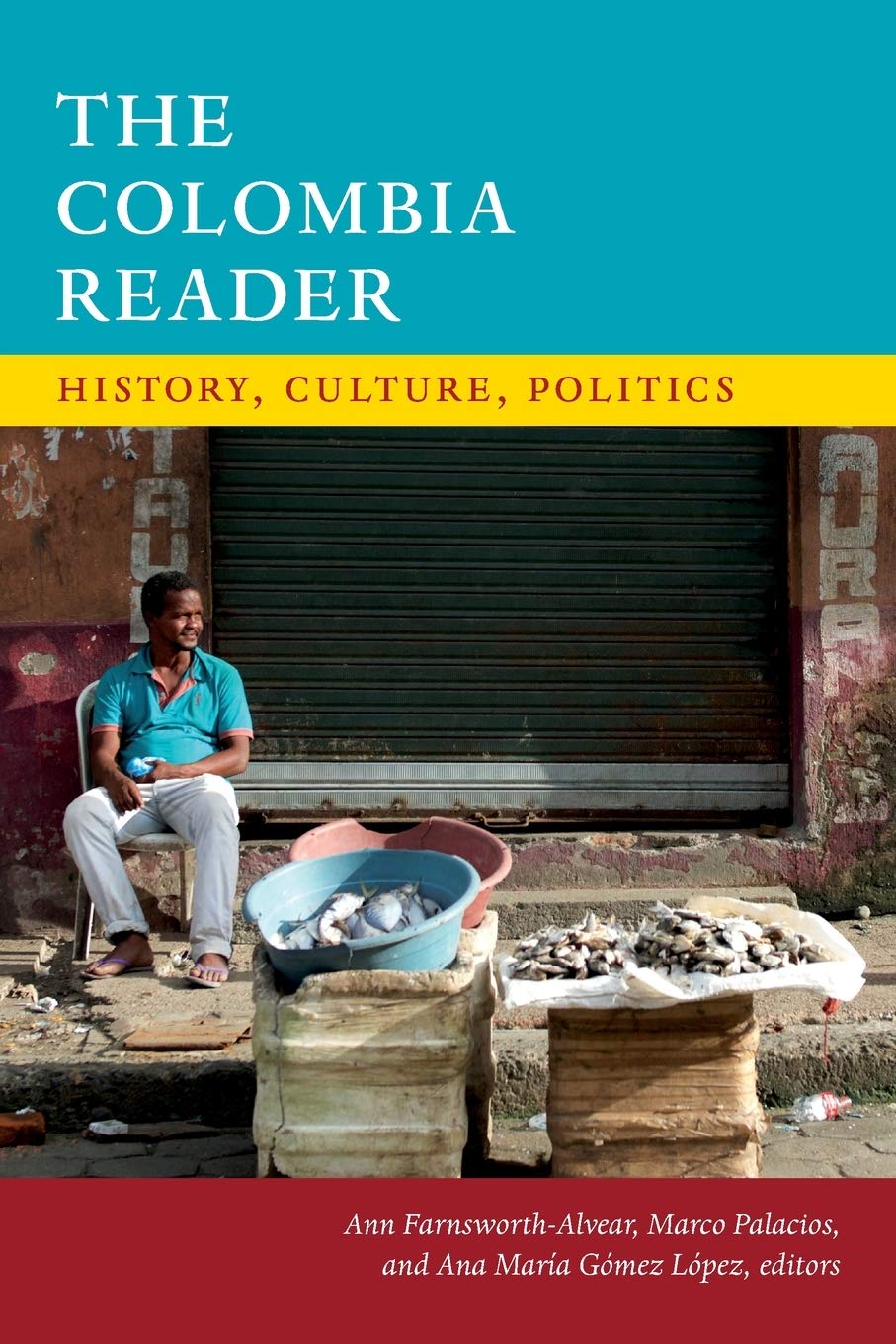
The Colombia Reader: History, Culture, Politics (The Latin America Readers)
$26.15
by Ann Farnsworth-Alvear



Containing over one hundred selections—most of them published in English for the first time— The Colombia Reader presents a rich and multilayered account of this complex nation from the colonial era to the present. The collection includes journalistic reports, songs, artwork, poetry, oral histories, government documents, and scholarship to illustrate the changing ways Colombians from all walks of life have made and understood their own history. Comprehensive in scope, it covers regional differences; religion, art, and culture; the urban/rural divide; patterns of racial, economic, and gender inequalities; the history of violence; and the transnational flows that have shaped the nation. The Colombia Reader expands readers' knowledge of Colombia beyond its reputation for violence, contrasting experiences of conflict with the stability and significance of cultural, intellectual, and economic life in this plural nation. "Including a wide range of photographs and reproductions of works of art, this remarkable and exciting collection is an indispensable work for all libraries, all scholars of Colombia, Latin Americanists of all sorts, and any interested reader. Essential. All levels/libraries." -- J. M. Rosenthal ― Choice "This book will allow us to write, teach, and tell not only different histories of Colombia but to write, teach, and tell those histories differently.... This collection will certainly become a foundational teaching tool not only for the histories of Colombia but also those of Latin America." -- A. Ricardo López ― Revista "In this stunning textual and visual compilation of daily historical moments, the Colombian people come alive, so that they may finally be understood alongside their fellow Latin Americans." -- Herbert Braun, author of ― Our Guerrillas, Our Sidewalks: A Journey into the Violence of Colombia Ann Farnsworth-Alvear is Associate Professor of History at the University of Pennsylvania and the author of Dulcinea in the Factory: Myths, Morals, Men, and Women in Colombia's Industrial Experiment, 1905–1960 , also published by Duke University Press. Marco Palacios is Professor at El Colegio de México and Universidad de los Andes, Bogotá, and the author of many books, including Between Legitimacy and Violence: A History of Colombia, 1875 – 2002 , also published by Duke University Press. Ana María Gómez López is an artist and independent scholar. The Colombia Reader History, Culture, Politics By Ann Farnsworth-Alvear, Marco Palacios, Ana María Gómez López, Carolina Navas Duke University Press Copyright © 2017 Duke University Press All rights reserved. ISBN: 978-0-8223-6228-9 Contents Acknowledgments, Introduction, I Human Geography, II Religious Pluralities: Faith, Intolerance, Politics, and Accommodation, III City and Country, Color Plates, IV Lived Inequalities, V Violence, VI Change and Continuity in the Colombian Economy, VII Transnational Colombia, Suggestions for Further Reading, Acknowledgment of Copyrights and Sources, Index, CHAPTER 1 Human Geography Boasting Andean peaks, a port on the Amazon River, and coasts along both the Atlantic and Pacific Oceans, Colombia's unique interrelation of climate, elevation, and topography creates sharply distinct regional and cultural differentiation. One way to sketch a simplified map of regions and subregions is to trace five broad areas: 1. Colombia's Caribbean: This is bisected by the Magdalena River; it extends westward to Panama and eastward to the Guajira peninsula and Venezuela. 2. The Eastern Cordillera: Known in the colonial period as El Reino (The Kingdom), this refers to a large region that coheres in cultural terms and includes Cundinamarca, Boyacá, the Santanderes, Huila, and Tolima — even though the last two are not part of the eastern mountains. 3. Oriente: The eastern grasslands, known as los Llanos, transition to the South into the Colombian Amazon. The grasslands and Amazonia are very different, but together they form a borderlands region that connects Colombia to Venezuela and the Orinoco watershed, as well as to northwestern Brazil. 4. Occidente: This complex area must be understood as a set of subregions: first, what Colombians will refer to as Greater Cauca, which includes the political departments of Cauca and Valle de Cauca and is often understood in reference to the cities of Popayán and Cali; second, a broad zone culturally bound by its having been an agricultural frontier in the late nineteenth century, including most of what are now the political departments of Antioquia, Caldas, Risaralda, and Quindío; third, the southernmost mountains, culturally rooted in an Andean indigenous experience that cuts across Colombia's borders with Ecuador and Peru. 5. The Pacific Lowlands: Colombia's long Pacific coast, from Panama to the Ecuadorian border and from the westernmost foothills of the Andes down to the sea, is associated with riches, in the form of enormous biodive