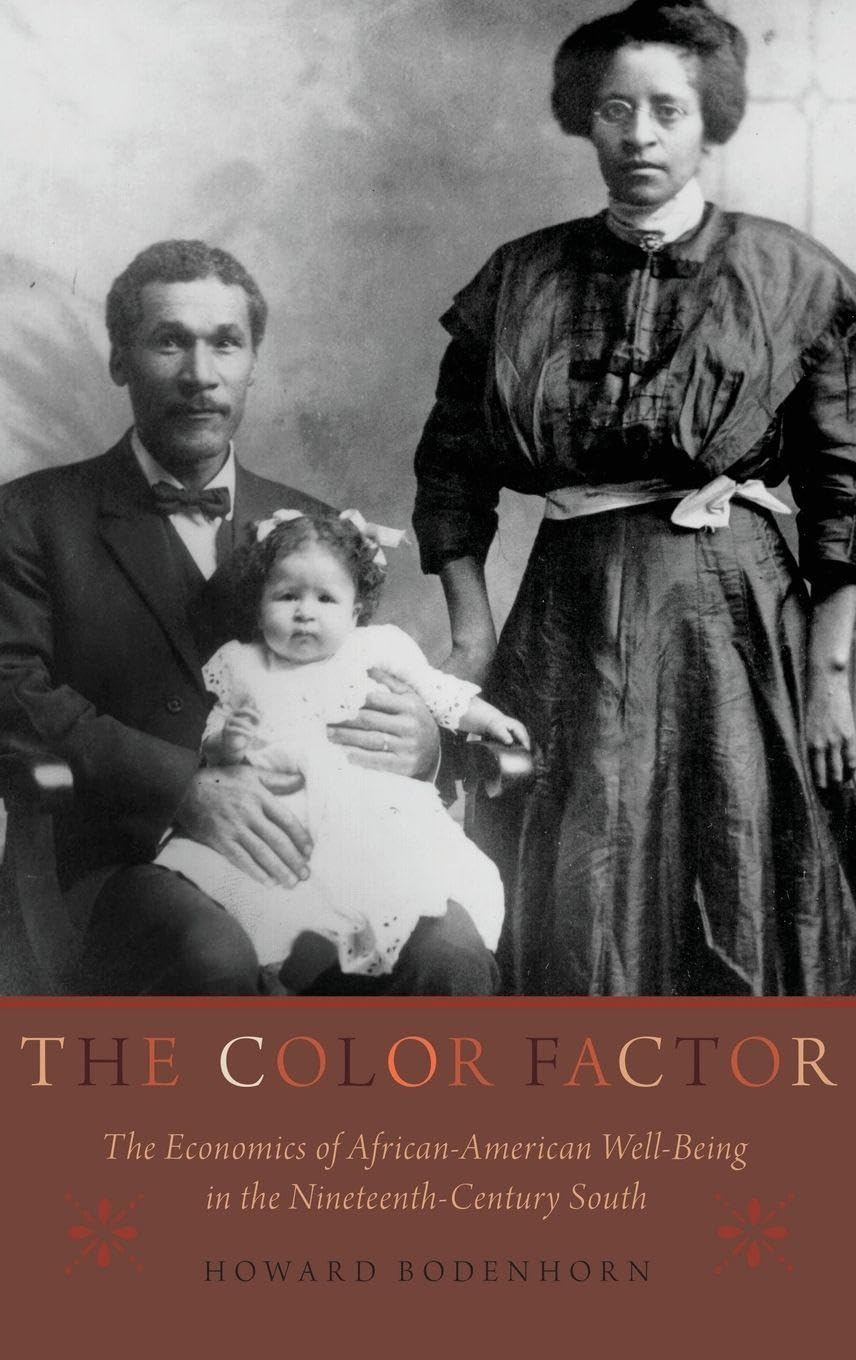
The Color Factor: The Economics of African-American Well-Being in the Nineteenth-Century South (National Bureau of Economic Research)
$83.00
by Howard Bodenhorn



Despite the many advances that the United States has made in racial equality over the past half century, numerous events within the past several years have proven prejudice to be alive and well in modern-day America. In one such example, Governor Nikki Haley of South Carolina dismissed one of her principal advisors in 2013 when his membership in the ultra-conservative Council of Conservative Citizens (CCC) came to light. According to the Southern Poverty Law Center, in 2001 the CCC website included a message that read "God is the one who divided mankind into different races.... Mixing the races is rebelliousness against God." This episode reveals America's continuing struggle with race, racial integration, and race mixing-a problem that has plagued the United States since its earliest days as a nation. The Color Factor: The Economics of African-American Well-Being in the Nineteenth-Century South demonstrates that the emergent twenty-first-century recognition of race mixing and the relative advantages of light-skinned, mixed-race people represent a re-emergence of one salient feature of race in America that dates to its founding. Economist Howard Bodenhorn presents the first full-length study of the ways in which skin color intersected with policy, society, and economy in the nineteenth-century South. With empirical and statistical rigor, the investigation confirms that individuals of mixed race experienced advantages over African Americans in multiple dimensions - in occupations, family formation and family size, wealth, health, and access to freedom, among other criteria. The Color Factor concludes that we will not really understand race until we understand how American attitudes toward race were shaped by race mixing. The text is an ideal resource for students, social scientists, and historians, and anyone hoping to gain a deeper understanding of the historical roots of modern race dynamics in America. "This important book deepens and complicates the history of race relations and should remind historians of how useful the application of social scientific methods to historical issues can be."-- The Journal of Southern History "[ The Color Factor ] is a truly unique and intriguing book. Rather than providing a narrative history, Bodenhorn presents a compelling economic study that challenges the suppositions of earlier, more traditional works on African American life and families This study surely belongs in all collegiate libraries and on the shelves of every professor of African American history. It is indeed a very important book."-- The North Carolina Historical Review "A truly unique and intriguing book. This study surely belongs in all collegiate libraries and on the shelves of every professor of African American history. It is indeed a very important book." -- The North Carolina Historical Review "If economic historians are guilty of too frequently reducing humanity and well-being to a measurable quantity, Bodenhorn skillfully weaves a story of people and families to surround the quantitative analysis. It is highly engaging and likely to become standard reading for scholars studying the economics of American slavery, southern labor markets, and household decision-making in the nineteenth century. On the back cover, two prominent economic historians separately refer to Bodenhorn's contribution as a "tour-de-force," and I wholeheartedly agree." -- EH.NET "Bodenhorn's clear prose will resonate with Americans seeking to understand the origins of racial distinctions in their history and the power and meaning of race in allegedly 'post-racial' US society today." -- Choice "In The Color Factor , Howard Bodenhorn provides a quite detailed examination of free black registers, tax records, and other primary and secondary sources for Maryland and Virginia in order to cast important new light on the still not fully understood aspects of the economic, social, and health differences between those considered to be mulatto and those regarded as black. This issue is not only of importance for historical studies but has significance for understanding the African-American community today." -- Stanley Engerman, John Munro Professor of Economics, University of Rochester "Howard Bodenhorn deftly explores the complexities of color and the status of people of black African ancestry during the slavery and post-slavery eras of 19th century America. The book is a tour de force. It is packed with new insights developed from economic reasoning, descriptions of the legal and social definitions of color, and careful analyses of a wide range of data sources that document the advantages on many socioeconomic dimensions experienced by lighter-skinned people of African descent." -- Price V. Fishback, Thomas R. Brown Professor of Economics, Eller College of Management, University of Arizona "A tour-de-force of interdisciplinary scholarship, Howard Bodenhorn creatively and exhaustively mines an astoni