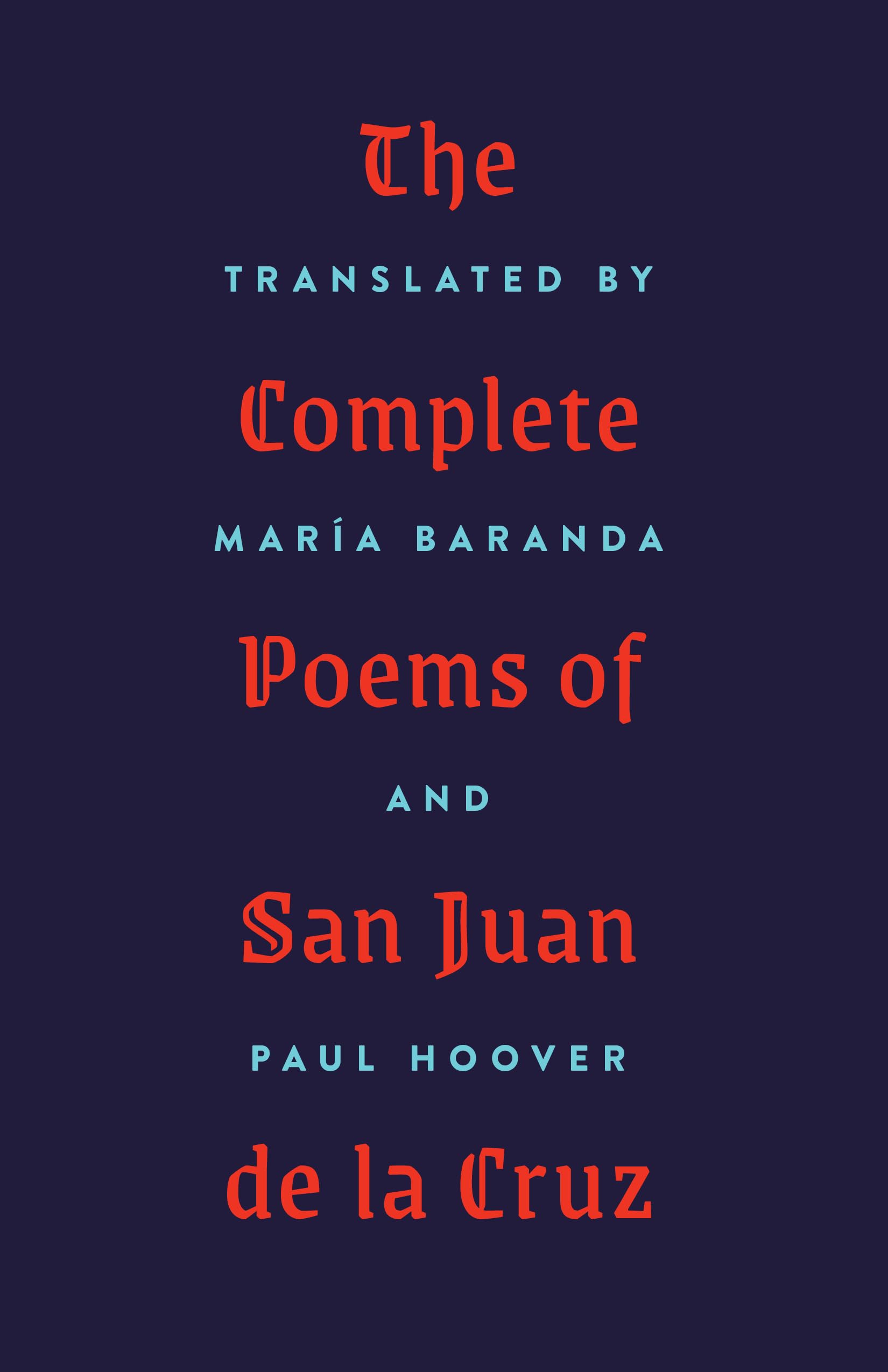



María Baranda and Paul Hoover present revitalized translations of some of the most beloved poems of the Golden Age of Spanish literature. In 1578, during months of imprisonment for his reformist beliefs, San Juan de la Cruz composed a series of narrative poems inspired by the Biblical Song of Songs—and, the story goes, a popular love song overheard from his cramped cell—that take God as the beloved. Erotically charged, initially scandalous, his mystical poetry engages with the journey of the soul through the darkest trenches of suffering and despair toward an enlightened spiritual connection with God. For hundreds of years, these poems have resonated deeply with those who search for meaning in the dark, and have influenced generations of poets, artists, and philosophers. This bilingual edition of the Complete Poems —including “Dark Night” and both the Sanlúcar and Jaén manuscripts of “Spiritual Canticle”—presents an intimate and exceptionally collaborative new translation from María Baranda and Paul Hoover. Baranda, one of the most distinguished Mexican poets of her generation, lends her deft hand with expansive, meditative poetry. Hoover—the accomplished American poet, editor, and translator—offers his dexterity with form and the possibilities of language. The product is uniquely faithful to image and idea, and loyal to the ecstatic lyricism of this canonical text. A volume that hums with the soul’s longing to find solace, The Complete Poems of San Juan de la Cruz is a collection to be treasured. Praise for The Complete Poems of San Juan de la Cruz “This is a gorgeously presented book with equally stunning verse.”— The Millions , “Must-Read Poetry of April 2021” “In poems that remind the reader of John Donne’s fierce, unbridled devotion, mingled with John Keats’s romanticism, people ‘suffer, grieve, and die’ at the various altars of love . . . The collection invites the acceptance of mystery ushered by the intoxicating work of devotion.” — Publishers Weekly “In St. John of the Cross’s poetry, the dark night is also a night of profound, even ecstatic beauty . . . This new edition thrills with the adventure of it all—the soul’s adventure, Juan’s adventure. You can feel Juan’s delight in his newfound freedom, even in the midst of tremendous uncertainty.” —Amy Frykholm, The Christian Century “I was so impressed by [ The Complete Poems of San Juan de la Cruz ] . . . [A] revelatory new translation.”— Sharon Mesmer, Commonweal Magazine “These sixteenth-century poems are gathered together and given a new, contemporary voice through poets María Baranda and Paul Hoover’s co-translation . . . This is the liberatory power of retranslating classic poets: the opportunity to read differently, on top of or alongside other readings—to provide new shades of meaning, and allow other elements of the poems to shine through.” —Gabriella Martin, Action Books blog María Baranda is a winner of major literary awards in Mexico, the Aguascalientes National Poetry Prize and the Efrain Huerta National Poetry Prize, as well as Spain’s Francisco de Quevedo Prize for Ibero-American Poetry. Her collections of poems include Narrar , Atlántica y el rústico , Avido mundo , Ficticia and El mar insuficiente: poemas 1989-2009 (translated into English by Joshua Edwards), and Yegua nocturna corriendo en un prado de luz absoluta (translated into English by Paul Hoover). Paul Hoover is the author of collections of poems including The Book of Unnamed Things , Desolation: Souvenir , Sonnet 56 , Edge and Fold , and Poems in Spanish , which was nominated for a Bay Area Book Award. He is editor of Postmodern American Poetry: A Norton Anthology and coeditor of the literary magazine New American Writing . He teaches creative writing at San Francisco State University. Noche Oscura Canciones del alma que se goza de haber llegado al alto estado de perfección, que es la unión con Dios, por el camino de la negación espiritual En una noche oscura, con ansias en amores inflamada, ¡oh dichosa ventura!, salí sin ser notada, estando ya mi casa sosegada. A escuras, y segura, por la secreta escala disfrazada, ¡oh, dichosa ventura!, a escuras, y en celada, estando ya mi casa sosegada. En la noche dichosa, en secreto, que nadie me veía, ni yo miraba cosa, sin otra luz y guía, sino la que en el corazón ardía. Aquesta me guiaba más cierto que la luz del mediodía, a donde me esperaba, quien yo bien me sabía, en parte donde nadie parecía. ¡Oh noche, que guiaste!, ¡oh noche amable más que el alborada!, ¡oh noche, que juntaste Amado con amada, amada en el Amado transformada! En mi pecho florido, que entero para él solo se guardaba, allí quedó dormido, y yo le regalaba, y el ventalle de cedros aire daba. El aire de la almena, cuando yo sus cabellos esparcía, con su mano serena en mi cuello hería, y todos mis sentidos suspendía. Quedéme, y olvidéme, el rostro recliné sobre el Amado; cesó to