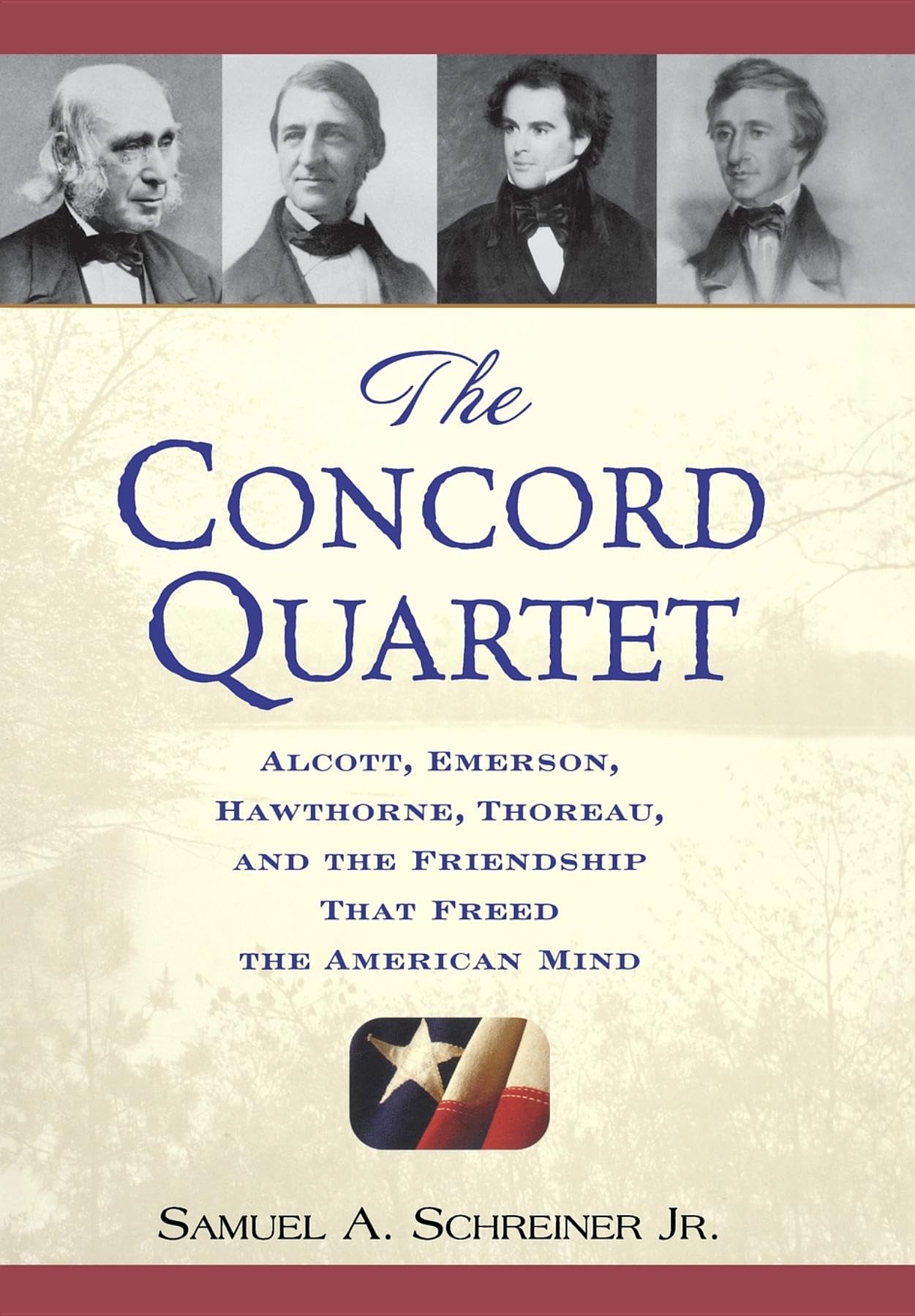
The Concord Quartet: Alcott, Emerson, Hawthorne, Thoreau and the Friendship That Freed the American Mind
$13.50
by Samuel A. Schreiner Jr



We will walk on our own feet; we will work with our own hands; we will speak our own minds. --Ralph Waldo Emerson, "The American Scholar," 1837 From the start of transcendentalism and America's intellectual renaissance in the 1830s, to the Civil War and beyond, the story of four extraordinary friends whose lives shaped a nation "Beginning in the 1830s, coincidences that seem almost miraculous in retrospect brought together in Concord as friends and neighbors four men of very different temperaments and talents who shared the same conviction that the soul had 'inherent power to grasp the truth' and that the truth would make men free of old constraints on thought and behavior. In addition to Emerson, a philosopher, there was Amos Bronson Alcott, an educator; Henry David Thoreau, a naturalist and rebel; and Nathaniel Hawthorne, a novelist. This book is the story of that unique and influential friendship in action, of the lives the friends led, and their work that resulted in an enduring change in their nation's direction." --From the Prologue With the publication of his Essay on Nature , in 1836, Emerson ushered in the beginnings of an intellectual revolution in the town famous for the first shots of the American Revolution. His friend Amos Bronson Alcott had shared the germination of those ideas with him. Henry David Thoreau, fresh from Harvard, was so taken with Nature that he became Emerson's most ardent follower, even sounding like the man before finding his own voice. Although Nathaniel Hawthorne was never quite a true transcendentalist, he certainly benefited from their friendship and support. Schreiner uses journals, eyewitness accounts, and the writings of the four men to bring them to life and to illustrate their effect on American thought. He deftly weaves their everyday lives--loves, losses, sicknesses, and disagreements--with historical events--the war with Mexico, the conflict over slavery, John Brown's rebellion, and the Civil War--giving their work a historical and a literary context. This book is eminently approachable and enlightening on various levels and will reshape the reader's image of these four men. Elizabeth Dickie Copyright © American Library Association. All rights reserved * Schreiner takes a close look at the intellectual life of Concord, Mass. from 1834 to 1888, a period during which four of Ameroca's leading intellectuals called it home. Three of them-Emerson, Thoreau and Hawthorne-were prolific and successful writers in their own time and still rank among the most important American writers. The fourth, Amos Bronson Alcott, is best known today as the father of Louisa May, but during his lifetime he was a respected social and educational reformer, political activist, and public speaker. Schreiner works hard to bring these personalities and their dynamic relations to life, using rich detail, both in terms of Concord life and the personal and professional lives of these men, as well as in the intersection between the Concord scene and events on the national stage (like Lincoln's presidency and the debate over slavery). Although Schreiner's work is rife with dramatic episodes and compelling stories, the overall tone is academic rather than popular, and includes many excerpts from the quartet's written work with accompanying analysis. Readers unfamiliar with Hawthorne or the Transcendentalists may have difficulty taking to the book initially, but sticking with it should make any reader eager to pick up Walden next. Readers interested in American literature or American history will gain much from Schreiner's work. ( Publishers Weekly , August 7, 2006) Ralph Waldo Emerson was not happy to be heading back to Concord, Massachusetts, in the fall of 1834. Although the autumn leaves were brilliant, he could think only of his situation. Having left a job, lost both his wife and brother, and no longer able to rent suitable quarters in Boston, he was returning to the family homestead to figure out what to do next. That day, no one would have guessed that he was starting a journey that would lead him to an American Renaissance in thought and philosophy as well as to a friendship that would span decades with three equally remarkable men and neighbors: Nathaniel Hawthorne, novelist; Henry David Thoreau, naturalist and author; and Amos Bronson Alcott, educator. As engaging as a novel, The Concord Quartet brings these nineteenth-century cultural icons to life. Deftly interweaving the everyday dramas of the four men's lives--their marriages, children, friends, accomplishments, disappointments, illnesses, and deaths--as well as a full account of their books and the development of the transcendentalist philosophies that united them, The Concord Quartet will fascinate readers with its modern resonance, as the men struggled with ideas that still perplex people today: Is the Bible divinely inspired and literally true? "The highest revelation is that God is in every man," Ralph Waldo Emerson