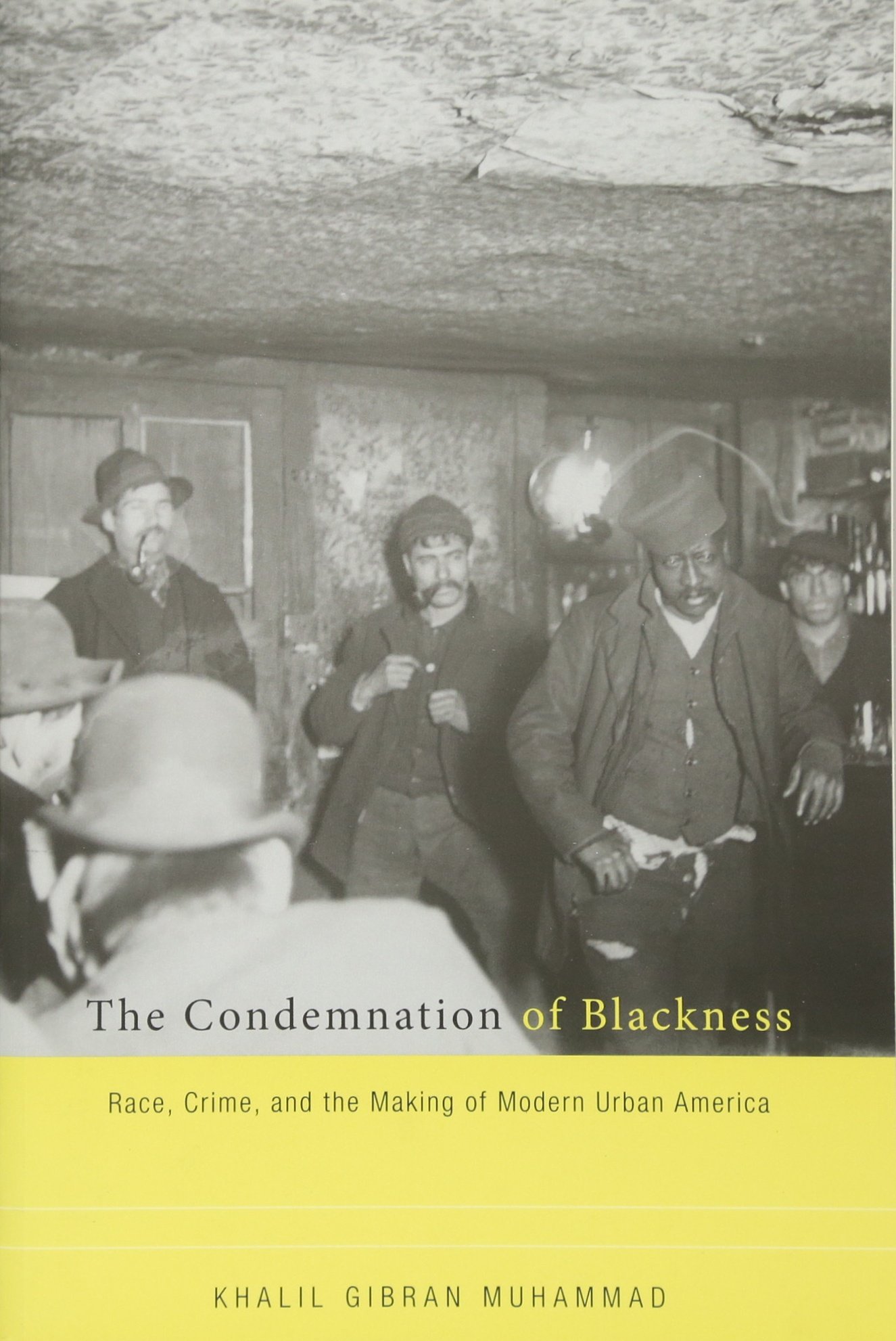
The Condemnation of Blackness: Race, Crime, and the Making of Modern Urban America
$35.99
by Khalil Gibran Muhammad



Winner of the John Hope Franklin Prize A Moyers & Company Best Book of the Year “[A] brilliant work that tells us how directly the past has formed us.” ―Darryl Pinckney, New York Review of Books Lynch mobs, chain gangs, and popular views of black southern criminals that defined the Jim Crow South are well known. We know less about the role of the urban North in shaping views of race and crime in American society. Following the 1890 census, the first to measure the generation of African Americans born after slavery, crime statistics, new migration and immigration trends, and symbolic references to America as the promised land of opportunity were woven into a cautionary tale about the exceptional threat black people posed to modern urban society. Excessive arrest rates and overrepresentation in northern prisons were seen by many whites―liberals and conservatives, northerners and southerners―as indisputable proof of blacks’ inferiority. In the heyday of “separate but equal,” what else but pathology could explain black failure in the “land of opportunity”? The idea of black criminality was crucial to the making of modern urban America, as were African Americans’ own ideas about race and crime. Chronicling the emergence of deeply embedded notions of black people as a dangerous race of criminals by explicit contrast to working-class whites and European immigrants, Khalil Gibran Muhammad reveals the influence such ideas have had on urban development and social policies. “A brilliant work that tells us how directly the past has formed us.” ― Darryl Pinckney , New York Review of Books “The role of social-science research in creating the myth of black criminality is the focus of this seminal work by historian Khalil Muhammad. The book shows how progressive reformers, academics, and policy-makers subscribed to a ‘statistical discourse’ about black crime almost immediately after Emancipation, one that shifted blame onto black people for their disproportionate incarceration and continues to sustain gross racial disparities in American law enforcement and criminal justice.” ― Elizabeth Hinton , The Nation “Muhammad identifies two different responses to crime among African-Americans in the post–Civil War years, both of which are still with us: in the South, there was vigilantism; in the North, there was an increased police presence. This was not the case when it came to white European-immigrant groups that were also being demonized for supposedly containing large criminal elements.” ― New Yorker “On the whole, Muhammad’s Condemnation of Blackness marks a tremendous contribution to scholarship on racism and reform in the Progressive era and will help point the way forward in ongoing conversations about crime, punishment, and representations of blackness in the United States. By weaving together the histories of scientific racism, migration, immigrant and African American uplift ideologies, racial violence, and sociopolitical change in the cauldron of the urban North, this text offers important insights into how ideas about race shaped urban life. As the nation continues to wrestle with disparities in its criminal justice system and the considerable consequences thereof, Muhammad’s work serves as a poignant reminder of how these inequalities were shaped and how deeply they reach back into the nation’s history.” ― Jeffrey D. Gonda , Journal of African American Literature “This important book bridges a scholarly gap between studies of racial disparities in arrest and incarceration in the contemporary United States and historical examinations of race and punishment in the Jim Crow South.” ― William P. Jones , Journal of American History “Meticulous in its research and brilliant in its exposition, Khalil Muhammad’s The Condemnation of Blackness addresses the contemporary crisis in criminal justice by examining its intellectual precedents in the decades after slavery.” ― Bryan Wagner , Law, Culture, and the Humanities “It is the rare piece of scholarship that invokes a feeling that our current moment is not so different from our racial past. Khalil Muhammad’s book does exactly that. By describing in incredible depth the ‘ideological currency of black criminality’ throughout the nation’s history, the author provides readers with a new vision through the lens of the past. The power of The Condemnation of Blackness is in giving contemporary debates―about Trayvon Martin, the black underclass, and the extraordinarily high rates of black contact with criminal justice―a fuller historical context.” ― Vesla M. Weaver , Perspectives on Politics “Muhammad’s book renders an incalculable service to civil rights scholarship by disrupting one of the nation’s most insidious, convenient, and resilient explanatory loops: whites commit crimes, but black males are criminals. With uncommon interpretive clarity and resourceful accumulation of data, the author disentangles crime as a fact of the urban experience from c