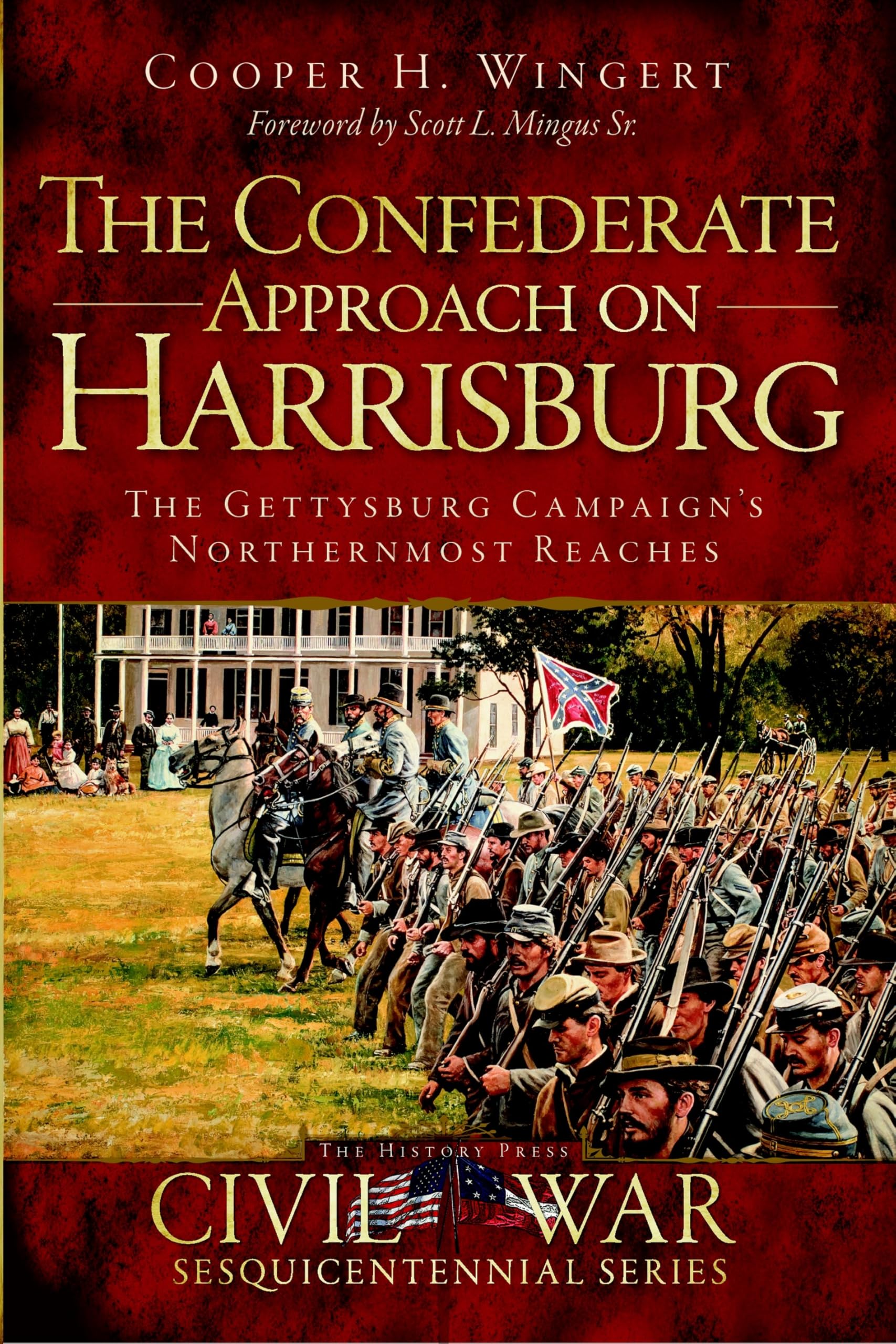
The Confederate Approach on Harrisburg: The Gettysburg Campaign's Northernmost Reaches (Civil War Series)
$22.04
by Cooper H. Wingert



In June 1863, Harrisburg braced for an invasion as the Confederate troops of Lieutenant General Richard S. Ewell steadily moved toward the Pennsylvania capital. Capturing Carlisle en route, Ewell sent forth a brigade of cavalry under Brigadier General Albert Gallatin Jenkins. After occupying Mechanicsburg for two days, Jenkins's troops skirmished with Union militia near Harrisburg. Jenkins then reported back to Ewell that Harrisburg was vulnerable. Ewell, however, received orders from army commander Lee to concentrate southward--toward Gettysburg--immediately. Left in front of Harrisburg, Jenkins had to fight his way out at the Battle of Sporting Hill. The following day, Jeb Stuart's Confederate cavalry made its way to Carlisle and began the infamous shelling of its Union defenders and civilian population. Running out of ammunition and finally making contact with Lee, Stuart also retired south toward Gettysburg. Author Cooper H. Wingert traces the Confederates to the gates of Harrisburg in these northernmost actions of the Gettysburg Campaign. Cooper H. Wingert is a Civil War historian based in Enola, Pennsylvania. Since 2011, he has given talks at the Hershey Civil War Round Table, the Camp Curtin Historical Society and Civil War Round Table, and the National Civil War Museum in Harrisburg. Gettysburg Magazine featured Wingert's article, "Master's of the Field: A New Interpretation of Wright's Brigade." Scott L. Mingus, Sr. is a Civil War historian, author, and tour guide based in York, Pennsylvania. The Confederate Approach on Harrisburg The Gettysburg Campaign's Northernmost Reaches By Cooper H. Wingert The History Press Copyright © 2012 Cooper H. Wingert All rights reserved. ISBN: 978-1-60949-858-0 Contents Foreword, by Scott L. Mingus Sr., Acknowledgements, 1. Harrisburg in Distress, 2. The Defenses of Harrisburg, 3. Southern Invaders, 4. Carlisle Falls, 5. Preparations at Oyster's Point, 6. Jenkins Captures Mechanicsburg, 7. The Skirmish of Oyster's Point Begins, 8. Spies, Scouts and Traitors, 9. Jenkins Reconnoiters Harrisburg, 10. The Battle of Sporting Hill, 11. The Shelling of Carlisle, 12. After Carlisle, Epilogue, Appendix A. Casualties during the Shelling of Carlisle, Appendix B. The Death of Private Charles Colliday at Carlisle, Abbreviations, Notes, Bibliography, About the Author, CHAPTER 1 Harrisburg in Distress It was pitch dark as many of the senior commanders of the Federal Army of the Potomac huddled in council past midnight on May 4, 1863. Their topic of discussion would have been inconceivable to anyone in the group — or for that matter any soldier in the large Northern army — a mere week ago. Then, in the last days of April, the Army of the Potomac boasted over 130,000 men, an imposing size compared to the meager Southern forces opposing them. Nearly all were extremely confident in their ability to deal with Robert E. Lee's Army of Northern Virginia. However, the sheer thickness of the so- called Wilderness — the dense, overgrown woods that enveloped the area west of Fredericksburg, Virginia, and south of the Rappahannock and Rapidan Rivers — seemed to clog the thought process of army commander Major General Joseph O. Hooker as much as it did the pace of his army's march. Hooker, who had frequently boasted of his upcoming offensive, soon stalled his progress around the Chancellor house when a bold counteroffensive by Lee and legendary corps commander Thomas Jonathan "Stonewall" Jackson stunned him. The battle took a turn for the worse for "Fighting Joe" when Lee dispatched Jackson as a flanking column. Stonewall's veterans reaped havoc on Hooker's bewildered army, whose right flank soon collapsed. Hooker's confidence and grand plans of a marvelous victory faded away before him. So brought Hooker and five of the army's seven corps commanders to this unwelcome meeting. The befuddled Hooker thought of retreat and only that. "It was seen by the most casual observer that he had made up his mind to retreat," later opined Second Corps commander Major General Darius N. Couch. "We were left by ourselves to consult," recollected Couch. A vote was taken, resulting three to two in favor of offensive operations. Hooker sauntered back to the tent and, after being informed of the vote, announced that "he should take upon himself the responsibility of retiring the army to the other side of the river." That was only another step in the beginning of the end for Fighting Joe's tenure at the helm of the Army of the Potomac. With that move, he did little to soothe his subordinates' anger. As Fighting Joe lost the tenacity garnered him by his sobriquet, Robert E. Lee basked in it. Harrisburg Laid out in 1785 and incorporated as a borough in 1791, Harrisburg became Pennsylvania's capital in 1812. The town's founder, John Harris Jr., boasted to one traveler in 1788 that "three years ago there was but one house built," and soon it had become a rapidly