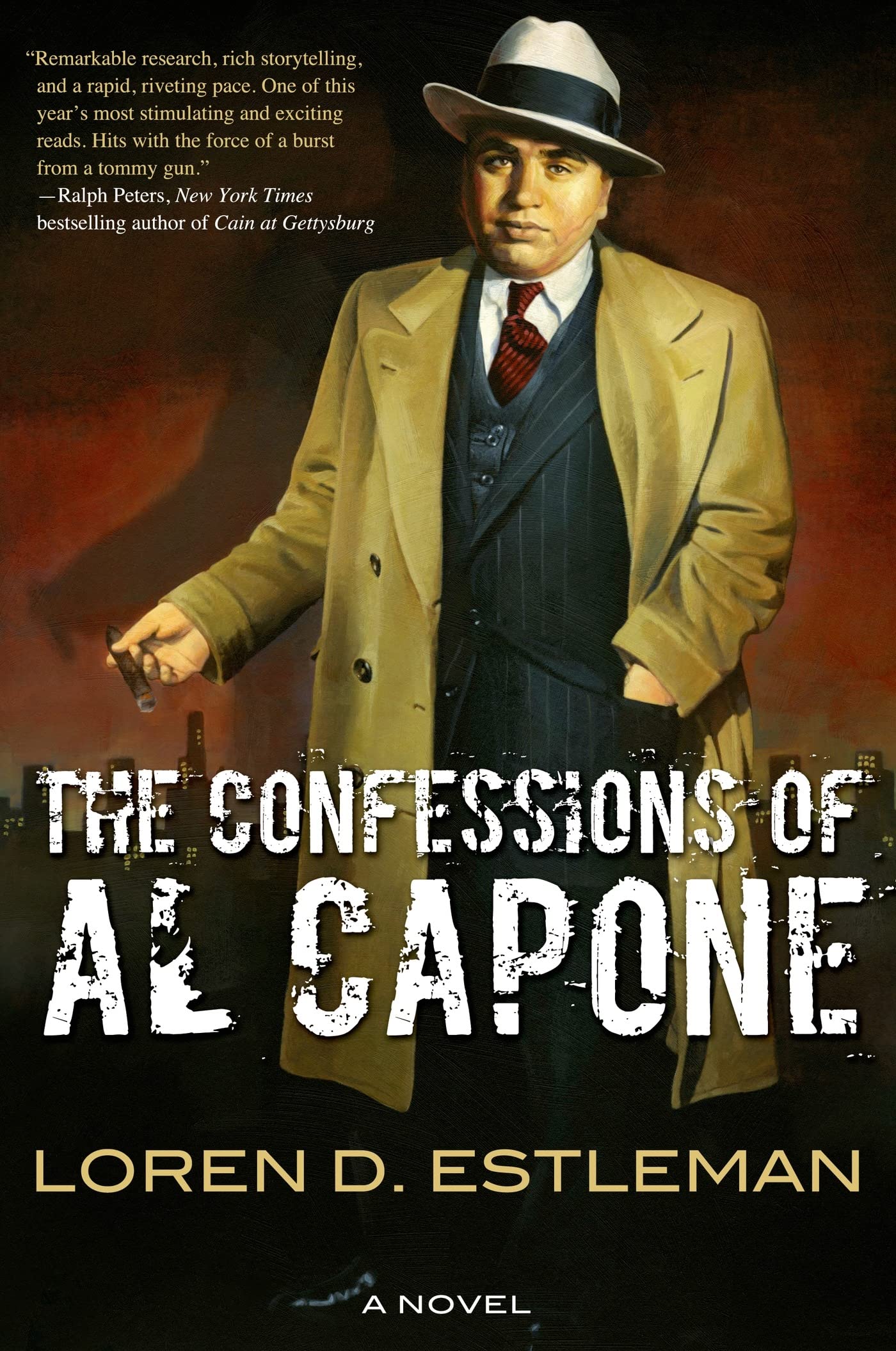



1944: Al Capone is living with his family in Florida and suffering from advanced syphilis. J. Edgar Hoover orders FBI agent Peter Vasco to pose as a priest and get close to the infamous American gangster, so he can obtain information that might help the Bureau nab members of Capone's Chicago Outfit. Vasco and Capone bond over card games, lunches, and even a trip to Wisconsin, and Capone spills secrets that expose in vivid detail this monster who was the most iconic figure in twentieth-century crime. What emerges is a fascinating, compelling portrait of Capone―a man who would stop at nothing to take what he wanted, but who also fed the poor of Chicago; who rose to the top of Chicago on a tide of bootleg beer and booze but took the time to ensure that innocent victims of mob violence got proper medical care. This is Al Capone as he's never been seen before, a ruthless crime lord who trafficked in death and corruption…as well as a man of refined tastes who loved his family. Loren D. Estleman's The Confessions of Al Capone is a rigorously researched historical thriller, with sharp and subtly nuanced portrayals of Capone, his family, members of the Chicago outfit, J. Edgar Hoover, and even Ernest Hemingway in a riveting story that truly exposes the real man behind Capone's iconic, scarred visage. “This is a book that took courage as well as talent to write. Loren Estleman has managed a literary miracle, a story full of surprising discoveries and often deep emotion.” ―Thomas Fleming, New York Times bestselling author “Remarkable research, rich storytelling and a rapid, riveting pace make The Confessions of Al Capone one of this year's most stimulating and exciting reads. Hits with the force of a burst from a tommy gun.” ―Ralph Peters, New York Times bestselling author of Cain at Gettysburg Loren D. Estleman is the author of more than eighty novels, including the Amos Walker, Page Murdock, and Peter Macklin series. The winner of four Shamus Awards, five Spur Awards, and three Western Heritage Awards, he lives in Central Michigan with his wife, author Deborah Morgan. Confessions of Al Capone By Loren D. Estleman Tom Doherty Associates Copyright © 2015 Loren D. Estleman All rights reserved. ISBN: 978-0-7653-3122-9 ONE An invitation to the director’s office always meant termination. Even a man without faith could depend on that. It was waiting for him on his desk, in a large brown interoffice envelope tied with red string, neatly typed in elite characters on the same undersize stationery the Director had used to congratulate the men who killed Dillinger: Peter Vasco Division Four Records and Communications Dear Mr. Vasco: The Director would appreciate your presence at the SOG at 1400 hours this date. (signed) Helen W. Gandy Gandy was the Director’s executive assistant: “Hoover’s secretary” to the unindoctrinated. She’d sat outside his door since his appointment to the General Investigation Division in 1919, and had processed every decision he’d made from the start, including converting to the military timetable after Pearl Harbor. SOG stood for Seat of Government. In early days this had referred to headquarters’ location in the District, but more recently it had become shorthand for the Director’s own office, and by extension the Director himself. To compare the Bureau to a beehive was a cliché, but clichés are nothing if not accurate. At the center was the queen—a career-destroying description if overheard, given the rumors that circulated among the Director’s enemies on the Hill. The field agents were the scouts swarming outside, while the drones inside worked around the clock to maintain the hive. Vasco was the drone of drones, assigned to proofread non-classified instructions to Special Agents in Charge and the odd innocuous press release for errors of spelling and grammar. The aptitude test he’d taken when he applied for employment had shown a high degree of stenographic ability; with no background in law or accountancy he’d hardly hoped for a field position, but it was dreary, tedious work, with the added inducement of a reprimand in his file if a single participle continued to dangle once it left his desk. The smallest blunder festered throughout the system and had to be cauterized at the source. Evidently a proper noun had escaped capitalization or, worse, a live document had been swept into the wastebasket with the day’s litter and sent directly to the incinerator where obsolete secrets were interred in the ashes. Vasco wasn’t incompetent on the job, merely indifferent to it. That hadn’t always been the case, but after nearly a year shackled to the same tin desk in a room filled with them, his hopes for advancement had died—pounded flat by the incessant artillery barrage of booming drawers and typewriters thundering on metal stands. He suspected that on some subconscious level he’d realized that consistency and reliability counted against change rather than for it, and had sabo