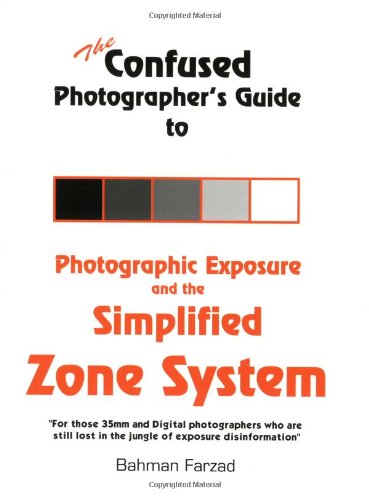
The Confused Photographer's Guide to Photographic Exposure and the Simplified Zone System
$96.01
by Bahman Farzad



Contrary to popular belief, when you buy an expensive camera the exposure skills DO NOT COME with it! When you buy an expensive GUITAR, you KNOW that playing skills DO NOT COME with it! When you buy an expensive CAR, you KNOW that driving skills DO NOT COME with it! When you buy an expensive CAMERA, why, then, do you NOT KNOW that exposure skills DO NOT COME with it? This book teaches the beginning Digital/35mm photographer (9th grade level) the simple and practical methods of correctly exposing a subject. This is also the world's first Digital Zone System book that addresses the application of the Zone System of exposure using current manual digital cameras including many of today's D-Slrs. The book covers in detail the applications of a camera's meter, an off-camera spot meter, an off-camera incident meter, and easy-to-remember techniques for exposing sunlit to moonlit subjects without a meter. The book uses Farzad's simplified 5-stop technique using 100 ISO color slide or Digital Film as its base, but the same techniques can be applied to Black and White, as well as color negative film with different ISOs. Since all the thinking is done before the photographer takes the picture, the book is ideal for this millennium's 35mm photographers that use one-hour processing labs. Since all the exposure decisions are made ahead of time (before the picture is taken), the technique saves the digital photographer many hours that he or she would waste behind the computer trying to figure out what he/she wanted to capture in the first place. The highest level of math required from the reader to understand this book, is to be able to multiply and divide a number by two. Also in the fourth edition (with the Lotus flower on the cover), a special calibration section is added to the end of the book for all those photographers who have spent a few thousand dollars on their D-Slr and are consistently getting underexposed and unacceptable images. The fourth edition also includes Digital footnotes and assignments for photographers using manual digital cameras. The book also includes Digital as well as 35mm exposure cheat sheets for Canon EOS 5D, Canon EOS 10D, Canon EOS 20D, Canon EOS 30D, Canon EOS A2/A2e, Canon EOS Rebel TI, Canon EOS Rebel XT, Canon EOS Rebel Xti, Canon PowerShot G5, FujiFilm FinePix S7000, Minolta Maxxum 5, Minolta Maxxum 7, Minolta Maxxum 9, Minolta Maxxum STSi, Nikon Coolpix 990, Nikon Coolpix 5700, Nikon Coolpix 8700, Nikon D50, Nikon D70, Nikon D80, Nikon D200, Nikon F4, Nikon F5, Nikon F100, Nikon N70, Nikon N90, Nikon N6006, Nikon N8008s, Pentax *ist-D, Pentax 645N, Pentax MZS, Pentax PZ1P, and Sony DSC-F717. "..to help teach light measurement without the students needing a math or science degree" -- Petersen's Photographic Magazine "..written for the photographer who is interested in the understanding of light" -- Today's Photographer Magazine "One of the easiest-to-understand books on exposure and the Zone System that we've ever seen" -- Outdoor Photographer Magazine The reality of life is that there is not a single metering system in the world that can give you a correctly exposed image for a given subject every time. If you do not believe this, set your expensive Digital Camera to its most advanced exposure mode and take pictures of a black surface and a white surface. When you look at the resulting Digital Image, negative, or slide you will be disappointed. Cameras of today, very much like the cameras of fifty years ago, are incapable of recognizing and recording extreme tones such as a black and a white surface. What you are going to get from this crude experiment is a medium gray image tone. To add insult to injury, you will have absolutely no clue which one of these resulting images is for the original black or white subjects. As this experiment demonstrates, there is not a single metering system that, without your help and intervention, can capture what your eye sees and what your mind wants to capture. Of all metering systems available to the photographer, the Zone System of exposure with the help of your on-camera or off-camera spot meter is the only one can give a consistent and predictable reading to the photographer EVERY TIME! Once equipped with this knowledge, the photographer can use his or her skill to determine the correct exposure for a desired subject. The major difference between a skilled photographer and an unskilled one is that the latter never questions the camera's readings. The skilled photographer has the knowledge to interpret the spot meter's reading according to the subject tone, and to capture desired image or capture it as the eye sees or desires it. The Confused Photographer's Guide to Photographic Exposure and the Simplified Zone System is the first book ever published that deals with the new millennium's Digital Cameras (5-stop Zone System). Unlike other reflective metering systems (including average, center-weighted, and matrix, and others), in which the