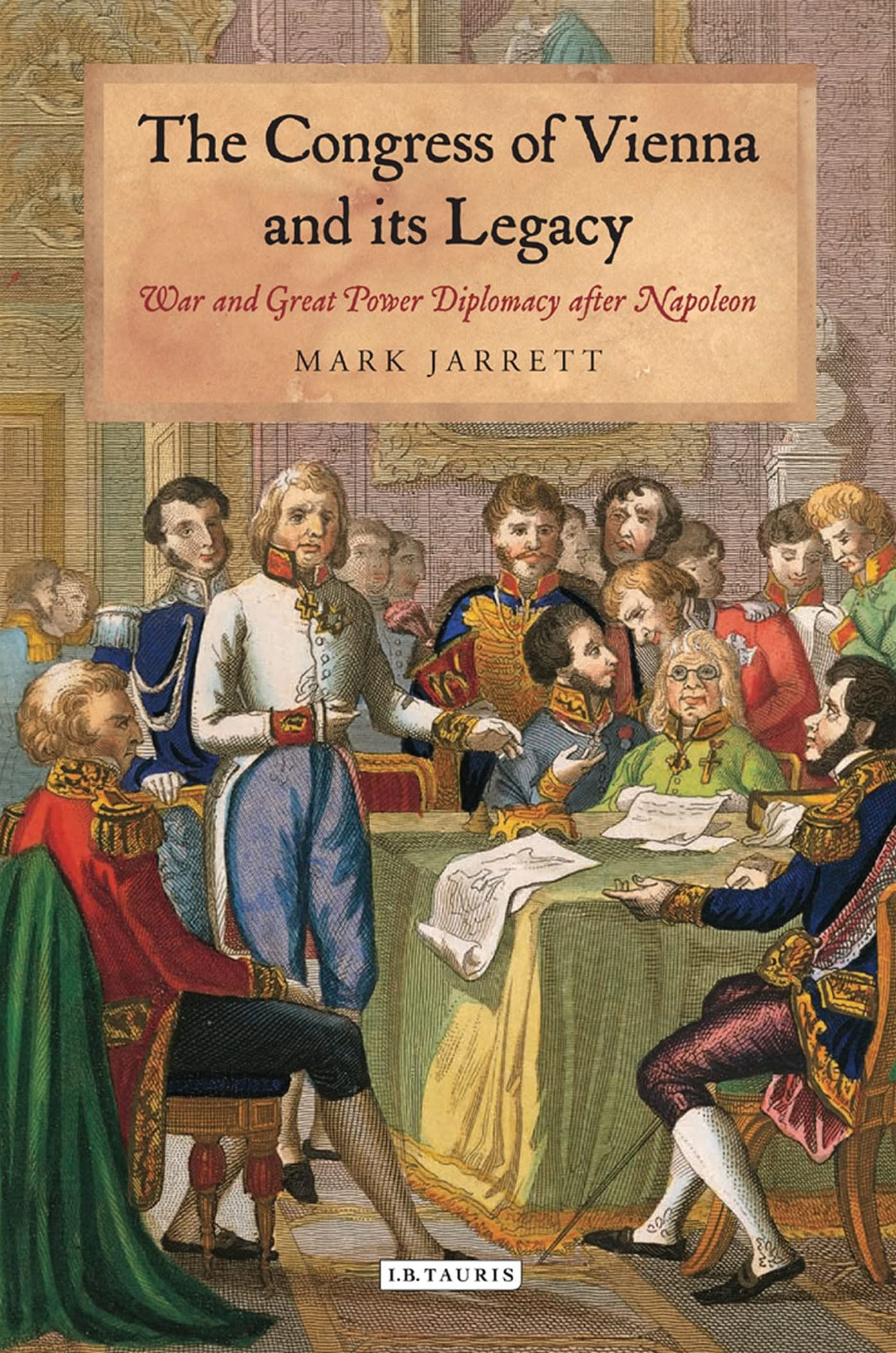
The Congress of Vienna and its Legacy: War and Great Power Diplomacy after Napoleon
$35.99
by Mark Jarrett



**CHOICE Outstanding Academic Title** In September 1814, the rulers of Europe and their ministers descended upon Vienna after two decades of revolution and war. Their task was to redraw continental borders following the collapse of the Napoleonic Empire. Inevitably, all of the major decisions were made by the leading statesmen of the five 'great powers'-Castlereagh, Metternich, Talleyrand, Hardenberg and Tsar Alexander of Russia. The territorial reconstruction of Europe marks only one part of this story. Over the next seven years, Europe witnessed unrest in Germany, Britain, and France, and revolution in Latin America, Spain, Portugal, Naples, Piedmont, Greece, and Romania. Against this backdrop, the Congress of Vienna was followed by an audacious experiment in international cooperation and counter-revolution, known as the 'Congress System'. This system marked the first genuine attempt to forge an 'international order' based upon consensus rather than conflict. The goal of the Congress statesmen was to secure long-term peace and stability by controlling the pace of political change through international supervision and intervention. The fear of revolution that first gave rise to the Congress System quickly became its exclusive concern, sowing division amongst its members and ironically ensuring its collapse. Despite this failure, the Congress System had a profound influence. The reliance on diplomacy as the primary means of conflict resolution; the devotion to multilateralism; the emphasis on international organization as a vehicle for preserving peace; the use of concerted action to promote international legitimacy - all these notions were by-products of the Congress System. In this book, Mark Jarrett argues that the decade of the Congresses marked the true beginning of our modern era. Based on original research and previously unseen sources, this book provides a fresh exploration of this pivotal moment in world history. “A meticulously researched, elegantly written and penetratingly insightful portrait of one of the key moments in the past millennium of European history.” ― Andrew Roberts, author of 'Napoleon: A Life' and 'Napoleon and Wellington' “The system established by the Congress of Vienna is of great interest to both historians and political scientists, and Mark Jarrett's is one of the rare treatments that will appeal to both groups. His narrative gives clear guidance through the complexities of the era and his analysis engages the central arguments about the period. It is a model treatment. It really is THE book on the period and will attract and enlighten readers for a generation to come.” ― Robert Jervis, Professor of International and Public Affairs and Adlai E. Stevenson Professor of Political Science, Columbia University, USA, and former President of the American Political Science Association “Jarrett's massive and impressively researched volume promises to become our generation's authoritative study of the peace settlements of 1814-1815. Jarrett begins with the wars of the French Revolution, shows how they morphed into Napoleon Bonaparte's wars for empire from 1801 and 1805, then recounts how the adversaries of France fitfully coalesced, sometimes attempted their own alliances with Bonaparte, and finally came together to defeat his over-extended armies. He follows with great clarity the negotiation of the settlements and the decade of post-Vienna diplomacy and interventions from 1815 to 1825 . . . Jarrett follows these two crowded decades with admirable narrative clarity and thoroughness -– concluding with the last hurrah of successful great-power agreement by the 1830s to establish a Greek monarchy and to recognize a separate Belgian kingdom. Given the frequent reshuffling of territories and regime forms and the proliferation of treaties made, broken, and remade, the book is a great achievement.” ― Charles Maier, Leverett Saltsonstall Professor of History, Harvard University, USA “Mark Jarrett illuminates a vital two decades in European history that have long been neglected. His is indeed a wonderful book-clearly written, extremely well-researched, open to a whole variety of explanations from historians and political scientists, well balanced, fair in its judgements of historical characters and contemporary academic opinion, and seminal in its allusions to present-day events. I have little doubt that this book will become the standard work on the Congress System.” ― Alan Sked, Professor of International History, London School of Economics and Political Science “Mark Jarrett's beautifully written book deploys a great deal of information without ever getting lost in detail. It weaves together personality and policy, providing a clear analysis of political structures as well as a vivid portrait of personalities.” ― James J. Sheehan, Professor of Modern European History Emeritus, Stanford University, and former President of the American Historical Association “Jarrett's ground-bre