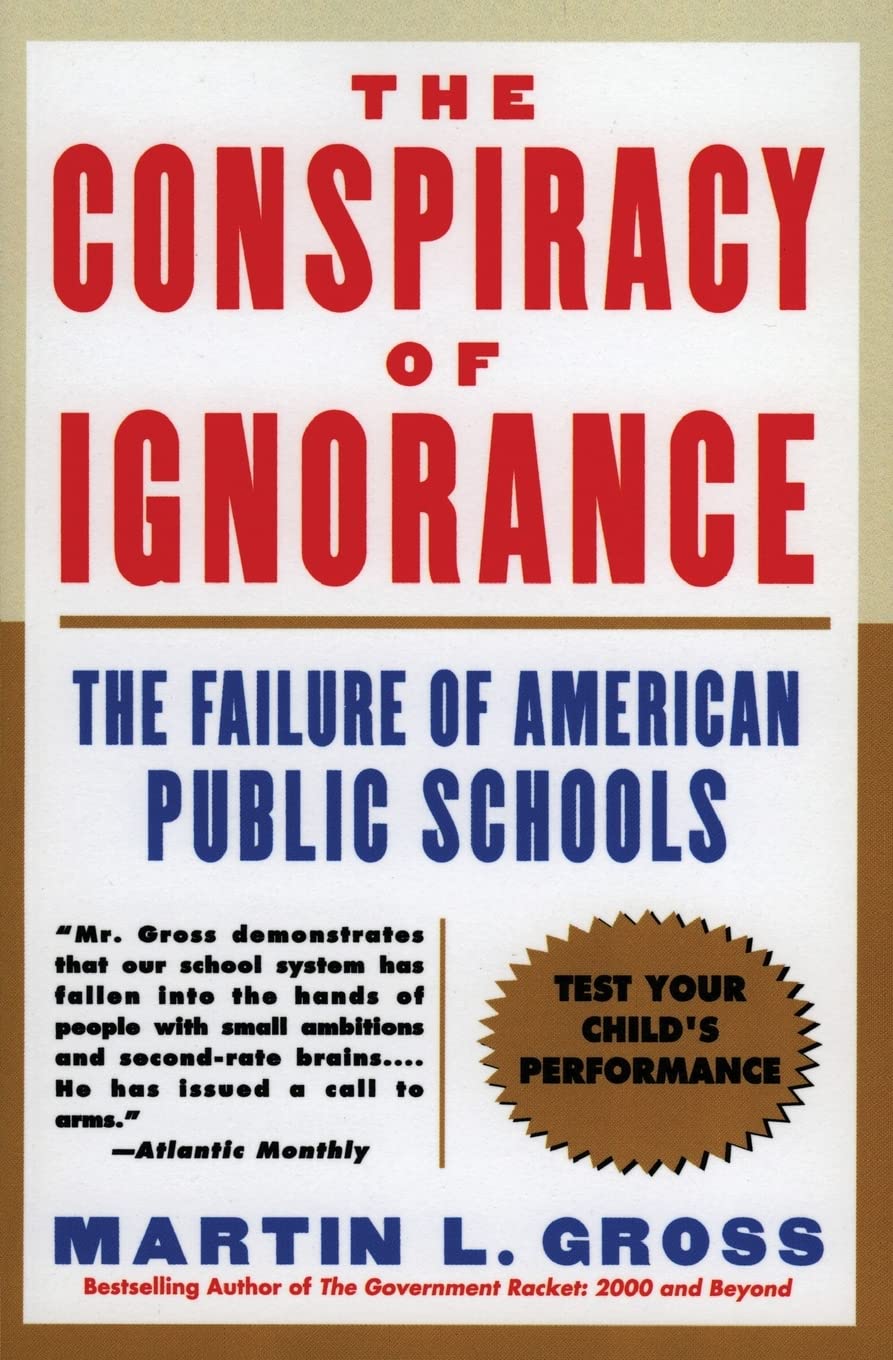
The Conspiracy of Ignorance: The Failure of American Public Schools
$12.79
by Martin L. Gross



Never before have public school students been so poorly educated. On national exams, almost 40 percent of fourth graders are reading at "below basic" levels, and in international contests in math and science, our seventeen-year-olds score near the bottom. In a shocking expose of the Educational Establishment, Martin L. Gross describes how the typical teacher is academically inferior and trained in dubious "educational psychology" and faddish "whole language" methods. Indeed, most teachers and administrators come from the bottom third of their class and are outscored on the SAT tests by their own college-bound students. The curriculum is so weak that only one in five students ever take trigonometry, physics, or geography in high school. The usual remedies-from smaller class sizes to federal aid-fail because the Etablishment is intent on maintaining both control and lower academic standards. Lucid, persuasive, and meticulously researched, The Conspiracy of Ignorance asks- and answers--the questions educators are afraid to ask. This book is desperately needed if American schoolchildren are to prosper in today's competitive world. "Longtime institutional critic Martin Gross is always fluent, persuasive and uncranky. Now, in one of his best books, he takes aim at the public schools.""-- Booklist" Never before have public school students been so poorly educated. On national exams, almost 40 percent of fourth graders are reading at "below basic" levels, and in international contests in math and science, our seventeen-year-olds score near the bottom. In a shocking expose of the Educational Establishment, Martin L. Gross describes how the typical teacher is academically inferior and trained in dubious "educational psychology" and faddish "whole language" methods. Indeed, most teachers and administrators come from the bottom third of their class and are outscored on the SAT tests by their own college-bound students. The curriculum is so weak that only one in five students ever take trigonometry, physics, or geography in high school. The usual remedies-from smaller class sizes to federal aid-fail because the Etablishment is intent on maintaining both control and lower academic standards. Lucid, persuasive, and meticulously researched, The Conspiracy of Ignorance asks- and answers--the questions educators are afraid to ask. This book is desperately needed if American schoolchildren are to prosper in today's competitive world. Martin L. Gross, has written more than a dozen books, including the New York Times bestsellers The Government Racket: Washington Waste from A to Z , which began the serious debate over capricious and wasteful government, and A Call for Revolution , as well as The End of Sanity, The Medical Racket and The Conspiracy of Ignorance . His 1995 bestseller, The Tax Racket , exposed the excesses of the IRS and asked for its elimination. He has testified before the U. S. Congress five times. Three of his prior nonfiction works, The Brain Watchers, The Doctors , and The Psychological Society , stimulated public debate in the fields of psychological testing, medicine, and psychiatry, resulting in Congressional hearings and reforms. Mr. Gross has been a member of the faculty of The New School for Social Research and an Adjunct Associate Professor of Social Science at New York University. He lives and works in suburban Connecticut. The Conspiracy of Ignorance The Failure of American Public Schools By Gross, Martin L. Perennial Copyright © 2004 Martin Gross All right reserved. ISBN: 0060932600 An Indictment of The Education Establishment The Decline of Teaching and Learning A large group of eager American 8th graders from two hundred schools coast-to-coast were excited about pitting their math skills against youngsters from several other nations. The math bee included 24,000 thirteen-year-olds from America, South Korea, the United Kingdom, Spain, Ireland, and four Canadian provinces, all chosen at random and given the same 63-question exam in their native language. It was a formidable contest, and the American kids felt primed and ready to show off their mathematical stuff. In addition to the math queries, all the students were asked to fill out a yes-no response to the simple statement "I am good at math." With typical American confidence, even bravado, our kids responded as their teachers would have hoped. Buoyed up by the constant ego building in school, two-thirds of the American kids answered yes. The emphasis on "self-esteem"--which permeates American schoolhouses-was apparently ready to pay off. Meanwhile, one of their adversaries, the South Korean youngsters, were more guarded about their skills, perhaps to the point where their self-esteem was jeopardized. Only one-fourth of these young math students answered yes to the same query on competence. Then the test began in earnest. Many of the questions were quite simple, even for 8th graders. One