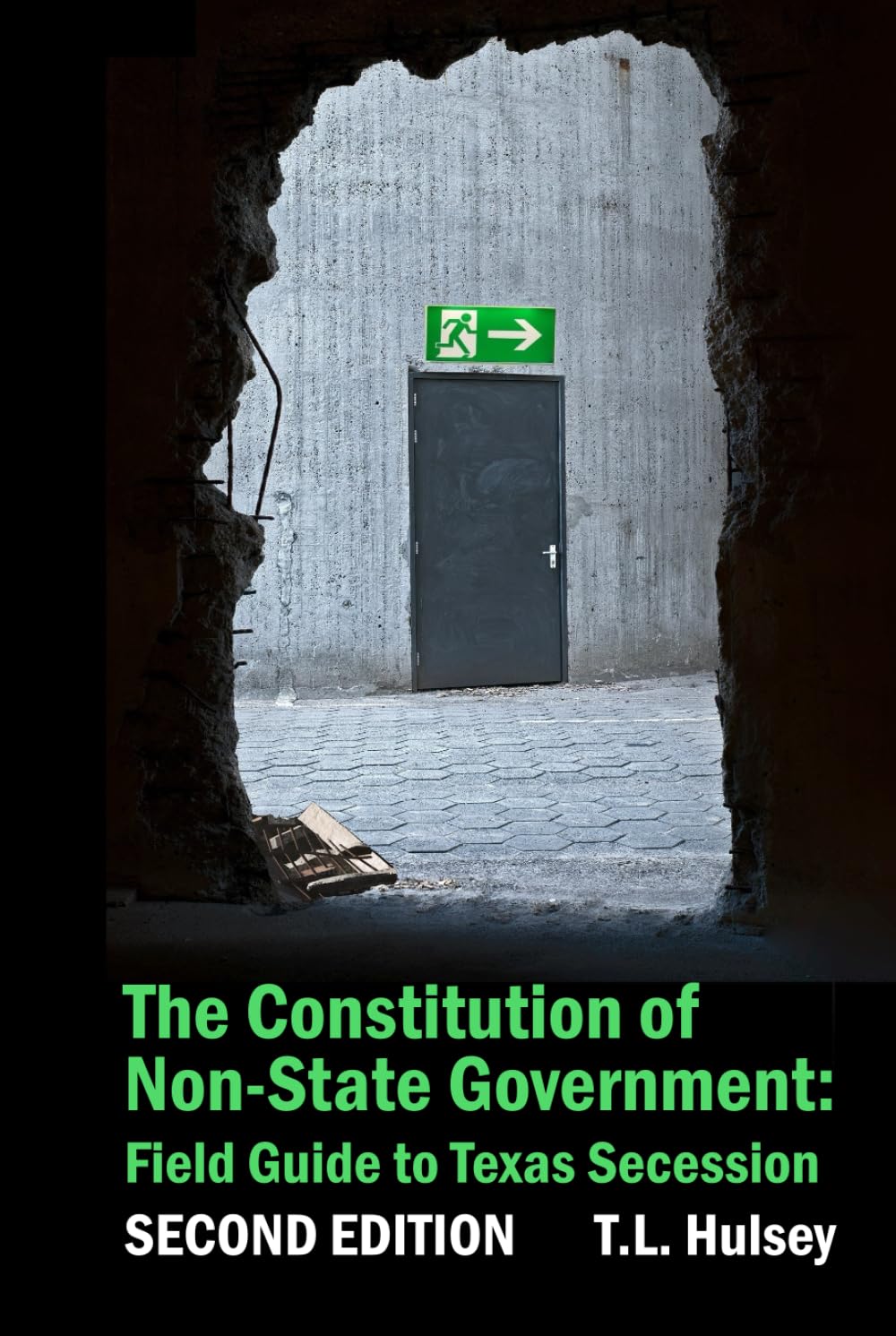
The Constitution of Non-State Government: Field Guide to Texas Secession
$27.67
by T.L. Hulsey



“Your book is brilliant and has the potential to move history.” – Dr. Clyde N. Wilson , editor of The Papers of John C. Calhoun Judge Andrew P. Napolitano : “Can any state secede from the Union peacefully? Thomas Jefferson and James Madison both believed that all can do so. The states entered voluntarily, so they can leave voluntarily. Moreover, no government is morally licit when it lacks the consent of the governed. Can Texas leave tomorrow? If Texans want out, YES. T.L. Hulsey explains why and how in this fascinating and superbly researched book. Every lawyer and judge should read it, and every Texan should value it.” Dr. Walter E. Block , Loyola University : “This is a tremendous achievement.” Dr. Donald Livingston , Abbeville Institute : “it is a splendid study written in a clear and spirited style”; “I especially liked the effort you made to show concretely how Texas (or some other state) could gradually transition into your non-state republic.” Dr. David R. Upham , University of Dallas : “an impressive achievement”; “a banquet of reflections and insights” ❦ Throughout the West, the basic institutions of public life are approaching collapse: Public debt has grown to unrepayable sums – currently at over $35 trillion in the United States alone; violent crime reigns in the once-great cities; social divisions are increasingly intractable; and the supposedly sovereign citizen feels powerless before an ever-growing centralized Leviathan. Is there no other form of government to replace the impending ruin of the state? This book contends that there is. The state is in fact a recent form of government, which has existed less than 400 years. Its key characteristics – centralization, ceaseless expansion of its powers to tax and coerce, its removal of all intermediating institutions between those powers and its citizens, its pretense of legitimacy in majoritarian absolutism – have finally reached their historical dead end. Far longer-lived and far more successful non-state governments have existed throughout history. The 500-year-old Hanseatic League, the over 700-year-old Swiss Confederation, and the 1100-year-old Venetian republic provide inspiring alternatives. From those examples this book has abstracted a non-state constitution, kleristocracy , established on the new praxeological category of architectonics . The brilliant insight of architectonics is astonishing in its simplicity. It is this: Just as the subjective theory of value establishes economics, so it establishes reason as the directing agency of political affairs in a communitarian polity. The book rigorously demonstrates the superiority of the kleristocratic constitution over all of the state’s advocates in political science, from Hobbes to Rawls. And it provides a highly detailed implementation of its principles in the American State where it is most likely to succeed: The State of Texas. The Constitution of Non-State Government is a book written with logical power and icon-busting verve, as befits a thoroughgoing tract that breathtakingly upends every received notion about what constitutes good government.