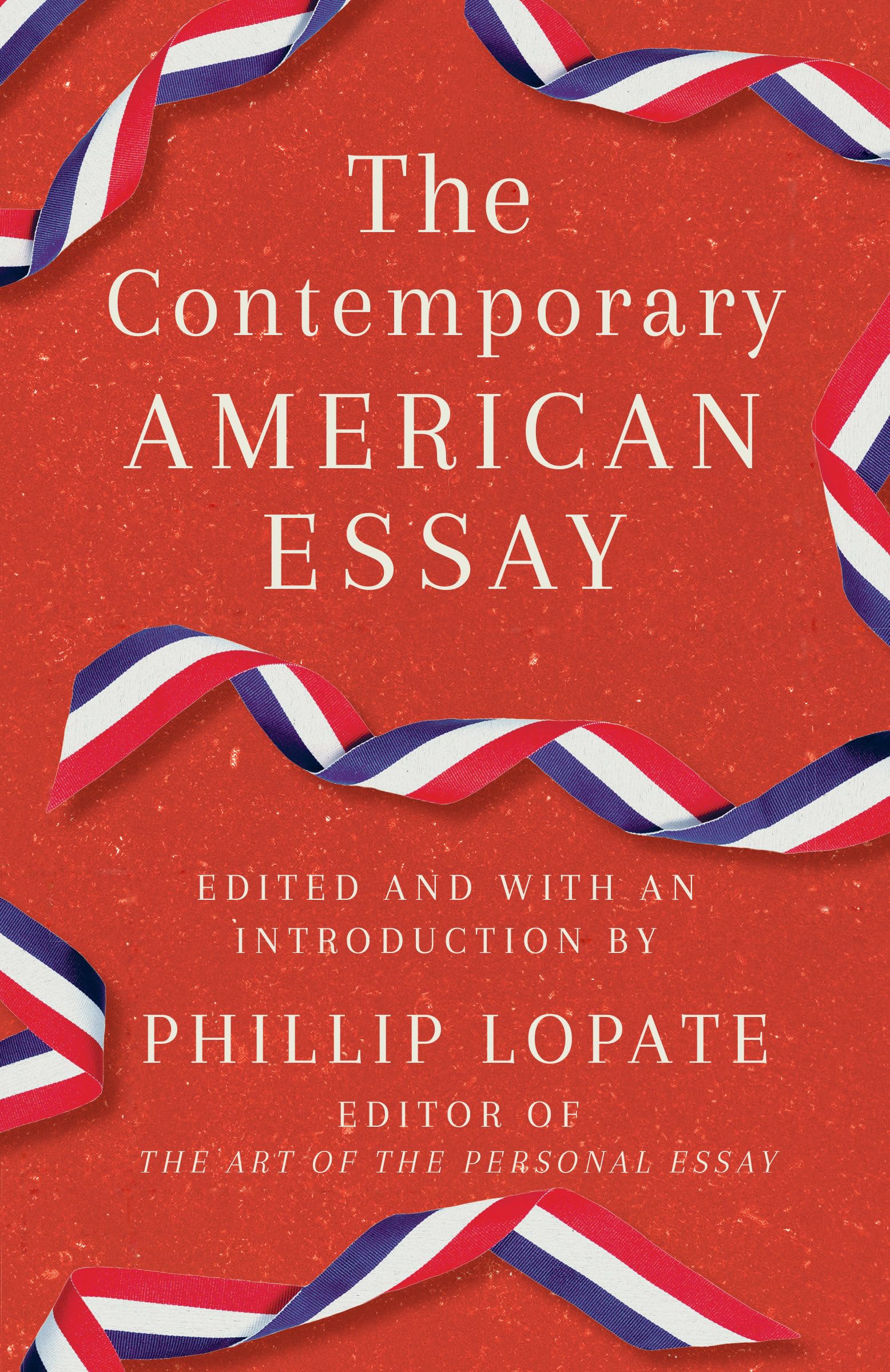



A dazzling anthology of essays by some of the best writers of the past quarter century—from Barry Lopez and Margo Jefferson to David Sedaris and Samantha Irby—selected by acclaimed essayist Phillip Lopate. The first decades of the twenty-first century have witnessed a blossoming of creative nonfiction. In this extraordinary collection, Phillip Lopate gathers essays by forty-seven of America’s best contemporary writers, mingling long-established eminences with newer voices and making room for a wide variety of perspectives and styles. The Contemporary American Essay is a monument to a remarkably adaptable form and a treat for anyone who loves fantastic writing. Hilton Als • Nicholson Baker • Thomas Beller • Sven Birkerts • Eula Biss • Mary Cappello • Anne Carson • Terry Castle • Alexander Chee • Teju Cole • Bernard Cooper • Sloane Crosley • Charles D’Ambrosio • Meghan Daum • Brian Doyle • Geoff Dyer • Lina Ferreira • Lynn Freed • Rivka Galchen • Ross Gay • Louise Glück • Emily Fox Gordon • Patricia Hampl • Aleksandar Hemon • Samantha Irby • Leslie Jamison • Margo Jefferson • Laura Kipnis • David Lazar • Yiyun Li • Phillip Lopate • Barry Lopez • Thomas Lynch • John McPhee • Ander Monson • Eileen Myles • Maggie Nelson • Meghan O’Gieblyn • Joyce Carol Oates • Darryl Pinckney • Lia Purpura • Karen Russell • David Sedaris • Shifra Sharlin • David Shields • Floyd Skloot • Rebecca Solnit • Clifford Thompson • Wesley Yang An Anchor Original. “What’s marvelous is the way Lopate’s anthologies . . . manage to be not only comprehensive monuments of deep expertise, but such continuously fresh and thrilling reading companions.” — Jonathan Lethem, author of The Feral Detective “Phillip Lopate is one of the most brilliant and original essayists now working.” — Louise Glück, winner of the Nobel Prize in Literature PHILLIP LOPATE is the author of To Show and to Tell: The Craft of Literary Nonfiction and four essay collections, Bachelorhood, Against Joie de Vivre, Portrait of My Body, and Portrait Inside My Head . He is the editor of the anthologies The Glorious American Essay, The Golden Age of the American Essay, The Art of the Personal Essay, Writing New York, and American Movie Critics . He was awarded a John Simon Guggenheim Fellowship, a New York Public Library Center for Scholars and Writers Fellowship, two National Endowment for the Arts grants, and two New York Foundation for the Arts grants. He is a professor of writing at Columbia University's nonfiction MFA program and lives in Brooklyn, New York. from the Introduction by Phillip Lopate The first quarter of the twenty-first century has been an uneasy time of rupture and anxiety, filled with historic challenges and opportunities. In that close to twenty-five-year span, the United States witnessed the ominous opening shot of September 11th, followed by the seemingly unending Afghanistan and Iraq wars, the effort to control HIV/AIDS, the 2008 recession, the election of the first African American president, the legalization of same-sex marriage, the contentious reign of Donald Trump, the stepped-up restriction of immigrants, the #MeToo movement, Black Lives Matter, and the pandemic, just to name a few major events. Intriguingly, the essay has blossomed during this time, in what many would deem an exceptionally good period for literary nonfiction—if not a golden one, then at least a silver: I think we can agree that there has been a remarkable outpouring of new and older voices responding to this perplexing moment in a form uniquely amenable to the processing of uncertainty. When the century began, essays were considered box office poison; editors would sometimes disguise collections of the stuff by packaging them as theme-driven memoirs. All that has changed: a generation of younger readers has embraced the essay form and made their favorite authors into bestsellers. We could speculate on the reasons for this growing popularity—the hunger for humane, authentic voices trying to get at least a partial grip on the truth in the face of so much political mendacity and information overload; the convenient, bite-sized nature of essays that require no excessive time commitment; the rise of identity politics and its promotion of eloquent spokespersons. Rather than trying to figure out why it’s happening, what’s important is to chart the high points of this resurgence, and to account for the range of styles, subgenres, experimental approaches, and moral positions that characterize the contemporary American essay. Of course, roping off a period like the year 2000 to the present and calling it “contemporary” is somewhat arbitrary, but one has to start somewhere. At least this artificial chronological box allows for the inclusion of older authors who made their mark in the twentieth century and had the temerity to keep producing significant work in the twenty-first (such as John McPhee, Joyce Carol Oates, Barry Lopez, Thomas Lynch). Just as set desi